Venezuela – the Amazon and the Tepuis
The southern-most state in Venezuela, Amazonas, contains vast tracts of pristine lowland rainforest. This remained inaccessible to birdwatchers until the development of camps for sport fishermen. One of these, Junglaven, is now open to birdwatching groups, giving unprecedented access to Venezuela's Amazonian lowlands. The camp is situated on the banks of a tributary of the Rio Ventuari, in an area populated only by a few tribes of Amazonian Indians. Accommodation is in two-bedded cabins, each with its own private toilet and cold-water shower, so conditions, while not luxurious, are reasonably comfortable. We'll spend five nights here, walking trails through the rainforest and exploring the extensive river systems by boat. This is one of the best sites we know for trumpeters and other highlights should include Agami Heron, Amazonian Umbrellabird, and many species of antbird.
The 'lost-world' plateaus of the Tepuis, rising above Guianan rainforests and rolling grasslands, form the magnificent landscape of the Gran Sabana. Many of the species here are endemic to this region and most of the birds will be different from those seen on the other sections of our tour. We should mention that in this remote part of Venezuela tourist hotels do not exist. Our accommodations in the Tepuis area will be clean and comfortable but in some places fairly basic.
The Tepuis week can be added to our standard two-week Venezuela tour to make a three-week trip. The Amazon week can be added as a fourth week.
Wednesday 26 February to Saturday 15 March 2003
Wednesday 25 February to Saturday 13 March 2004
with Judy Davis and David Fisher as leaders.
 Venezuela (Amazon/Tepuis) bird list
return
to the South American and introduction
return to Calendar
Day 1: The tour starts in London with a morning flight to Caracas.
On arrival we'll transfer to nearby Macuto for the night.
Day 2: We'll catch an early morning flight to Puerto Ayacucho and take a spectacular charter flight across vast tracts of untouched Amazonian rainforest. Surprisingly, the land we'll pass over is anything but flat, and includes spectacular mountain ridges, deep valleys and tepui-like scenery. After lunch, we'll spend our first afternoon exploring the area around the camp and make a boat trip along the adjacent river. Likely highlights include Black Caracara, Black and Crestless Curassows, Sunbittern, Band-tailed Nighthawk, up to five species of kingfisher, Violaceous Jay, Amazonian Oropendola, and the remarkable Amazonian Umbrellabird. Night at Junglaven.
Days 3-6: We'll spend much of our time walking the road from the camp to the airstrip which runs through pristine rainforest containing a rich avifauna that has yet to be properly surveyed. However, the bird list for the road already includes several hundred species and doubtless many more will be added as more birdwatchers visit the camp. Species of particular interest along the road include four species of tinamou, Gray-winged Trumpeter, Spix's Guan, Blue-throated Piping-Guan, Rufous-winged Ground-Cuckoo, Black-headed and Orange-cheeked Parrots, Reddish Hermit, Yellow-billed and Green-tailed Jacamars, Many-banded and Ivory-billed Araçaris, Ringed and Cream-colored Woodpeckers, Amazonian and Spot-winged Antshrikes, Cherrie's and Stipple-throated Antwrens, Rufous-capped Antthrush, White-crested Spadebill, Spangled Cotinga, and Bare-necked Fruitcrow. During our walks through the forest we may also encounter Brown Bearded Saki Monkeys.
On one day we'll make a boat trip up the Ventuari River to a lagoon covered in waterbirds. We'll look for Pied Lapwings and Collared Plovers on the sandbars and Large-billed and Yellow-billed Terns feeding over the river. Along the banks we should spot Drab Water-Tyrants and resting flocks of White-banded Swallows, and at any time could be surprised by a group of Pink River-Dolphins coming up for air alongside the boat. At the lagoon itself, we'll look for the beautiful Agami Heron, and have a good chance of encountering Giant River Otters on this quiet backwater. During our previous visits unexpected highlights here have included Harpy Eagle and Jaguar! Nights at Junglaven.
Day 7: After an early breakfast we'll fly back to Puerto Ayacucho by charter plane and then fly to Caracas on a scheduled flight. We'll then drive west into the coastal mountain range. Our destination is Colonia Tovar, a 19th century German colony that still retains its strong architectural style and Germanic culture. We'll spend the afternoon birding the grounds of the hotel and surrounding areas in the town, searching for flowering trees which may host several species of hummingbirds and tanager flocks. Night in Colonia Tovar.
Day 8: We'll spend the morning walking a quiet road through nearby montane rainforest looking for local specialities such as Tyrian Metaltail, the endemic Black-throated Spinetail, Slate-crowned Antpitta, the endemic Caracas Tapaculo, Yellow-bellied Chat-Tyrant, Mountain Elaenia, Black-crested Warbler, Bluish Flowerpiercer and the unique Plush-capped Finch. After lunch we'll drive back to Caracas, arriving in Macuto by late afternoon where those who wish can rest, while others may seawatch from the hotel roof and watch for Vaux's Swifts that nest nearby. Night in Macuto.
Day 9: This morning we'll catch an early flight to Ciudad Guyana, and shortly after landing will visit the magnificent rapids on the Caroni River, close to where it joins the Orinoco, to look for Black-collared Swallow, a local speciality. We'll then drive to El Palmar, stopping for some pleasant roadside birdwatching en route. Night in El Palmar.
Days 10-11: We'll devote two full days to birdwatching in lowland Guianan rainforest along the Rio Grande Road, which leads eastward into the forest of Delta Amacuro. Though recently logged, this forest is still largely intact, and its birdlife is particularly rich. We'll look for such species as Greater Yellow-headed Vulture, Red-throated Caracara, Painted Parakeet, Paradise Jacamar, Black Nunbird, Red-billed Toucan, Yellow-tufted Woodpecker, Ferruginous-backed Antbird, and Cayenne Jay, and have a good chance of seeing an active Harpy Eagle nest! Nights in El Palmar.
Day 12: This morning we'll drive south, stopping at various roadside pools that hold a good selection of waterbirds. Later we'll walk a side road through the rainforest where in previous years we've seen Great Jacamar, Black-spotted Barbet, Guianan Slaty-Antshrike, and Blue-backed Manakin. Night in Las Claritas.
Days 13-16: These four days will be spent studying the rich birdlife to be found in the nearby Guianan lowland rainforest and along the Escalera, one of South America's most exciting birding roads, against a backdrop of some very striking Tepuis scenery. These flat-topped mountains rise steeply from the rolling grasslands of the Gran Sabana, and their characteristic silhouettes create an unforgettable effect of immensity and remoteness. Birdwatching at many spots in this area, we'll hope to find such delights as Red-and-green Macaw, Crimson Topaz, Rufous-breasted Sabrewing, Tepui Antpitta, Streak-backed Antshrike, Pompadour Cotinga, White and Bearded Bellbirds, Guianan Cock-of-the-Rock, Capuchinbird, Scarlet-horned Manakin, Golden-tufted Grackle, Greater Flowerpiecer, and many, many others. Nights in Las Claritas.
Day 17: After some early morning birdwatching near Km 85 we'll drive to Ciudad Guyana, fly to Caracas and, after dinner at a local hotel, catch an overnight flight to London where the tour concludes on day 18. Those joining our main Venezuela tour will overnight in Macuto.
Amazon and Tepuis as an 18-day tour
Cost £3680
Single Room Supplement £310
Maximum group size: 16 participants and 2 leaders.
Venezuela (Amazon/Tepuis) bird list
return to top of page
return
to the South American and introduction
return to Calendar
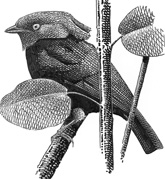
Scarlet-horned manakins are a fancy Tepui endemic that will buzz at us from the undergrowth, but occasionally give themselves up in a fruiting tree.