Eastern Ecuador
Focusing on Ecuador's Amazonian lowlands and eastern Andes, this tour is designed to be an introductory foray into the richest avifauna on earth. To immerse ourselves in the diversity of birds, we'll be based at only two lodges, one in the western Amazonian lowlands, and the other in cloud forest, both operated by Ecuadorian families. Although these lodges take some effort to reach, they are well worth it as they will be our bases for short trips, most of which involve simply walking from our rooms!
Our first base is Yuturi Lodge, on the south bank of the Río Napo, amid an avifauna of more than 500 species. A good network of trails, and access by canoe to excellent varzea (seasonally flooded) forest, will enable us to sample the region's remarkable avifauna. Bird families particularly well represented are raptors, parrots, toucans, puffbirds, woodpeckers, woodcreepers, antbirds (more than 50 species!) and tanagers, and the area is home to a variety of mammals including the endearing Golden-mantled Tamarin. Like most Amazon lodges, Yuturi is relatively rustic but has good food and private cabins, each with its own bathroom (cold showers).
After our stay at Yuturi we'll return to Quito and then head across the eastern Andes to our second base, the increasingly-renowned Cabañas San Isidro, at about 6,500 feet elevation, with Collared Incas feeding on flowers by the cabins, a lek of Andean Cocks-of-the-Rock nearby, and a dazzling array of tanagers. Cabañas San Isidro is an excellent point from which to explore temperate and subtropical forests. Spectacled Bears have even been seen on the property, but we'd be exceedingly lucky to spot one.
Sunday 13 July to Monday 28 July
with Steve Howell as leader.
Cumulative bird list | Latest trip report
 return to the South American introduction
return to Calendar
Day 1: The tour begins in London with a flight to Quito, via Miami. Night in Quito.
Day 2: Because of the potential for travel delays, we've allowed this first day for birding around Quito before we head down to the Amazonian lowlands. We'll spend the day on the famous Nono-Mindo road, which winds its way down the west slope of the Andes through temperate and subtropical forest. One day can hardly scratch the surface of this area, where possibilities include Toucan Barbet, White-capped Dipper, and glittering arrays of hummingbirds and tanagers. We're sure to see more than enough to keep us busy! Night in Quito.
Day 3: This morning we'll take a flight to the town of Coca, in the 'Oriente' (Ecuador's eastern lowlands), and board our launch for the river trip to Yuturi Lodge. This relatively new lodge is about four and a half hours downriver and along the way we'll have our first taste of the avifauna. We may see Greater Yellow-headed Vultures soaring over the forested banks, Swallow-winged Puffbirds perched atop dead snags, fancy White-banded Swallows twinkling low over the water, and groups of parrots and oropendolas flying overhead. We'll arrive in time to have a welcome drink and settle into our cabins before dinner. Night at Yuturi Lodge.
Days 4-7: We'll spend nearly five days birding along trails and from canoes in the vicinity of Yuturi Lodge, exploring a variety of habitats. The lodge is set on a rise between excellent varzea forest and terra firme forest, the two main forest habitats in western Amazonia. From the bar, one can watch Hoatzins flopping around, Plum-throated Cotingas picking off berries, and King Vultures soaring overhead. Among the 500 species possible around Yuturi is the spectacular Blue-and-yellow Macaw, as well as Ochre-striped Antpitta, Lunulated Antbird, Orange-crowned Manakin, and Paradise Tanager. On river islands in the nearby Río Napo, we'll look for island specialists such as Olive-spotted Hummingbird and Black-and-white Antbird, and we might even run into a group of Pink River Dolphins! Nights at Yuturi Lodge.
Day 8: We'll take about a five-hour boat ride from Yuturi back to Coca. We'll arrive at Yarina Lodge, owned and operated by the same family that owns Yuturi, with time for casual birding in lodge grounds before dinner. The mix of birds here is slightly different from that at Yuturi and we can expect to see a number of new species. Night at Yarina Lodge.
Day 9: After early morning birding at Yarina Lodge, we'll complete the final leg of our journey to Coca, followed by a flight to Quito. We'll arrive at our hotel in the early afternoon with time to relax. Night in Quito.
Day 10: We'll start early for our drive across the eastern Andes via the spectacular Papallacta Pass where, if we're lucky, we may find the ptarmigan-like Rufous-bellied Seedsnipe. As we drop down from the high-elevation Polylepis forest into humid subtropical forest, birds change along the way, from Shining Sunbeam and Rufous-breasted Chat-Tyrant to Emerald Toucanet and Golden Tanager. We'll reach our cabins in mid-afternoon, in time to settle in and take a walk around. Night at San Isidro.
Days 11-13: We'll spend three days at Cabañas San Isidro, home to more than 250 species. We'll explore the subtropical forest via a number of trails, some rather steep and perhaps muddy, depending on recent weather. Birds possible within walking distance of our rooms include Black-and-chestnut Eagle, Long-tailed Sylph, Chestnut-breasted Coronet, Crimson-mantled and Powerful Woodpeckers, White-bellied and Slate-crowned Antpittas, Barred Becard, Turquoise Jay and many, many tanagers, including White-capped, Flame-faced, Grass-green and Beryl-spangled. Nights at San Isidro.
Day 14: After a final morning at San Isidro we'll head back to Quito, birding en route. Night in Quito.
Day 15: We'll catch a morning flight to Miami, where we'll connect with an overnight flight to London, arriving on the morning of day 16, where the tour concludes.
Cost £3460
Single Room Supplement £200
Maximum group size: 7 participants and 1 leader
The ground arrangements for this tour are organised
by our American associates Wings.
Cumulative bird list | Latest trip report
return to top of page
return to the South American introduction
return to Calendar
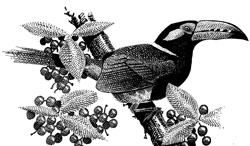
Though large and colourful, Golden-collared Toucanets can be surprisingly hard to find in the dense rainforest.