Brazil – a birder's paradise
Home to almost a fifth of the world's birds of which more than 175 species are endemic, Brazil has recently started attracting the attention of birders world-wide. Each year, new species are being described and as more birders and ornithologists explore the country, species previously thought extinct are being re-discovered. This ornithological extravaganza, combined with an excellent infrastructure of hotels and lodges located close to birding sites, friendly people and superb food sets the stage for one of the best birding experiences that can be imagined.
The Atlantic rainforest, one of the most threatened habitats in South America, will have us spending our days searching for endemics and threatened species. In the Pantanal, a host of waterbirds will compete with many other species, including the striking Hyacinth Macaw, for our attention. Our comfortable lodge in the lower Amazonian basin will have us relishing its pristine setting on the Rio Cristalino as mixed-species flocks leave us marvelling at how quickly so many birds can appear (and disappear) in the forest. The geographic diversity of the state of Minas Gerais will offer both birding and mammalian highlights as we bird the low mountains, grasslands and savannahs looking for threatened species such as Brazilian Merganser, recently described species including Cipó Canastero and non-avian targets including Giant Anteater and Maned Wolf.
With its three consecutive segments, this itinerary allows participation by birders with time constraints, as well as a longer tour for those who want to spend more time immersing themselves in the Brazilian avifaunas.
Saturday 12 July to Wednesday 23 July
Extensions to Sunday 3 August, or Saturday 9 August
with Judy Davis and David Fisher as leaders.
 Brazil bird list
return to the South American introduction
return to Calendar
Southeast Brazil: The Atlantic Rainforest
(Saturday 12 July to Wednesday 23 July)
Day 1: The tour starts in London with an overnight flight to Rio de Janeiro.
Day 2: After arriving in Rio, we'll drive northeast to Teresopolis, where our base for two nights will be a recently established guesthouse in Serra dos Orgáos National Park thus providing easy access to our birding sites. With a list comprised of more endemics than any other reserve in Brazil, jetlag will soon be forgotten as we immerse ourselves in the birdlife of the park. We'll spend the afternoon birding the lower stretches of the park where our first Brazilian endemics await us - Pallid Spinetail, White-collared Foliage-gleaner, and Star-throated Antwren are all possibilities. Tanager flocks providing kaleidoscopes of colour and insectivorous furnariids creeping along branches foraging in dead leaf clusters will have us examining every call and leaf movement for the new species awaiting us. Night in Teresopolis.
Day 3: After an early breakfast, we'll drive northeast of Teresopolis to a remnant area of dry forest that continues to support a good selection of birds including the Three-toed Jacamar. While our focus will be on locating this endangered species, we'll endeavour to see other interesting species including Yellow-lored Tody-Flycatcher, Long-billed Wren, and Crescent-chested Puffbird. Night in Teresopolis.
Day 4: Carrying packed lunches, we'll spend the morning and early afternoon walking a trail in Serra dos Orgáos National Park. The trail will take us through different altitudinal zones, thus providing opportunities to see species we may not have encountered our first afternoon in the park. By quietly walking the trail, we'll listen for the distinctive call of Hooded Berryeater, a striking endemic cotinga, and will watch for flocks moving through the dense bamboo in hope of Tufted Antshrike, Ferruginous and Ochre-rumped Antbirds, Black-billed Scythebill, and White-browed Warbler. Trailside streams and small waterfalls may yield Sharp-tailed Streamcreeper. In the afternoon we'll drive to Itatiaia National Park where we'll spend four nights in a comfortable hotel highlighted by grounds filled with birds.
Days 5-7: Located only 125 miles from Rio, Itatiaia is Brazil's oldest national park with a variety of habitats ranging from Atlantic rainforest to the treeless summit of Agulhas Negras, the second highest mountain wholly within Brazil. Our days will be spent birding the entrance road and an excellent trail system in the park through elevations ranging from 2,700 and 5,200 feet. From the cacophony of parrots screeching overhead at dawn to the musical song of Slaty Bristlefront, the forest birds will hold our attention throughout our stay. Our efforts should be rewarded with sightings of large and small, from Dusky-legged Guans to numerous hummingbirds, including Frilled Coquette, Violet-capped Woodnymph, the striking Brazilian Ruby, and Swallow-tailed Hummingbird. White-throated and Planalto Woodcreepers, Giant Antshrike, Spot-breasted Antvireo, and a variety of trogons and toucans including Saffron and Spot-billed Toucanets, will entertain us in the forest throughout each day, while birds that come to the feeders and nearby fruiting trees in the hotel garden will fill any free moments. One day will be spent exploring the higher reaches of the park where we'll drive above the treeline to the top of Agulhas Negras. Here we'll concentrate on finding Itatiaia Spinetail, Araucaria Tit-Spinetail, Black-breasted Plovercrest, Black-and-gold Cotinga, Mouse-colored Tapaculo, Gray-capped Tyrannulet, Blackish Rail and other species that are not normally found lower down. Nights in Itiatiaia National Park.
Day 8: Following a final morning birding in Itatiaia National Park, we'll spend the afternoon driving to Angra dos Reis on the coast, with birding stops en route. Night in Angra dos Reis.
Day 9: Our focus this morning will be on locating the recently re-discovered Black-hooded Antwren. While visiting sites where this attractive endemic has been found, we'll also have opportunities to see other species including White-shouldered Fire-eye, Gray-hooded Attila, and Brazilian and Red-necked Tanagers. Following a leisurely lunch, we'll drive along the coast to Ubatuba where we'll be based for two nights. Night in Ubatuba.
Day 10: During our time in the Ubatuba area, we'll visit one or two local fazendas (ranches) where patches of forest have been left among the cocoa plants. We'll seek southeast Brazilian endemics including Saw-billed Hermit and Buff-throated Purpletuft. Fork-tailed Pygmy-Tyrant, Sharpbill, Blond-crested Woodpecker, and Bay-ringed Tyrannulet are just a few of the other species we hope to encounter here. Clearings in the fazendas will give us opportunities to scan the sky for raptors, with possibilities including Bicolored and Mantled Hawks. Night in Ubatuba.
Day 11: Today will be primarily a travel day, but depending on flight times from São Paulo, we may have some time for early morning birding in the Ubatuba area. We'll then drive to São Paulo where the Southeast Brazil segment of the tour ends and those departing will catch an overnight flight to London where the tour concludes on day 12. Participants continuing on the Pantanal and Mato Grosso Rainforest segment will take a connecting flight to Cuiaba.
The Pantanal and Matto Grosso Rainforest
(Tuesday 22 July to Sunday 3 August)
Day 1: This segment begins with an afternoon flight to Cuiaba, capital of Mato Grosso state. (Those joining at this stage will catch an overnight flight from London departing on 21 July). Upon arrival, we'll drive south to Pocone where we'll connect with the Transpantaneira highway. Not a highway by modern definition, it is actually a raised dirt track crossing part of the world's largest freshwater wetland, known as the Pantanal, that covers approximately 90,000 square miles. The Transpantaneira extends for 90 miles to Porto Jofre, providing excellent roadside birding throughout its length. Our base in the Pantanal is a private fazenda south of Pocone known for its comfortable lodging and superb birding opportunities. Walks from the lodge, boat trips on small streams and lagoons, and drives along the Transpantaneira will give us opportunities to feast upon the avian offerings of this vast wetland. We'll enjoy dusk flights of parrots, and Nacunda Nighthawks hawking in a marshy area near the lodge, while listening to the distinctive calls of Buff-necked Ibises. Hyacinth Macaws, the world's largest parrot, occasionally nest in the grounds of the fazenda providing unsurpassed opportunities to observe these spectacular birds. Night in the Pantanal.
Days 2-3: Our time will be spent exploring and birding the forest and open areas of the lodge and the Transpantaneira between Pocone and Pixiam. While enjoying the spectacle of herons, ibises, Jabirus, Sunbitterns and parrot flocks through 'scopes, and splendid photographic opportunities, we'll also spend time looking for gems including Chaco Chachalaca, Buff-bellied Hermit, Mato Grosso Antbird, White-eyed Attila, and the recently described Gray-crested Cachalote. Nights in the Pantanal.
Day 4: After some early morning birding near the lodge, we'll return to Cuiaba in time for our flight to Alta Floresta. Arriving in the forest of the southern Amazon basin, we'll feel as though we have entered a different world. Following a transfer to the Teles Pires River, we'll enjoy a boat trip on the pristine Cristalino River en route to the lodge. Our introduction to the Amazonian forest could include Scarlet, Red-and-green, or Blue-and-yellow Macaws flying overhead, an Amazonian Umbrellabird crossing the river in front of us, Red-throated Piping Guans perched high in trees or, with incredible luck, a tapir taking a cooling swim in the river. Our lodge is located minutes away from the river with comfortable accommodation, friendly staff waiting to help make our experience one of the best ever, and birds, birds, birds! Night at Rio Cristalino Lodge.
Days 5-8: We'll quickly realise that four days, four weeks, or even four months would not allow us ample time to absorb all the surrounding forest has to offer. We'll spend our days walking trails near the lodge, surveying the canopy from a recently constructed tower, and exploring the riverine forest by boat. With luck we may encounter an antswarm, allowing us to watch at close range such species as Bare-eyed Antbird, Black-spotted Bare-eye or even Dark-winged Trumpeter. The many woodcreepers, furnariids, antbirds and flycatchers, combined with the local Crimson-bellied Parakeet, the shy Pavonine Quetzal, Striolated Puffbird, Musician and Tooth-billed Wrens, Rufous-capped Antthrush and, always, the rare and unexpected such as Gray-bellied Hawk or Kawall's Parrot, will have us birding from dawn to dusk and beyond, with breaks only for the incredibly delicious food provided by the staff (and rest breaks during the heat of the day). Nights at Rio Cristalino Lodge.
Day 9: Following a final morning birding this superb area, we'll sadly say farewell and transfer to Alta Floresta for our afternoon flight to Cuiaba. We'll then drive to Serra das Araras, a lodge located in an area of transitional habitats including cerrado (savanna) vegetation and Amazonian forest. The area became well known to birders in 1999 when an active Harpy Eagle nest was discovered here. Although the birds do not nest every year, our time spent birding the forest area near the original nest site gives us the possibility of happening upon one of these magnificent birds. This is also an excellent area for nightbirds where an evening trip into the forest may yield Scissor-tailed Nightjar, Ocellated Poorwill or Least Nighthawk. Night at Serra das Araras.
Day 10: The day will be spent birding the surrounding area looking for birds not seen elsewhere on this segment, including Red-shouldered Macaw, Dusky-headed Parakeet, Sharpbill, Warbling and Black-throated Antbirds, and Turquoise Tanager. We'll offer a second evening-birding option to look for any nocturnal species we missed the previous night. Night at Serra das Araras.
Day 11: After breakfast, we'll depart for our drive to Chapada dos Guimaráes where we'll spend a bird-filled last day. Located on the edge of Brazil's central plateau, the Chapada offers impressive monolithic rock formations and spectacular waterfalls. We'll bird along the way and arrive in time to spend the final hours of the day at Portao do Inferno where we may witness flocks of Biscutate and Great Dusky Swifts flying overhead while we watch for the evening return of Red-and-green and Blue-winged Macaws to their cliff-side roost sites.
Day 12: The early morning will be spent birding other areas of the Chapada searching for such specialities as Cinnamon-throated Hermit, Southern Antpipit, and Helmeted Manakin. We'll scan the campo areas for Red-winged Tinamou, Red-legged Seriema, and White-banded and White-rumped Tanagers. We'll return to Cuiaba in time for our connecting flight to Sao Paulo where the Pantanal and Mato Grosso Rainforest segment of the tour concludes. Participants continuing on the Minas Gerais segment will make a connecting flight to Belo Horizonte. Participants not accompanying us on the third segment of the tour will connect with a flight to London this evening, arriving home on Day 13.
Minas Gerais Extension: Parque Natural do Caraça,
Serra da Canastra National Park, and Serra do Cipo National Park.
(Saturday 2 August to Saturday 9 August)
Day 1: The extension begins with a flight from São Paulo to Belo Horizonte, capital of the state of Minas Gerais and the beginning of an incredible birding week through the 'Brazilian Alps', and campo and cerrado habitats. Night in Belo Horizonte.
Day 2: Following an early breakfast, we'll drive to Parque Natural do Caraça with birding stops en route. A former monastery that has become a popular tourist resort, the park has attracted the interest of birders over the past decade with avian highlights including Swallow-tailed Hummingbird, Crescent-chested Puffbird, Rufous Gnateater, Serra Antwren, Swallow-tailed Cotinga, and Velvety Black-Tyrant. Our time here will be spent birding the grounds and the nearby trails in search of these and many more species. The evening hours will have us standing watch for a mammalian highlight that has made Caraça famous. For many years, the monks have placed food on the monastery steps each evening and one or a pair of Maned Wolves quietly appears most nights to partake of this offering. Night at Parque Natural do Caraça.
Day 3: We'll have the morning to bird around Caraça before our long drive westward to São Roque de Minas, a small town adjacent to Canastra National Park. Our base here for three nights will be a small hotel along the park entrance-road thus providing easy proximity for exploring the park. Night in São Roque de Minas.
Days 4-5: Serra da Canastra National Park is a cerrado reserve that offers a diversity of birdlife as well as splendid scenery. Encompassing 2,700 square miles, the park sits atop a steep-walled escarpment. Within the park, the headwaters of the Rio São Francisco provide habitat for two scarce species; the highly endangered Brazilian Merganser and the very local Brasilia Tapaculo. While searching for these rarities, we'll have opportunities to see many of the species typical of the Brazilian cerrado and campo including Greater Rhea, Red-legged Seriema, the entertaining Cock-tailed Tyrant, and Sharp-tailed Grass-Tyrant. We'll spend part of our time birding an area of gallery forest along the Rio São Franscisco where we'll search for Red-ruffed Fruitcrow, Golden-capped Parakeet, and Stripe-breasted Starthroat. In addition to the birds, another highlights here should be Giant Anteaters roaming across the vast grasslands. Nights in São Roque de Minas.
Day 6: After an early breakfast we'll drive to Serra do Cipó National Park, a long drive but worthwhile for the specialities we hope to see during our short stay. This park offers a mixture of campo, cerrado and gallery forest habitats. We'll attempt to arrive in time to spend the last hours of daylight birding the higher areas of the park searching for our target species including Hyacinth Visorbearer, Gray-backed Tachuri, Buff-throated Pampa-Finch, and Cipó Canastero, a recently discovered species described in 1990. Night in Serra do Cipó National Park.
Day 7: We'll spend the morning in Serro do Cipo National Park searching for any of the specialities which we may have missed yesterday. After lunch we'll return to Belo Horizonte and catch our flight to Rio where we'll connect with our flight to London.
Day 8: The tour concludes today with our arrival in London.
Air fare from London £620 plus
Southeast Brazil: cost £2370
Single Room Supplement £150
Pantanal: cost £3050
Single Room Supplement £110
Minas Gerais: cost £1890
Single Room Supplement £50
Maximum group size: 14 participants and 2 leaders.
The ground arrangements for this tour are organised
by our American associates WINGS.
Brazil bird list
return to top of page
return to the South American introduction
return to Calendar
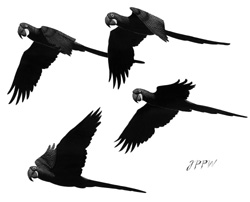
Hyacinth Macaw, the world's largest parrot, is sure to one of the highlights of our visit to Brazil.