The Pacific Northwest calls to mind forests of huge conifers towering over a dense understory of fern and moss-covered logs, while in the near distance the Pacific thunders among rocky headlands and exhausts its strength on narrow sandy beaches. The image is as correct as it is spectacular, but the region offers much more as well: sheltered waters dotted with islands, many of which are rich in nesting and summering waterbirds; picturesque cities such as Vancouver and Victoria; drier interior valleys of grassland, pine, sage, and high basalt cliffs; ancient Indian cultures; excellent cuisine; and some of the most magnificent scenery anywhere.
Beginning in Seattle and covering the Columbia Basin, the Okanagan Valley, Manning Provincial Park, Vancouver, Vancouver Island, and the Olympic Peninsula, our trip will draw from all these elements when resident bird populations are near their peak. We'll finish the tour with a visit to the Pacific coast at Ocean Shores and Westport, Washington, which will include a pelagic trip offshore as well as coastal birdwatching.
Monday 30 June to Monday 14 July
with Paul Lehman as leader.
 Pacific Northwest bird list
return to North American introduction
return to Calendar
Day 1: The tour begins in London with a flight to Seattle where
we'll spend the night.
Day 2: We'll depart Seattle to the east, cross the Cascades and stop to look for Sage Thrasher and Sage Sparrow near the Columbia River. Angling northeast along the Grand Coulee, we'll pass through a beautiful region of high basalt cliffs frequented by White-throated Swifts. We'll stop at dams and lakes and should see Western Grebe and a variety of waterfowl. The afternoon will find us in the sage-pine grasslands just south of Okanagan, where Gray Flycatcher, Brewer's and Lark Sparrows, Cassin's Finch and such waterbirds as American Avocet and Wilson's Phalarope breed. In the evening we'll look for Flammulated Owl and Common Poorwill. Night in Okanagan.
Day 3: We'll spend a half-day in the Okanagan, Washington, area before crossing into the British Columbia portion of the valley. The Okanagan Highlands region, located southeast of Oroville, is famous for its avian diversity and rich mix of coniferous and deciduous woodland, rolling grassland, and ponds. Species of interest here include Swainson's Hawk, Williamson's Sapsucker, Townsend's Solitaire, and possibly Great Gray Owl and American Three-toed Woodpecker. Night in Oliver.
Day 4: Located in the rainshadow of the Coast and Cascade mountain ranges, parts of the Okanagan Valley receive as little as 10 inches of precipitation annually, thus supporting a semi-arid steppe climate unique to Canada. The area has been called 'Canada's Pocket Desert' and is a place of mesmerising beauty characterised by huge rocky outcroppings, large lakes, sagebrush, riparian woodland, and dry ponderosa pine forest at lower elevations, with spruce and fir forests higher up. Species of interest here include Northern Pygmy-Owl, Calliope Hummingbird, Lewis's and Black-backed Woodpeckers, Hammond's and Dusky Flycatchers, Say's Phoebe, Canyon and Rock Wrens, MacGillivray's Warbler, Lazuli Bunting, and such eastern species as Veery and Bobolink. Night in Oliver.
Day 5: We'll spend the early morning in the Okanagan before leaving for Manning Provincial Park. On the way we'll pause in the Princeton area where open forest, lush meadows and small lakes support Barrow's Goldeneye, Pygmy Nuthatch, American Dipper, and Mountain Bluebird. We'll arrive in Manning Provincial Park in time for some late-afternoon birdwatching and an evening looking for Black Swift. Night in Manning Provincial Park.
Day 6: Located just north of the international border and North Cascades National Park, Manning Provincial Park is characterised by glacial landscapes and extensive forests of pine and fir, alder, willow-lined streams, beaver ponds, and alpine meadows. It is an excellent place to look for a variety of mountain forest birds such as Red-naped Sapsucker, Pileated Woodpecker, Clark's Nutcracker, Boreal Chickadee, Pine Grosbeak, and possibly White-winged Crossbill. Three species of grouse - Spruce, Blue and Ruffed - occur in the park, and we have a good chance of seeing Blue. Night in Manning Provincial Park.
Day 7: We'll spend the early morning in Manning Provincial Park before departing for Vancouver. Vancouver is a splendid city nestled between the mountains and the sea. We'll visit Iona Island, a waste- disposal site famous for its concentrations of waders and frequent rarities including, one year, a Spoon-billed Sandpiper! We'll also visit Boundary Bay, another famous wader locale and later look for Barn and Short-eared Owls. Night in Vancouver.
Day 8: We'll spend our morning visiting a few of Vancouver's lovely parks and surrounding mountains looking in forests of fir, hemlock and cedar for Band-tailed Pigeon, Vaux's Swift, Red-breasted Sapsucker, Chestnut-backed Chickadee, and Black-headed Grosbeak. We'll then catch a mid-afternoon ferry to Vancouver Island, a scenic route providing views of many Bald Eagles and our first auks, then drive to Victoria city, where we'll spend the night.
Day 9: Not unexpectedly, Victoria is an ideal place for waterbirds and we'll search for Pelagic Cormorant, auks (including Marbled Murrelet), gulls, and rocky-coast waders at Clover Point. We'll explore Victoria's lovely parks and woodlands seeking Wood Duck, Anna's Hummingbird, Pacific-slope Flycatcher, Hutton's Vireo, and MacGillivray's and Black-throated Gray Warblers. Independent afternoon time may be spent touring the attractive harbour area, visiting the famous Bouchart Gardens or taking a whale-watching trip in search of Orcas. Night in Victoria.
Day 10: We'll take an early-morning ferry across the Strait of Juan de Fuca to the Olympic Peninsula town of Port Angeles, Washington, a trip of about 90 minutes which affords us a chance for one or two new pelagic species. We'll spend the remainder of the morning in Olympic National Park. There are plenty of birds here - Golden Eagle, Blue Grouse, Gray Jay, Varied Thrush, and Townsend's Warbler - but it may be the magnificent forest and alpine wildflowers that leave the most lasting impression. In the afternoon we'll visit Dungeness, where we could see especially large numbers of waterbirds, early returning waders, auks, Black Oystercatcher, and Northwestern Crow. Night in Port Angeles.
Day 11: We'll drive to Port Townsend and the 35-minute ferry ride across Admiralty Inlet, connecting southern Puget Sound with the Strait of Juan de Fuca, to Whidbey Island. It's a busy place for man and nature and we should see large numbers of Heermann's Gulls, Pigeon Guillemots, Marbled Murrelets, and Rhinoceros Auklets. The waters around Whidbey Island support large numbers of summering divers (including Pacific), cormorants, scoters, and Harlequin Duck. We'll reach Seattle late in the afternoon. Night in Seattle.
Day 12: We'll drive south from Seattle, stopping along the way to search for any landbird we might have missed so far, before turning west toward Gray's Harbor and the region around Ocean Shores, Washington. Here one finds open ocean, large bays, marshes, mud flats, rocky coast and broad, wild sandy beaches, and not surprisingly the area is well known for its birds. In addition to summering divers and scoters, we'll look for Brown Pelican, Brandt's Cormorant, rocky-habitat waders including Surfbird, and Western Scrub-Jay, and may see Elegant Tern. If we're lucky, thousands of Sooty Shearwaters will be passing just offshore. Night in Westport.
Day 13: Pelagic trips off Westport have a long tradition of being some of the best along the Pacific coast. In July we can expect to see up to a hundred Black-footed Albatrosses, Pink-footed Shearwater, Fork-tailed Storm-petrel, and Cassin's Auklet. The list of possibles is much longer and includes Laysan Albatross, Flesh-footed Shearwater, Leach's Storm-petrel, Sabine's Gull, and Tufted Puffin. Where there are birds there are mammals, and we should see the irrepressible Dall's Porpoise, Harbour Porpoise, and possibly Northern Fur Seal, Pacific White-sided Dolphin, and Gray Whale. Pelagic trips are full of glorious uncertainty and a day off Westport is always an adventure. Following our boat trip we'll return to Seattle. Night in Seattle.
Day 14: We'll catch a morning flight to London where the tour concludes the following morning, on Day 15.
Cost £2610
Single Room Supplement £330
Maximum group size: 16 participants and 2 leaders.
The ground arrangements for this tour are organised
by our American associates WINGS.
Pacific Northwest bird list
return to top of page
return to North American introduction
return to Calendar
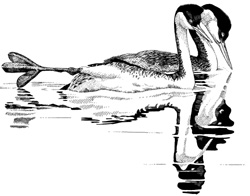
Western Grebes will surely delight us during our travels in the Pacific Northwest.