The spectacular canyons, rivers and forests of northern Arizona and southwestern Utah are surely the most dramatic in North America. Our tour will combine breathtaking landscapes with exciting birdwatching, especially in the desert oases. We'll visit a variety of colourful canyons and monoliths sculpted from the massive Colorado Plateau, including the world-famous Grand Canyon, as well as the less well-known but equally spectacular Bryce and Zion Canyons, Monument Valley, and the Petrified Forest. We'll also stop at a number of historic and scenic sites in Navajo country, before ending up in the boreal coolness of eastern Arizona's White Mountains.
Tuesday 2 September to Monday 15 September
with Gary Rosenberg as leader.
 Northern Arizona and Utah bird list
return to North American introduction
return to Calendar
Day 1: The tour begins with a flight from London to Phoenix, via
Houston. Night in Phoenix.
Day 2: We'll start at the Boyce Thompson Arboretum east of Phoenix, where we can expect an assortment of desert residents such as Gila Woodpecker, Cactus Wren, Phainopepla, Curve-billed Thrasher, and Abert's Towhee. We'll also look for western migrants that commonly pass through the Arizona lowlands: Black-chinned Hummingbird, Pacific-slope and Cordilleran Flycatchers, MacGillivray's Warbler, and Lazuli Bunting, for example. After lunch we'll drive north, leaving the heat behind as we climb the Mogollon Rim toward Flagstaff. Time permitting, we'll stop at several lakes outside Flagstaff where we may see an assortment of ducks, Western Bluebird, Steller's Jay and Cassin's Finch. Night in Flagstaff.
Day 3: We'll drive north toward the North Rim of the Grand Canyon. Our journey will take us through spectacular scenery in the Painted Desert and along the Vermillion Cliffs where we'll look for the recently released California Condors. En route we'll get our first taste of true 'oasis' birding at a number of isolated waterholes, including the mouth of the Paria River in Marble Canyon where a large grove of cottonwood trees attracts migrants, sometimes in dazzling numbers. We'll arrive at the North Rim in the early afternoon in time to explore many of the Grand Canyon's magnificent vantage points while birding in the ponderosa pine and spruce-fir forests that dominate the area. Mountain Bluebird and Pygmy Nuthatch will be much in evidence, and lingering summer residents may include Grace's Warbler and Western Tanager. Night at the North Rim.
Days 4-5: After a final morning enjoying the views of the canyon and searching for the elusive Blue Grouse and American Three-toed Woodpecker, we'll drive north toward Utah, stopping at Pipe Springs National Monument, one of the best migrant traps in northern Arizona. We'll very likely see a wide variety of western migrants, including several Empidonax flycatchers, Western Wood-Pewee, Warbling Vireo, several warbler species, possibly including Hermit, Townsend's and Virginia's, Black-headed Grosbeak, and Green-tailed Towhee. In the afternoon we'll pass into southern Utah and Zion National Park, where the willow-fringed Virgin River flows below towering cliffs. We'll have the late afternoon and the next morning to explore Zion's splendid terrain, and once again we'll have the opportunity to see a wide array of migrants, as well as resident Black and Say's Phoebes, Rock and Canyon Wrens and, along the river, American Dipper. Nights in Mt. Carmel Junction.
Day 6: Today we'll drive a short distance north to Bryce Canyon National Park, stopping first at Cedar Breaks National Monument. The road to Cedar Breaks passes through spruce-fir forest where we'll look for Williamson's Sapsucker and Clark's Nutcracker. The overlook at Cedar Breaks is breathtaking, rivalling that of the Grand Canyon, and perhaps we'll find Golden Eagle or Prairie Falcon soaring overhead. Although not known for extraordinary bird diversity, Bryce Canyon more than makes up for it with astounding scenery. The fairyland quality of the landscape, with its spires and spindle-like formations, is one of the highlights of the trip. Townsend's Solitaire, Pinyon Jay and Mountain Chickadee will provide ornithological distractions. Night in Mt. Carmel Junction.
Day 7: This morning we'll begin our travels into Navajo country. Our drive to Page, Arizona, passes through splendid terrain as the road descends through the pinyon-juniper zone and the barren approaches to Lake Powell. At the lake we can expect an assortment of waterbirds, perhaps including Western or Clark's Grebes. Northern Arizona is memorable for its fantastic geology and both ancient and modern Indian culture. Just outside Page we'll be sure to visit Antelope Canyon, a unique and wondrous slot canyon with intricate, swirling patterns etched deeply into limestone walls. We'll also investigate many isolated clusters of trees, for any patch of vegetation acts as a magnet for migrants. One such oasis near Kayenta was the site of one of the most impressive 'falls' we have seen in Arizona, with literally hundreds of migrant warblers and vireos crammed into as few as ten trees. During the afternoon we'll drive north of Kayenta into Monument Valley. Even though most of us are familiar with the valley from television or magazines, actually being in the presence of those huge monoliths as the sun sets is beyond description. Night in Kayenta.
Day 8: Today we'll begin a two-day journey from Kayenta to Springerville, stopping en route at many of the best oases in northern Arizona. Our main stops will be Many Farms and Tsaile Lakes where we may see a variety of waders. We'll also search the sagebrush for Sage Thrasher and Sage Sparrow, and we'll make a stop in the pines for Lewis's Woodpecker. We'll end the day at spectacular Canyon de Chelly National Monument. Night in Chinle.
Day 9: We'll start this morning at Ganado Lake and the Hubbell Trading Post in Ganado. We can expect a large assortment of migrants and may find one or two rarities. We'll drive through the Painted Desert and Petrified Forest National Park, where we'll check the trees near the park headquarters before enjoying the sights within the park. Our main destination today is Springerville, located at 7,000 feet at the base of the White Mountains. We'll have the late afternoon to explore the habitats around Springerville and Eagar, including Becker Lake, groves of cottonwoods, and agricultural fields, which act collectively as one giant migrant trap. Night in Eagar.
Days 10-11: For a change of pace we'll spend two days in the Springerville area. We'll visit South Fork, one of the prettiest parts of northern Arizona and one of the best birding localities in the state. We may find a few lingering Gray Catbirds (South Fork is the only place they nest in the Southwest) and we'll see numerous migrants and perhaps such birds as Rufous and Calliope Hummingbirds, Virginia's Warbler, and many others. The combination of many migrants, resident ponderosa pine and pinyon-juniper species and attractive surroundings, makes South Fork a pleasant and worthwhile stop. We'll have ample opportunity to birdwatch in the White Mountains at elevations up to 11,000 feet. The mountains here look like the Colorado Rockies and the birds are extremely similar as well. We'll search especially for American Three-toed Woodpecker, Gray Jay, and Pine Grosbeak, all of which nest locally in the spruce-fir forest. Nights in Eagar.
Day 12: After a final early morning walk along the Little Colorado River we'll start our journey back to Phoenix. We'll stop again in the White Mountains and our route will take us along the Mogollon Rim to the town of Globe, where we may see Mexican Jay, Band-tailed Pigeon, and possibly Hepatic Tanager. As we descend from the rim we'll search the chaparral for Gray Vireo, and Rufous-crowned and Black-chinned Sparrows. As we approach Phoenix we may find a Harris's Hawk perched on a telephone pole. Night in Phoenix.
Day 13: We'll catch a morning flight to Houston, where we'll connect with an overnight flight to London arriving on the morning of day 14.
Cost £2020
Single Room Supplement £370
Maximum group size: 16 participants and 2 leaders.
The ground arrangements for this tour are organised
by our American associates WINGS.
Northern Arizona and Utah bird list
return to top of page
return to North American introduction
return to Calendar
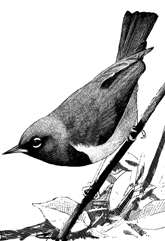
We'll search for western migrants such as MacGillivray's Warbler in the many oases of northern Arizona.