Canada – Churchill and the prairies
This tour to Manitoba, in northern Canada, starts with six days in the prairies west of Winnipeg and in Riding Mountain National Park. Here, a range of habitats, including deciduous and coniferous forests, prairies, marshes and lakes, will provide exciting birdwatching, including many of the North American species that turn up as vagrants in Europe.
The tour then moves to Churchill, located at about 60ºN on the western shore of Hudson Bay. Churchill has long attracted birdwatchers because it is one of the few accessible communities above the treeline and because its location in a transition zone between boreal forest, tundra and Hudson Bay offers an unusually diverse avifauna. Many high-Arctic species pass through here on migration and the breeding birds are remarkably tame. These, and the tundra wildflowers, mammals and striking landscapes, furnish an abundance of subjects for photographers.
Thursday 29 May to Wednesday 11 June
with Michael O'Brien as leader.
 Canada bird list
return to North American introduction
return to Calendar
Day 1: The tour begins with a flight from London to Winnipeg, via Toronto. Night in Winnipeg.
Day 2: En route west from Winnipeg to the prairies of southwestern Manitoba, we'll stop first at Oak Hammock Marsh, a marvellous wetland with abundant breeding waterfowl and such species as American Bittern, Franklin's Gull, Black Tern, and Yellow-headed Blackbird. As we head west to our hotel in Brandon, we may encounter our first Swainson's Hawks or Mountain Bluebirds along the roadside. Near Brandon there is a lovely little marsh that we'll visit in the evening to look for Sedge Wren, and Le Conte's and Nelson's Sharp-tailed Sparrows. Yellow Rails also occur here though their numbers fluctuate from year to year. Night in Brandon.
Day 3: We'll head first to the deciduous woodlands of Brandon Hills Wildlife Management Area, where we may find such species as Ruffed Grouse, Black-billed Cuckoo, and Rose-breasted Grosbeak. After leaving Brandon Hills, we'll begin our search for prairie specialities such as Marbled Godwit and Chestnut-collared Longspur. We'll also visit Whitewater Lake where migrant and resident waders such as American Avocet, White-rumped Sandpiper, and Wilson's Phalarope are often abundant. Night in Melita.
Day 4: We'll spend a full day exploring the prairies near the Saskatchewan border. A more westerly element graces the avifauna here and we'll look especially for Ferruginous Hawk, Sharp-tailed Grouse, Burrowing Owl, Sprague's Pipit, and Baird's Sparrow. The prairies are beautiful at this time of year, full of bird-song and floral displays, and our experience should be delightful. Night in Melita.
Days 5-6: After a final morning in Melita, we'll drive north across the pothole country with its numerous waterbirds, arriving at Riding Mountain National Park in the afternoon. During our two days here we'll explore the boreal forests, lakes, and bogs of Riding Mountain, an extensive 1500-foot escarpment that rises as an island from the Manitoba plains. Birds are abundant and very active at this season and we'll hope for boreal species such as Spruce Grouse, Gray Jay, upward of 18 species of warblers including Connecticut and Mourning, Boreal Chickadee, Lincoln's Sparrow, and Evening Grosbeak. In some years, Great Gray Owl, Black-backed and American Three-toed Woodpeckers, and Two-barred Crossbill have enlivened our visits. Nearby lakes may provide close views of nesting Red-necked Grebes. A variety of mammals adds extra interest: Black Bears are frequently seen in the park as well as Moose, Elk, Beaver, and Porcupine. Nights in Riding Mountain National Park.
Day 7: After another full morning in Riding Mountain, we'll drive back to Winnipeg, stopping at least briefly in the dry deciduous forest on the park's east side to look for Yellow-bellied Sapsucker, Golden-winged Warbler, and Indigo Bunting. We'll arrive at Winnipeg in the afternoon, giving us plenty of time to relax before the trip to Churchill. Night in Winnipeg.
Day 8: This morning we'll visit nearby Assiniboine Park, a tract of deciduous forest that is home to birds of more eastern affinity such as Chimney Swift, Great Crested Flycatcher, Yellow-throated Vireo, and migrants. We'll take a late morning flight to Churchill. Night in Churchill.
Days 9-11: The tour will, we hope, coincide with ice-out, when large numbers of migrant waterfowl and waders mass before continuing to the arctic. Ross's Goose and Sabine's Gull occur at this season and the sheer numbers of birds can be staggering: hundreds of Pacific and Red-throated Divers, thousands of Snow Geese, brightly-plumaged Ruddy Turnstones, White-rumped Sandpipers, Arctic Terns, and Snow and Lapland Buntings.
The tour should correspond with the flowering of many arctic plants and the first hatching of several species of wader. In past years we've observed the nests, eggs, broods, or fledglings of an astonishing variety of species including Pacific Diver, Common Eider, Merlin, Willow Ptarmigan, almost all of Churchill's 15 breeding waders, Arctic Skua, Bonaparte's Gull, Arctic Tern, Short-eared Owl, Great Grey Shrike, Orange-crowned Warbler, Arctic and Common Redpolls, Harris's Sparrow, and Smith's Longspur. Birds are least secretive when feeding or protecting young, and their visibility on the Churchill tundra is something few birdwatchers can imagine: Whimbrels and Hudsonian Godwits hovering and singing low overhead and Red-necked Phalaropes swimming just inches away. Since 1980 Ross's Gull has been a regular feature of our Churchill tours. We can only hope that this small population continues to survive.
Churchill has a fairly extensive road system and we'll have ample time to look carefully at all the breeding birds which include Rough-legged Buzzard, Little Gull, Gray-cheeked Thrush, Bohemian Waxwing, and Pine Grosbeak. Nights in Churchill.
Day 12: After another morning around Churchill, we'll take an afternoon flight back to Winnipeg. In the evening those who wish can return to Oak Hammock to watch dusk settle over this beautiful marsh. Night in Winnipeg.
Day 13: We'll spend the early morning birding near Winnipeg looking for any species that have eluded us up to this point. We'll then catch an afternoon flight to Toronto, and connect with an overnight flight to London where the tour concludes on day 14.
Cost £2630
Single Room Supplement £230
Maximum group size: 16 participants and 2 leaders.
The ground arrangements for this tour are organised
by our American associates WINGS.
Canada bird list
return to top of page
return to North American introduction
return to Calendar
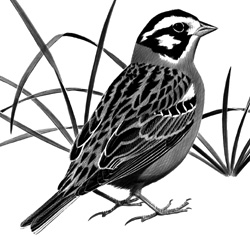
One of Churchill's very special birds is the colourful Smith's Longspur.