California – in the fall
Much of what is written about California is couched in superlatives, whether it be a description of some new social trend or an account of the natural aspects of this remarkable state. Certainly no other state can approach the range of physical environments encountered here, which in large measure explains why California's birdlist is the second longest (behind Texas) of any in the United States. Our tour of southern and central California will sample much of this variety beginning on the south coast at Los Angeles and covering the Imperial Valley and Salton Sea, the Colorado and Mohave deserts, the magnificent Owens Valley and the Sierra Nevada Mountains near Yosemite, before returning to the central coast at Monterey and concluding in San Francisco. It's a spectacular route by any standard and ornithologically rich as well: trip lists average about 280 species, many in large numbers. September is arguably the best time to watch birds in the southern half of California. Migrants everywhere augment the varied array of residents and more rarities show up in autumn than in any other season.
Wednesday 3 September to Sunday 21 September
with Jon Dunn as leader.
 California bird list
return to North American introduction
return to Calendar
Day 1: The tour begins in London with a morning flight to Los Angeles.
Night in Los Angeles.
Day 2: Those aware of the urban sprawl of Los Angeles will be pleasantly surprised at the unspoilt and scenic north coast of Los Angeles County and southern Ventura County. Here steep hills drop sharply to the sea forming a ruggedly scenic coastline. We'll explore canyons that hold some of California's distinctive landbirds including California Quail, Allen's Hummingbird, Wrentit, California Thrasher and California Towhee, as well as a variety of western migrants. Later we'll continue north to the Oxnard Plain where migrant waders, sometimes including Pacific Golden Plover and other scarce species, can often be found. Night in Camarillo.
Day 3: We'll spend the morning crossing to Santa Cruz Island, the largest and most wooded of southern California's Channel Islands. Once on the island we'll hike gently in search of Island Scrub-Jay, a California endemic. If the weather is favourable we'll see a scattering of western migrants. Although transport is on a high speed catamaran we hope to see a few pelagic birds, possibly including Black Storm-petrel and Sooty and Black-vented Shearwaters, as we cross the channel. Night in Camarillo.
Day 4: After breakfast we'll drive south through Los Angeles to Huntington Beach Central Park and the San Joaquin Marsh. Here we should see a fine variety of waterbirds including Elegant Tern, Long-billed Curlew, Marbled Godwit and Common Ground Dove. Later we'll continue down the coast in search of the endangered California Gnatcatcher. Night at San Clemente.
Day 5: Assuming we've seen the gnatcatcher, we'll drive south and east to the low but lovely and unpopulated mountains of eastern San Diego County. Here among the pines and oaks we should encounter a variety of species including Oak Titmouse, Mountain Chickadee, Western Bluebird and, with luck, the local and often scarce Lawrence's Goldfinch. Later we'll drive down into the Imperial Valley for some afternoon birding at the south end of the Salton Sea. Night in Calipatria.
Day 6: The Imperial Valley and Salton Sea may test our endurance - for the area can be blazingly hot - but by starting early we'll be able to study various waterbirds at Finney and Ramer lakes and at the south end of the sea. The 30-mile-long body of water attracts post-breeding visitors from Mexico including Wood Stork and Yellow-footed Gull. Some of the landbirds we have a good chance of encountering are Ladder-backed Woodpecker, Black-tailed Gnatcatcher, Abert's Towhee, and the distinctive large-billed 'species' of Savannah Sparrow. In the town of Brawley we may see Costa's Hummingbird and Gila Woodpecker. Night in Calipatria.
Day 7: Departing very early from the Salton Sea we'll stop briefly at Morongo Valley, a desert oasis that may harbour Nuttall's Woodpecker, Vermilion Flycatcher or a lingering Summer Tanager. After a picnic high in the San Gabriel Mountains, where we'll look for White-headed Woodpecker and the distinctive stephensi ('Thick-billed') race of Fox Sparrow, we'll continue to Galileo for late afternoon birding. Night in Galileo.
Day 8: Galileo is a high desert ranch and club, an artificial oasis that attracts large numbers of landbird migrants, including many rarities. We'll spend the morning here looking for Sage Sparrow and searching for migrants. Le Conte's Thrasher inhabits nearby Jawbone Canyon and we'll search for it as well. Night in Galileo.
Day 9: We'll depart Galileo this morning, following a route taking us along the south end of the Sierra Nevada and up the great Owens Valley. With the precipitous east face of the sierra on the left and the high but arid peaks of the Inyo and White Mountains on the right, the drive up the valley recalls Alaska in its grandeur. We'll stop at a number of lakes along the way, each a powerful lure for waterbirds; in the past we've seen such 'oceanic' birds as skuas and Sabine's Gull. Night in Bishop.
Day 10: We'll drive across the White Mountains to Deep Springs, one of a series of desert oases where water and greenery are attractive to migrating landbirds. We'll also visit Fish Lake Valley, an excellent location for raptors including Swainson's and possibly Ferruginous Hawks. Later we'll drive high into the White Mountains to see the ancient bristlecone pines, magnificent 3000-year-old trees whose rusty bark and twisted shapes are starkly beautiful against the rocky slopes. Night in Bishop.
Day 11: We'll depart before dawn for the 45-minute drive to Crowley Lake and a sunrise search for Greater Sage-Grouse. Crowley Lake is one of the best locations for waterbirds in this part of the Great Basin, including sometimes the occasional skua, Sabine's Gull or Arctic Tern. In addition there are both Western and Clark's Grebes, and often a few Great Northern Divers, as well as a variety of waders. The sagebrush flats are usually alive with various sparrows along with Sage Thrasher. Late in the day we'll travel to Mono Lake, celebrated as a conservation issue. Lowered water levels resulting from use by the Los Angeles water district threaten the lake's scenic beauty and its huge California Gull colony, posing as well more fundamental questions of resource use. A nearby grove of yellow pines often contains Pinyon Jay and Clark's Nutcracker. Night in Lee Vining.
Day 12: Today we'll visit canyons on the east side of the sierra in the vicinity of Lee Vining. In addition to the breathtaking scenery, including a spectacular view of Mono Lake, we'll be looking for Red-breasted Sapsucker, Townsend's Solitaire, and Cassin's Finch. Night in Lee Vining.
Day 13: We'll start early and drive north to Bridgeport and then across the Sierra Nevada at Sonora Pass. Although much of the day will be spent driving, we'll mix in birding spots along the way, searching for montane species we may have missed earlier. In particular we'll look for American Dipper at several favoured spots on the west side of the crest. Once we reach the oak foothills and valleys on the west side we'll search carefully for the distinctive Yellow-billed Magpie, a California endemic. Night in Monterey.
Day 14: After an early breakfast we'll drive to Monterey Harbour for a pelagic trip on Monterey Bay. The edge of the continental shelf lies just a few miles offshore and this zone is usually rich in birds and marine mammals. Barring heavy fog, we are almost certain to see Pink-footed and Sooty Shearwaters, Ashy and Black Storm-petrels, and Cassin's and Rhinoceros Auklets. We may also encounter some less common species such as Buller's Shearwater, South Polar Skua, and Xantus's or Craveri's Murrelets. A pelagic trip on the bay is always enlivened by the presence of marine mammals. On our way out we may view Sea Otters afloat in beds of kelp, Dall's Porpoises riding the bow waves, or any of four or five other species of cetaceans. Even to those who have made them many times, Monterey boat trips are exciting. After docking and a stop at our motel, those who wish will visit the rocky shore at Point Piños in search of waders characteristic of the area such as Black Oystercatcher, Black Turnstone, and Surfbird. Night in Monterey.
Days 15-16: The Monterey and Big Sur region is one of the finest birding areas in the state and we'll spend two full days here. One day we'll venture south to Andrew Molera State Park near Big Sur, one of the better spots for migrants in the region and a location where many rarities have been found. A full-time bird observatory is located here, and we'll check in to get the latest news. In addition to lots of residents, such as Hutton's Vireo and Chestnut-backed Chickadee, there is superb rocky coastline that attracts many birds. A fine network of trails enables easy access to the best areas.
On another day we'll go north to Elkhorn Slough and the nearby Moonglow Dairy, where in addition to concentrations of waders and other waterbirds, including summering divers and both Western and Clark's Grebes, we should see Tricolored Blackbirds.
We'll also spend one pre-dawn morning owling with a good chance of hearing both Western Screech-Owl and Northern Pygmy-Owls, and possibly Spotted Owl. Excellent birding at the headland at Point Piños and the nearby Carmel Valley mouth ensure that we will not run short of birding opportunities. Nights in Monterey.
Day 17: After another morning birding in the Monterey area we'll drive north along the coast stopping at several spots including the area north of Pigeon Point. Here, depending on water conditions, we may find Marbled Murrelet. Night in San Francisco.
Day 18: We'll spend our final morning on the Marin headlands just north of Golden Gate Bridge watching migrant raptors. The views north along the golden hills and, particularly, south across the bridge, are simply breathtaking, and given the right conditions migrating raptors, including occasionally Broad-winged Hawks, can be numerous. We'll return about midday to San Francisco International Airport to catch an afternoon flight to London, where the tour concludes on the morning of Day 19.
Cost £3200
Single Room Supplement £440
Maximum group size: 16 participants and 2 leaders.
The ground arrangements for this tour are organised by our American associates WINGS.
California bird
list
return to top of page
return to North American introduction
return to Calendar
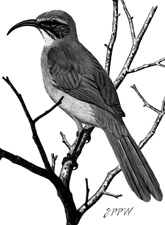
The near-endemic California Thrasher should be one of the specialities we'll see during our first day's birding.