The ornithological richness of a spring visit to Mallorca has made the island famous as one of Europe's prime birdwatching destinations. We'll be based close to Porto Pollensa, centrally located among the varied mountain, marsh and coastal habitats of the northern part of the island and well removed from the main tourist areas in the southwest. Our itinerary is flexible, offering a choice of day-long birdwatching or a more leisurely pace for those who prefer it. With little physical effort, we'll be able to enjoy some of Europe's most sought-after species amid beautiful, sometimes spectacular, scenery. This gently-paced tour has a potential list of over 120 species and a major objective is for participants to get good views of all of them, as well as plenty of informal guidance on improving identification skills.
This will be our seventeenth tour to Mallorca. We have chosen the dates to make the most of the weekends giving us 7 full days on the island and a bit at either end. With the leaders driving our own mini-buses we are assured of the greatest flexibility possible and are not handicapped by the restrictions of a large coach.
Saturday 26 April to Sunday 4 May
with Steve Rooke as leader.
 Mallorca bird list
return to Europe introduction
return to Calendar
Day 1: The tour begins in London with a flight to Palma followed
by a one-hour drive to Cala San Vicente. Night in Cala San Vicente.
Days 2-8: With no hotel changes during our stay, the daily itinerary is both uncomplicated and flexible. On most days there will be a short pre-breakfast trip for those who want to catch the beginning of the day. After breakfast we'll leave to visit one or another of the island's noted birdwatching localities and each day the leader will prepare a delicious picnic lunch of local delicacies. On some days we'll return to the hotel in the afternoon and, after a short break, offer more local birding before dinner. Thus the day's birding can be broken into sessions, any of which are optional for those preferring a more leisurely pace.
Each of the localities we'll visit has its own special attractions. Albufera is Mallorca's largest marsh and has so far resisted all attempts to drain it; in 1985 it was declared a reserve, a tribute to the local and international conservationists who fought to save it. Here, and at the smaller Albufereta marsh, we'll seek a variety of wetland species and other birds, among them Little Egret, Purple and Night Herons, Little Bittern, Garganey, Osprey, and Great Reed and Moustached Warblers, with the possibility of rarities such as Squacco Heron, Marsh Sandpiper, Slender-billed Gull, and Red-throated Pipit.
In the island's northern mountain range we'll drive to the picturesque, peak-ringed Cuber Reservoir. On other days the Arta Mountains and the spectacular Formentor Peninsula will be our destinations. In these largely montane habitats we hope to see Black Vulture at one of its few remaining European sites, and a variety of other birds such as Egyptian Vulture, Booted Eagle, Peregrine, the spectacular Eleonora's Falcon (which usually begins to arrive in late April), Blue Rock Thrush, Spectacled Warbler, Firecrest, and many Crossbills.
At Porto Colom or Cabo de Salinas, sea-watching should provide views of Mediterranean and Cory's Shearwaters, and, gracefully patrolling the clifftops, several Audouin's Gulls, the rarest breeding gull in Europe. This is also one of the best areas to see Marmora's Warbler, a delightful Mediterranean species of very limited distribution.
At the nearby saltpans of Salinas de Levante, the island's main wader site, Kentish Plover and Black-winged Stilt occur regularly. If weather conditions are right the saltpans can be thronged with waders of many species, and there is a chance of rarities such as Collared Pratincole, and Gull-billed and Whiskered Terns. In stony fields in this part of the island we'll look for Stone-curlew and the rare Thekla Lark.
For many birdwatchers, Mallorca's main appeal is the constant stream of migrant arrivals, which usually reaches its height in late April and early May. Unexpected rarities can occur anywhere on the island, but particularly good are migrant 'traps' such as the fig orchards and fields at Casas Veyas on the Formentor Peninsula, and the Boquer Valley.
In all habitats we'll hope for uncommon species; recent tours have produced Glossy Ibis, Black Kite, Red-footed Falcon, Pallid and Alpine Swifts, Bee-eater, Red-rumped Swallow, Black-eared Wheatear, Rock Thrush, Rufous Bush Robin, Subalpine and Western Bonelli's Warblers, and Golden Oriole, as well as the local specialities mentioned above. All of this, of course, in a context of regular Mediterranean birds such as Hoopoe, Wryneck, Short-toed Lark, Crag Martin, Cetti's, Fan-tailed and Sardinian Warblers, Woodchat Shrike, Serin, and Cirl Bunting. Nights in Cala San Vicente.
Day 9: After our last morning's birdwatching we'll drive to Palma for our return flight to London where the trip concludes.
Cost £1070
Single Room Supplement £70
Maximum group size: 14 participants and 2 leaders.
Mallorca bird list
return to top of page
return to Europe introduction
return to Calendar
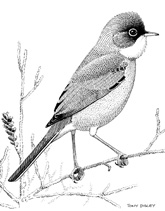
Mallorca is a great place for wonderful views of the normally secretive Spectacled Warbler.