Islands hold a special fascination for most people, including birdwatchers. When they have been isolated long enough to have evolved their own endemic avifauna they become particularly intriguing, representing classic examples of the evolutionary process. The Canary Islands are no exception and at least eight species endemic to the eastern Atlantic islands can be found there. We'll concentrate on seeing all of these during the tour and should obtain good views of each.
The islands are also the breeding site for many seabirds, some of which are hard to see elsewhere in the Western Palearctic. During our week we'll make a couple of boat trips to look for these species which should add an exciting element to the tour. We'll also spend two days on Fuerteventura, looking for specialities such as Houbara Bustard, Cream-coloured Courser and the endemic Canary Islands Chat.
Friday 20 June to Friday 27 June
with Tony Clarke
as leader.
 Canary Islands bird list
return to Europe introduction
return to Calendar
Day 1: The tour begins with a flight from London to Tenerife. Night in Vilaflor.
Days 2-7: The Canary Islands can be divided into two types, the wet, well-vegetated western islands and the dry, desert-like eastern ones. During our week we'll explore an example of each: Tenerife, our main base, which holds seven of the endemics, and Fuerteventura, home to the eighth, where we'll spend one night. We'll also make a day trip to Gomera by ferry, both for the seabirds on the crossing and the spectacular scenery and birds on the island.
The avifauna of the islands is clearly of Western Palearctic origin and the endemic species show close affinities to species found in Europe. Perhaps the two most interesting endemics are Laurel and Bolle's Pigeons, which are restricted to the remaining patches of native laurel forest in the more remote mountainous parts of the islands. They inhabit steep-sided valleys, often shrouded in mist and cloud, where the scene resembles a high Andean valley rather than a holiday island in the sun. A third endemic, the recently split Tenerife Goldcrest, is also found in these mid-altitude forests.
That most familiar of garden birds the Chaffinch has evolved into a very different blue species, the Canary Islands Chaffinch, which has also grown larger - a typical feature of island endemics. Regular Chaffinches also occur, but even they have evolved into a distinct race. The finch for which the islands are most famous is of course the Canary. This species probably evolved from a group of Serins that were isolated on the islands long ago and has also increased in size over the years.
Plain Swifts are reasonably common and we should see them every day. Berthelot's Pipits occur in drier, rocky habitats throughout the islands, though they are commoner on the eastern islands such as Fuerteventura. We'll spend one night on that island so as to look for the most restricted endemic, Canary Islands Chat. This beautiful bird is found nowhere else in the world and while not uncommon in the right habitat is very much a speciality. Its origins are uncertain - no-one is sure whether it is closer to Stonechat or Whinchat.
Being so much drier, Fuerteventura is also home to a number of North African species, including an endemic race of Houbara Bustard, a species that is becoming endangered over most of its range owing to the hunting activities of Arabian falconers. Fortunately, the population on the Canary Islands is still healthy and Fuerteventura may become one of the species' final strongholds. The island also holds a number of other exciting species, absent or rare in the western islands, including Egyptian Vulture, Barbary Partridge, Cream-coloured Courser, Black-bellied Sandgrouse, Lesser Short-toed Lark, Spectacled Warbler, Great Grey Shrike, and Trumpeter Finch and we should see most, if not all, of these.
The seabirds of most interest to visiting birders are Cory's and Little Shearwaters, and Bulwer's Petrel. We'll make a couple of ferry trips between the islands to look for these species and should see large numbers of Cory's and small numbers of both Little and Bulwer's. We also have a chance to see European Storm-petrels and an outside chance of other rarer seabirds. Another highlight on the sea trips are the pods of Pilot Whales, which spend lengthy periods floating on the surface.
Day 8: After a final morning on Tenerife we'll catch a flight back to London where the tour concludes.
Cost £1380
Single Room Supplement £130
Maximum group size: 14 participants and 2 leaders
Canary Islands bird list
return to top of page
return to Europe introduction
return to Calendar
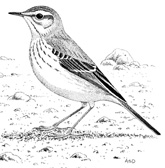
Berthelot's Pipit is one of the eight Atlantic Islands endemics that we'll see during the tour.