Slovakia – birds and bears in the Carpathian mountains
At the beginning of the 10th century Slovakia joined the Kingdom of Hungary where it remained until 1918 when the Czechoslovak Republic was founded. Recently it became a separate country once more and there has never been a more auspicious time to visit this fascinating and relatively unknown pocket of Eastern Europe. The mountains bordering Poland and the Ukraine offer a wild area of beech and conifer forests with rocky outcrops, inhabited by lynx, wolf and bear. We have a good chance of seeing the latter, which during each of the last seven tours we have seen well on at least two separate evenings - thrilling finales to our day's birding. The local bird population includes Black Stork, Lesser Spotted Eagle, Hazel Grouse, Ural and Eagle Owls, and White-backed Woodpecker. En route, the very beautiful High and Low Tatras offer limestone gorges, waterfalls, alpine plateaux, and the best in mountain scenery - with Wallcreeper, Nutcracker, and Alpine Accentor. The Slovakian karst could add Pygmy and Tengmalm's Owls, Three-toed Woodpecker, Rock Thrush, and Rock Bunting. At lower altitudes the fishponds and lagoons of the world-famous SennŽ marshes attract Red-necked Grebe, Pygmy Cormorant, and various herons, egrets, waders, and terns. The delightful countryside offers an endless backdrop of dandelion meadows, wooded hills, fruit trees in blossom, horses ploughing, and a sense of living in another age.
This carefully designed experience offers maximum time exploring all these habitats in the company of various local experts (with many options for time off), yet, thanks to the Bank Holiday, you need only take five days off work to enjoy this ten-day tour. Alternatively, why not carry on birding with Bryan in Hungary?
Saturday 26 April to Monday 5 May
with Bryan Bland as leader and various Slovakian ornithologists assisting locally.
 Slovakia bird list
return to Europe introduction
return to Calendar
Day 1: The tour begins with a flight from London to Budapest, from
where we'll drive to Liptovsky Mikulás (about five hours including
a break). Our hotel is renowned for its panoramic views, maybe with Ring
Ouzel, Crossbill, and Nutcracker from the window, all set against the
dramatic snow-clad Tatras. Before we eat we might even have seen our first
European Brown Bear.
Day 2: Accompanied by a local ornithologist, we'll spend the morning in the Low Tatra National Park, the largest park in Slovakia. In 1996 our first walk here yielded three Tengmalm's Owls, Pygmy Owl, White-backed Woodpecker, and two Three-toed Woodpeckers. In 1998 the highlights were two bears, Capercaillie, and Pygmy Owl mobbed by Crossbills, as a Goshawk flew overhead. After a picnic lunch we'll continue birding until just before sunset, when we'll ensure we are safely inside our comfortable hide to await more bears. Night in the Tatra mountains.
Day 3: Hopefully, the highlight of our morning exploring a dramatic and photogenic gorge in the Choské mountains will be Wallcreeper, though other attractions in recent years have included Hazel Grouse and Golden Eagle. We may then visit the World Heritage Site of Vlkolinec village and step back in time to sense life in Eastern Europe centuries ago. Complementing this, a stop at Pribylina Museum (of old Slovakian buildings) may be of interest. We'll continue birding until we finish the day with another evening (with luck) bear watching. Night in the Tatra mountains.
Day 4: This morning we'll visit the mountain tops of the High Tatra National Park. By taking the cable car to about 2000m we can easily explore the beautiful alpine meadows for Alpine Accentor and Water Pipit. Below us the watershed of Europe sends one river to the Mediterranean and one to the Baltic. After more birding in the afternoon, where Three-toed Woodpecker has obliged in recent years, we can spend a fourth evening hoping for spectacularly close views of bears at sunset, if we wish. Night in the Tatra mountains.
Day 5: Today we'll head south through this Slovakian Paradise to less mountainous woodland where we'll search for Middle Spotted Woodpecker and Collared Flycatcher. Our hotel is in the heart of the forest close to the territories of Ural Owl and Red-breasted Flycatcher.
Day 6: Most of the day we'll spend on the Slovakian karst, a plateau formed by limestone and dolomites which is famous for its hundreds of caves and rich alpine and thermophile flora. Here on the warm limestone cliffs that form the border with Hungary, we hope to see Woodlark, Hoopoe, Rock Thrush, Hawfinch, and Rock Bunting. In the evening we may try for Pygmy Owl or relax around our hotel.
Day 7: Heading east, a feature of the changing scenery and urban life of Slovakia that will unfold as we travel is the sudden abundance of White Storks that nest on the roadside telegraph poles. More excitingly, it is not uncommon to see Lesser Spotted Eagles from the motorway. More 'Mediterranean' species await us, with Bee-eater and Tawny Pipit as distinct possibilities - plus maybe our first Barred Warbler. Night on a promontory surrounded by Zemplinská Lake, where with luck 'window-birds' could change to Bee-eater, Golden Oriole, Nightingale, and Serin.
Day 8: The Eastern Slovakian lowlands offer very different birdwatching possibilities with fishponds, lagoons, reedbeds, and attractive rivers winding through fields and woodlands. The varying water levels provide ideal habitat for Pygmy Cormorant, Spoonbill, Great Egret, Purple Heron, and Marsh Sandpiper and along the banks we can enjoy watching Penduline Tits. Surprisingly easy of access (but well guarded by local birders) are the nests of Imperial and Short-toed Eagles, and Eagle Owl. Other raptors could include Red-footed Falcon, Saker, and Goshawk. In this bird-rich area we are likely to see more than a hundred species in a day. Night at Zemplinská Lake.
Day 9: We'll continue to explore this area before we transfer to Snina, the farthest-east Slovakian town, lying on the border with the Ukraine and Poland. We'll spend much of our time on the heavily-wooded mountain slopes, carpeted with the most delightful spring flowers, where our target species will include Black Stork, Lesser Spotted Eagle, Ural Owl, Black and White-backed Woodpeckers, and Collared and Red-breasted Flycatchers. Hazel Grouse might require a longer walk - or we could visit the centuries-old wooden churches in the area - such as in the Russian Orthodox village of Rusky Potok. In the evening we'll spend time by the Cirocha river distinguishing the songs of Nightingale and Thrush Nightingale. Night at Zemplinská Lake.
Day 10: After breakfast and maybe a brief search for late migrants such as River Warbler and Lesser Grey Shrike, we'll drive back to Budapest and catch our return flight to London where the tour concludes.
Cost £1290
Single Room Supplement £120
Slovakia and Hungary combined £2360
Single Room Supplement £220
Maximum group size: 14 participants and 2 leaders.
Slovakia bird list
return to top of page
return to Europe introduction
return to Calendar
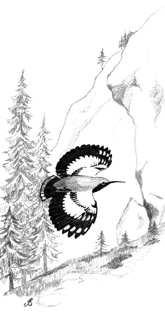
Hopefully, Wallcreeper will be the highlight of our morning in the Choské mountains.