Poland – birds in primeval forest and marshes
In recent years Poland has become a popular destination for birdwatchers from other parts of Europe. The undoubted main attractions have been the ancient, primeval forest at Bialowieza and the marshes at Biebrza, famous as the breeding grounds of Great Snipe and Aquatic Warbler.
While these areas are indeed very special and rewarding, the country as a whole has much more to offer, as we hope to demonstrate with this itinerary. Beginning in the extreme southeast of the country, where Ukraine, Slovakia, and Poland meet, we'll travel slowly north following the former Soviet border, taking in habitats that range from mountains and the majestic beech forest of the Carpathian uplands, to lower-altitude, mixed woodlands and steppe grasslands, before visiting the rich mosaic of habitats that make up the Bialowieza National Park. The tour finishes with a visit to the Biebrza marshes where we should see one of Europe's rarest birds, the Great Snipe.
Thursday 8 May to Sunday 18 May
with Stuart Elsom and a local guide as leaders.
 Poland bird list
return to Europe introduction
return to Calendar
Day 1: Our tour begins with a morning flight from London to Warsaw. We'll then drive south to the town of Przemysl among the foothills of the Carpathian Mountains. Night in Przemysl.
Day 2: This beautiful area is designated a Landscape Park, consisting of wooded hills and valleys providing us with a scenic start to our birdwatching. Although the birds around the hotel will whet our appetite, our first stop in the morning will be in the aptly named Eagle Valley, where we hope to see Lesser Spotted and Golden Eagles and with luck Corncrake, Black Stork, and River Warbler. In the afternoon, we'll drive deep into the mountains close to the southern border of Poland to Bieszczadzki National Park. This impressive area is by far the best place to search for Ural Owl, and since we will spend two nights in our hotel we'll have ample time to seek out this particular species. Night in Bieszczadzki.
Day 3: We'll spend the whole day in and around Bieszczadzki exploring the impressive beech woodland. Here we hope to see a variety of montane and woodland species such as White-backed, Syrian and Grey-headed Woodpeckers, Nutcracker, and perhaps upland species such as Ring Ouzel. In the evening we'll have the opportunity of searching for owls again. Night in Bieszczadzki.
Day 4: Today we must leave the mountains and head north, visiting several excellent birding locations on the way, including the first of many fishponds, home to nesting Red-necked and Black-necked Grebes, migrant waders, Marsh Harriers, White-winged Black, Whiskered and Black Terns, Marsh and Great Reed Warblers, and hopefully the impressive White-tailed Eagle. Night in Lubelski.
Day 5: Our destination today is Chelm, which we'll reach around mid-afternoon. On the way, we'll call in at the 16th century town of Zamosc to admire its fine buildings and to search for Syrian Woodpecker, which sometimes nests in this region. Moving on, we'll visit an area of open grassland to look for Spotted Suslik, and perhaps check more fishponds before reaching the hotel. We'll spend the late afternoon and early part of the evening walking along a track that overlooks a large marsh. Here Montagu's Harriers quarter the vegetation and we may well witness an aerial food pass between a nesting pair. However, the main reason for visiting this site is to see one of Europe's rarest passerines - Aquatic Warbler. As evening approaches we should see these delightful birds singing from the tops of reed stems. A few Great Snipe also nest, and we could well get our first glimpses of this other Poland speciality here. Night in Chelm.
Day 6: Our drive north to the mighty Bialowieza Forest will again be broken with birding stops. More fishponds en route may hold White-tailed Eagle, Penduline Tit and maybe even Little Crake. At the River Bug we'll walk along the sandy banks looking for terns, migrant waders, and Woodlark, and we may find the odd rarity. This area is also excellent for butterflies and other insects. Night in the Bialowieza area.
Days 7-8: We'll spend two days exploring the famous Bialowieza Forest and surrounding areas. The Polish part of this ancient woodland covers 580 square kilometres and during gentle walks around the numerous trails we should encounter Pygmy Owl, Black, White-backed, Grey-headed and Middle Spotted Woodpeckers, Thrush Nightingale, Collared and Red-breasted Flycatchers, and numerous Hawfinches. Hazel Grouse and Tengmalm's Owl occur in the forest, although careful searching is required to find these elusive birds. We may even catch sight of a few European Bison in this, their last European stronghold.
One day we'll travel to the northern part of the forest to visit the extensive Siemianowka reservoir. Here we'll look for brightly marked Citrine Wagtails picking their way around the lake edge and striking Barred Warblers performing their frantic aerial display flight. This part of Poland is remote, and ancient farming methods, unchanged for centuries, produce a wild and attractive countryside. Nights in the Bialowieza area.
Day 9: Our final destination is the Biebrza marshes, but our journey there will be broken by a visit to a lower part of the massive drainage system in the floodplain of the River Narew. Here we'll have a traditional Polish lunch in a village so isolated that it is not even on most maps! After lunch we'll take to the water on wooden punts and explore the maze of channels that wind through the reedbeds and willow carr. European Beavers thrive in this habitat and we'll see some of their huge domed lodges or holts. After this relaxing interlude we'll continue towards our hotel near the marshes. Night in the Biebrza area.
Day 10: The Biebrza river is the only river in Europe that still has a natural flood plain. Each winter as the river floods the waters spread out to inundate a huge area, creating a unique mosaic of habitats from open water to reed beds, willow scrub, flooded meadows and wet alder forest, a good place to search for the striking Common Rosefinch. A small escarpment marks the southern boundary of the marshes, and we'll call in at a spectacular viewpoint during our stay here so we can truly appreciate the extent of this wilderness.
This magical place is as much about sounds as it is about sights. An early morning or evening visit to any of these habitats will bring the sound of trumpeting Cranes or booming Bitterns to our ears, along with the haunting aerial display calls of Black-tailed Godwits and Redshank, drumming Snipe, reeling Savi's Warblers, and the sweet song of Ortolan Buntings. In the evening we'll stand on a wooden platform, overlooking a small marsh that for countless years has acted as a gathering place for Great Snipe. Again it will be their strange clicking call that we'll first notice before we catch sight of the lekking males, puffing their chests out in a frantic attempt to attract a female.
If the water levels are right we'll be treated to the sight of clouds of White-winged Black Terns and perhaps Little Gulls dancing over the wetlands, or we might marvel at a Hobby lazily plucking dragonflies from the air. White Storks are simply everywhere and in some villages we'll pass through, there will seem to be a nest on every building. Night in the Biebrza area.
Day 11: We'll drive back to Warsaw and catch a flight to London, where the tour concludes.
Cost £1190
Single Room Supplement £70
Maximum group size: 16 participants and 2 leaders.
Poland bird list
return to top of page
return to Europe introduction
return to Calendar
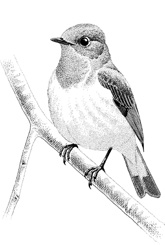
We should encounter
delightful Red-breasted Flycatchers in Bialowieza Forest.