Sultanate
of Oman – a land of beauty and contrasts
Oman, one of the most attractive, unspoilt and safe countries in the Middle East, was comparatively unknown to birdwatchers until just a few years ago. Pioneering exploration by a handful of dedicated resident birders, combined with the findings of an ever-increasing number of visitors, has revealed not only an extraordinary wealth of bird life, but also an exceptionally pleasant, welcoming and relaxed atmosphere in which to enjoy them. Located on the southern tip of the Arabian Peninsula, and with over one thousand miles of coastline, Oman's varied habitats host a diverse selection of birds with significant elements of Palearctic, Oriental and Afrotropical avifaunas. Offshore, its clean, fish-rich waters support an abundance of breeding and over-summering seabirds, quite a few of which should be present at the time of our tour.
We will spend most of our first week in the north of the country, and the remainder in the somewhat more tropical 'Dhofar' region in the far south. Throughout, we will avail of the high standard of accommodation available in Oman, and we can look forward to a varied, but always fresh and appetising cuisine.
Saturday 2 November to Saturday 16 November 2002
Saturday 1 November to Saturday 15 November 2003
with Killian Mullarney as leader.
 Oman bird list
return to Europe introduction
return to Calendar
Day 1: The tour will start with a flight from London to Muscat,
the capital of Oman. Night at Al Sawadi, an hour's drive north of Seeb
airport.
Day 2: Our hotel is located within walking distance of a long, sandy beach where we can expect to find an exciting selection of waders, gulls, terns, and a few skuas. Sooty Falcons breed on a small island a few hundred yards offshore and, while the majority will have already departed, there is a chance we'll find one or two lingering birds. For those with a head for heights, the commanding view from the precipitous cliff-top at the eastern end of the island provides an irresistible opportunity to observe turtles, graceful manta-rays and even the occasional shark in the clear, emerald green water below. If we are very lucky we could see a Red-billed Tropicbird patrolling these cliffs. Back on the shore, we'll find mixed flocks of Crested and Lesser Crested Terns, and among the flocks of barabensis-type Yellow-legged Gulls we should find a few Great Black-headed Gulls. This is a good place to study Greater and Lesser Sandplovers side-by-side, and there are usually a few Terek Sandpipers among them. The small bushes above the tidal flats may well produce the first Steppe Grey Shrike of the trip. Night at Al Sawadi.
Days 3-5: We'll have another opportunity for some early morning birding around Al Sawadi before we head north for Sohar, our base for the next three days. The drive will be enlivened by frequent sightings of stunningly iridescent-winged Indian Rollers, launching themselves from lamp-post lookouts to catch unsuspecting prey. Our primary destination in the Sohar area is the government-controlled 'Sun Farm', a haven for birdlife. We'll make several visits to this area and among the birds we'll expect to see are Montagu's and Pallid Harriers, Spotted and Eastern Imperial Eagles, Grey Francolin, Pacific Golden Plover, White-tailed and Red-wattled Lapwings, Cream-coloured Courser, Chestnut-bellied Sandgrouse, Whiskered and White-winged Black Terns, European Roller, Black-crowned Finch-Lark, Bimaculated Lark, White Wagtail of the handsome race personata, and Indian Silverbill. This area has also produced an impressive list of rarities ranging from Long-billed Dowitcher to Blyth's Pipit, so we'll be keeping our eyes open for something unusual.
On one day we'll start early and drive north to Khatmat Milahah, close to the border with the United Arab Emirates. The natural acacia forest here hosts two specialities of the region in winter, the appropriately named Plain Leaf Warbler and the more exotic-sounding Eastern Pied Wheatear. While searching for these, we are likely to encounter Black Redstarts, Desert Lesser Whitethroats, Purple Sunbirds, and perhaps a few Great Grey Shrikes. Later, we'll visit the mangroves around Shinas Lagoons where we'll look for the elusive White-collared Kingfisher (of the globally threatened race kalbaensis), Striated Heron, and 'Sykes's' (Booted) Warbler. This is the spot in Oman where most records of the rare Great Stone Plover have occurred. Who knows, there just might be one around! Nights in Sohar.
Day 6: Today, we'll return south to bird sites close to the capital, Muscat. We'll include a (brief!) visit to Lansab rubbish dump, an excellent spot for close-range viewing of eagles and vultures, where, among the assembly we'll hope to see the magnificent Lappet-faced Vulture. The surrounding rocky slopes are a good place for the handsome resident Hume's Wheatear, as well as the wintering eastern chrysopygia form of Red-tailed Wheatear. We'll also visit the productive Al Ansab Lagoons, a good site for Black-necked Grebe, Ferruginous Duck, Spotted Eagle, crakes, White-tailed Lapwing, Citrine Wagtail, Clamorous Reed Warbler, Isabelline Shrike, and Ménétries's Warbler. We'll return here in evening time to see Lichtenstein's Sandgrouse coming to drink, and if we are very lucky we may see Egyptian Nightjar. Night in Muscat.
Days 7-14: Our flight to Salalah, at the opposite end of the country, passes over 1,000 km of desert before touching down in quite different surroundings to those we became acquainted with in the north. Swathes of tall coconut palms along the coast and extensive drought-deciduous forest on the nearby mountain slopes are indicators of monsoon rainfall influence in this region in the summer months. Salalah, on the edge of the Arabian Sea, is the ideal place to base ourselves for the next eight days.
There is a distinctly Afrotropical element to the bird life in this area, as evidenced by the presence of birds such as Rüppell's Weaver, African Silverbill, and the extraordinarily flamboyant African Paradise Flycatcher. We'll find an exciting mix of indigenous species and Palearctic migrants, including Grey-headed Kingfisher, Blue-cheeked Bee-eater, Hoopoe, Bluethroat, Desert Wheatear, Arabian Warbler, Shining Sunbird, White-breasted White-eye, Black-crowned Tchagra, Fan-tailed Raven, Yemen Serin, and African Rock Bunting. At Ain Razat, we'll scan carefully through the fruiting trees in search of the exquisitely patterned - but extremely well camouflaged - Bruce's Green Pigeon, and we'll keep a constant eye on the impressive cliff facade, in case a Verreaux's Eagle should drift past.
A series of natural lagoons, or 'kwahrs' both east and west of Salalah host an abundance of birds at this time of year. Indian Pond Heron, Glossy Ibis, and Pheasant-tailed Jacana are common, while careful checking should produce Intermediate Egret, Cotton Teal, Baillon's Crake, Pintail Snipe, Long-toed Stint, and Steppe Grey Shrikes.
At almost any point where we stop along the miles of sandy beach there will be gatherings of Sooty Gulls and, predominantly, Siberian (Heuglin's) Gulls. Less numerous, but still quite easy to see are Gull-billed and Caspian Terns, while careful checking of the numerous Common Terns will be required to pick up White-cheeked Tern. We'll also find Socotra Cormorants just offshore, sometimes in large gatherings. We'll seawatch from headlands and should see such exotics as Jouanin's Petrel, Persian (Audubon's) Shearwater, and Masked Booby, and with a little luck we may find Pale-footed Shearwater, Wilson's Storm-petrel, or Brown Booby. We'll leave the Dhofar area on one of these days, drive north into the desert and spend a night at Quitabit. From there we'll set off early the next morning for Montasar, an oasis where we should find lots to look at, including Golden Eagle, three species of sandgrouse, Bar-tailed Desert and Hoopoe Larks, Desert Warbler, and perhaps Lanner.
Day 15: All good things must come to an end! After a last look at the Arabian Sea and its birds, we'll catch a flight to Muscat. A connecting flight will take us back to London, where the tour concludes.
Cost £2690 (2002)
Single Room Supplement £220
Cost £2740 (2003)
Single Room Supplement £230
Maximum group size: 14 participants and 2 leaders.
Oman bird list
return to top of page
return to Europe introduction
return to Calendar
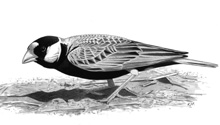
Black-crowned Finch-lark will be just one of many birds at the 'Sun Farm' near Sohar.