Hungary – the western edge of the Asian steppe
For many years now Bryan's Slovakia 'Birds and Bears' tour has been very popular. But the one complaint is always 'What a pity it only lasts a week'. To satisfy this demand, Bryan has organised a further week in Hungary which can be taken as an extension to see many different birds. Or of course it can be enjoyed as a spring break on its own. In 2001 the combined Slovakia and Hungary trip tallied 222 species - a record for any bird tour of the two countries. But in 2002 the total was 229, another new Carpathian basin record, with 200 in Hungary alone.
Hungary is incredibly rich in habitats that have all but disappeared from the rest of Europe and as such has much to offer the visiting birdwatcher. It is here that the vast Asian steppe reaches its western border. This once-continuous sea of grass, lakes, and marshes was the stage for some momentous historical events, most notably the spread of the Golden Horde out of Asia that led to the establishment of one of the largest empires the world has ever seen. A unique fragment of this habitat can still be found in the Hortobágy National Park. Here, magnificent Great Bustards still roam, while the huge wide-open skies are the domain of such raptors as Saker, Long-legged Buzzard, and White-tailed Eagle.
We will experience a dramatic change in habitat when we turn our attention to the foothills of the Carpathian Mountains. This quiet landscape of low hills, forested slopes, beautiful valleys, and meandering rivers is dotted with tiny villages and fine castles which all combine to create an unforgettable atmosphere of peace and tranquillity. Here we can find some very special birds, including the massive Imperial Eagle, Ural and Eagle Owls, up to nine species of woodpecker, and a host of passerines including Collared Flycatcher and Hawfinch.
Monday 5 May to Monday 12 May
with Bryan Bland
and Zoltán Escedi as leaders.
 Hungary bird list
return to Europe introduction
return to Calendar
Day 1: Our tour starts in London with a flight to Budapest. Within
an hour of leaving the airport we could be watching Great Bustards displaying
while Collared Pratincoles fly around, with Rollers on the wires and Red-footed
Falcons on the bushes. After dinner at our nearby hotel in the Kiskunság
National Park we might add Nightjar and Scops Owl.
Day 2: After an early breakfast we'll visit the nearby Szegedi Feherto, an extensive lake and fishpond system. This is home to all the European herons as well as the largest Hungarian nesting colony of Mediterranean Gull. The reeds will be full of singing passerines including Bluethroat and Savi's Warbler, plus Bearded and Penduline Tits. We'll have our lunch in a nearby goulash restaurant. Then we'll drive to Kardoskut Nature Reserve to look for more waterbirds and waders including perhaps some late migrating Cranes. Night in Kiskunság National Park.
Day 3: After breakfast we'll drive towards the famous Hortobágy National Park. On the way we'll stop at the organically rich ponds of the Kaba Sugar Factory with breeding Avocet and Black-winged Stilt. Amidst the ancient steppe of Hortobágy, with its mosaic of small woods and wetlands, we'll look for a variety of birds including Black-necked and Red-necked Grebes, Bittern, White-tailed Eagle, Long-legged Buzzard, Goshawk, and Saker. A local Rook colony usually holds a few pairs of Red-footed Falcons, while Lesser Grey Shrikes should also be breeding nearby. Night in Balmazujvaros.
Day 4: We are staying in the heart of the Hortobágy and early morning is the best time to find more Great Bustards striding through the short grasslands. This habitat is also ideal for Montagu's Harrier, Stone-curlew, and Tawny Pipit, while the marshy depressions are a favoured nesting area for Aquatic Warbler. Our main destination today is the Hortobágy fishpond, the birding Mecca of the national park. Observation towers (including one sponsored by Sunbird) allow one to search this wonderful habitat in comfort and it is possible to see more than a hundred species in a day. Great White and Little Egrets, Purple, Night and Squacco Herons, Spoonbill, and Glossy Ibis are all to be found here, while searching through the noisy Cormorant colony should reveal some smaller Pygmy Cormorants. All three marsh terns will be much in evidence, the first Great Black-headed Gulls should already have arrived and the occasional Caspian Tern is usually present among the sleeping gulls. Bearded and Penduline Tits should be active among the reeds and willows, as should lots of stunning Bluethroats. There are a good number of Short-eared Owls at the southern side of the fishponds, and with luck we may see them hunting before we take our dinner in an old country restaurant at the famous historical bridge on the Hortobágy river. Night in Balmazujvaros.
Day 5: After breakfast we'll do some final birdwatching on the Hortobágy steppe and then drive to the Great Wood of Debrecen to look for Short-toed Treecreeper and Middle Spotted Woodpecker. Our destination today is the small town of Tokaj, famous for Tokaj white wine, and we'll spend the next three nights here as a base for exploring the Zemplen hills. This wonderful mosaic of small peaks, forested slopes, beautiful valleys, and rivers meandering through countryside dotted with tiny villages and castles, creates a magical landscape. Oak and beech woods clad the northern slopes, coniferous forests cover the tops, and the wineries of the famous Tokaj wine stretch out to the south. There are several old quarries in this region and here we'll hope to find Eagle Owl, European Bee-eaters, and even Rock Thrush nesting. Night in Tokaj.
Day 6: One of the special birds of the protected tranquil forests of the Zemplen valleys is the Ural Owl. Our local guide here has spent a long time studying this bird and should have no trouble in finding one for us. This is prime woodland and we should also see Black, Lesser Spotted, Middle Spotted, Great Spotted, White-backed, and Grey-headed Woodpeckers here. Collared Flycatchers will be nesting in the trees and Hawfinches frequent the clearings, while Green and Syrian Woodpeckers live near the many small settlements. Scops Owl and Nightjar could bring our day to a close. Night in Tokaj.
Day 7: This morning we'll go birdwatching along the open valleys looking for Lesser Spotted, Short-toed, and Imperial Eagles and we may also see Saker and Honey-Buzzard. At the end of the day we'll stop at the floodplain meadows of the River Bodrog where the first Corncrakes should already be calling and Barred and River Warblers will be creeping through the willows. We'll combine our final meal together with a wine-tasting in one of the famous old cellars. Night in Tokaj.
Day 8: After an early breakfast we'll leave this remarkable area to drive to the airport along the northern foothills, birdwatching as we go. We may have time for some sightseeing in the capital, Budapest, before we catch our return flight to London, where the tour ends.
Cost £1290
Single Room Supplement £100
Slovakia and Hungary combined £2360
Single Room Supplement £220
Maximum group size: 16 participants and 2 leaders.
Hungary bird list
return to top of page
return to Europe introduction
return to Calendar
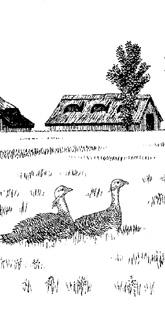
Great Bustards still roam the plains in the Hortobágy National Park.