Lesvos – spring migration through the Aegean
So, how did such a sensational birding spot, and a Greek island at that, remain so unappreciated for so long? Whatever the reason, Lesvos is now firmly established as one of the most bird-rich and stunningly attractive locations in Europe for observing spring migration. In spite of being one of the largest islands in the Aegean Sea (second in size only to Crete) and having an international airport at Mytilini, Lesvos has remained remarkably unspoilt; one suspects that large parts of the island have changed little in the past hundred years.
Its rich tapestry of habitats, ranging from rocky mountains, forested hills, and stony uncultivated sheep pasture, through to more fertile lowlands planted with figs and olive groves, ensures an exciting variety of migrant and resident landbirds, including two specialities which breed, Krüper's Nuthatch and Cinereous Bunting. Along the coast there are salt pans, pools and river margins that act as magnets for the many waterbirds that stop off on migration. Our hotel is located at the quiet, scenic resort of Skala Kalloni very close to a number of the island's most rewarding birding spots and is also well positioned for visits to the more peripheral sites.
Note: We have extended this tour by one day at the beginning give us an extra days bird watching. We are also using large 9-seater minibuses brought over especially from the mainland. These are much better than the small cramped vehicles only available on the island.
Friday 18 April to Saturday 26 April
with Killian Mullarney and Ian Lewington as leaders.
 Greece (Lesvos) bird list
return to Europe introduction
return to Calendar
Day 1: The tour begins with a flight from London to Athens, from
where we'll take a connecting flight to Mytilini airport on the island
of Lesvos. We'll proceed directly to our hotel at Skala Kalloni. Depending
on the time of our arrival we may have time for some evening birding in
the vicinity of our hotel. Night at Skala Kalloni.
Days 2-8: Since we'll be located at the same hotel for the whole week, each day's itinerary will be very flexible and the pace relaxed. We can expect to see in excess of 140 species of bird and the main objective will be for everyone to get good views of them. For those who wish, there will be plenty of informal guidance on improving identification skills.
Our ideal location gives us great scope for optional pre-breakfast birding. On some mornings there will be no need to go any further than literally across the road from our hotel to sample the delights of what is known as 'Kalloni Two pool'. Depending on the water level the pool is attractive to a variety of waders including Little and Temminck's Stints, Wood Sandpiper, and Little Ringed and Kentish Plovers; even when the water level is high it is never too high for the ubiquitous Black-winged Stilts or the more secretive Purple Herons. The early morning can be an especially good time for observing newly arrived migrants and on the best days the bushes in this area can be almost jumping with warblers, chats, and shrikes.
After breakfast we'll travel further afield to one or more of the island's particular birding localities, few of which are more than an hour's drive away. Most days we'll take an appetising picnic lunch with us and thus avoid having to leave good birding spots to drive to the nearest town for lunch. On some days, we may return to the hotel in the afternoon and, after a break, go back out for some more local birding before dinner.
During the course of the week we'll undoubtedly make several visits to the East River, only a few minutes drive from the hotel but one of the best birding spots on the island. The elevated tracks that run alongside the river on both sides provide an excellent vantage from which to view the abundant birdlife. Squacco Herons, Little Bitterns, Purple Herons, and Spotted and Little Crakes lurk in the thickly vegetated margins while confiding White Storks, Glossy Ibis, and Little Egrets forage out in the open. The bushes surrounding the scented wild-flower meadows on either side are liberally scattered with Woodchat Shrikes, Whinchats, and other migrants while the background sound is dominated by the 'fuzzling' song of numerous Corn Buntings.
Another site we are sure to visit more than once is the nearby Kalloni salt pans, the most productive wader habitat on the island. At this time of year Wood Sandpipers, Little Stints and Ruffs predominate, but Curlew Sandpiper, Temminck's Stint, Stone-curlew, Collared Pratincole, and Marsh Sandpiper all occur and Broad-billed Sandpiper is a possibility. The cultivated fields and rough pastures adjacent to the pans are excellent places for migrant Red-footed Falcons and we can expect to see small gatherings of these attractive birds perched up on the telegraph wires.
When we feel like a complete change of scenery we can visit the shady pine forests around Achlederi, a stronghold for one of the island's specialities, the handsome Krüper's Nuthatch. This can be a difficult bird to locate but we should find plenty to interest us while we search, including Short-toed Treecreeper, Masked Shrike, Subalpine Warbler, Serin, and the distinctive local race of Long-tailed Tit.
When we visit the western end of the island around Eressos and Sigri we'll notice that the habitat is distinctly more barren, but no less beautiful and every bit as exciting for birds. This is good wheatear country, Black-eared and Northern being abundant, but with a few pairs of more discreetly plumaged Isabelline Wheatears here and there. Rock Nuthatches, singing Woodlarks, Cretzschmar's Buntings, and Rock Sparrows provide added interest while we look for that other island speciality, Cinereous Bunting. A narrow fertile strip just north of Sigri has proved to be an excellent migrant trap, and there is a good chance of finding some of the scarcer species such as Red-throated Pipit and Collared Flycatcher here.
The northern parts of the island around the picturesque towns of Petra and Molivos present yet another habitat and some interesting birds that we may not encounter elsewhere. Here we'll look for Rüppell's Warbler, Blue Rock Thrush, and early-returning Eleonora's Falcons. We will keep a close eye on the gulls as we follow the coast east of Molivos, the best place on the island for seeing Audouin's Gulls, as well as Yelkouan and Cory's Shearwaters.
Perhaps the most appealing aspect of birding on Lesvos is the volume of migration and the variety of species, which at its height is quite spectacular and all the more impressive for the splendid unspoilt surroundings. Every spring produces its own mix of species and includes one or two unexpected rarities. Our week on this beautiful island is certain to be very enjoyable.
Day 9: We'll catch a flight back via Athens to London, where the tour ends.
Cost £1190
Single Room Supplement £70
Maximum group size: 14 participants and 2 leaders
Greece (Lesvos) bird list
return to top of page
return to Europe introduction
return to Calendar
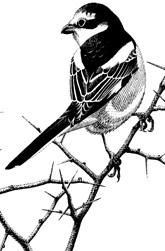
Lesvos is a very reliable site for the graceful Masked Shrike.