Finland and Arctic Norway – the ultimate tour of northern Europe
This exciting tour runs at absolutely the optimal time not only to give the best possible chance of finding the northern owls but also to see the excellent line-up of other resident species and summer visitors, many of which are difficult to find elsewhere in Europe. Just before or just after, and either some of the owls or some of the migrants become very hard to find. We'll begin in Finland, land of over 180,000 lakes and the westernmost outskirts of the vast Siberian taiga forest. Finland provides a unique wilderness setting for a birdwatching tour, and many migrant birds will be just arriving at their remote arctic breeding areas, making several species a little easier to find than later in the summer, although those annoying mosquitoes will not yet be active.
Among British birdwatchers Finland is best known for the northern species which seldom venture farther south. These include most of Europe's scarcer owls and on this tour we'll concentrate on finding these and the other Finnish specialities. Among the birds we hope to see in northern Finland are Hawk and Great Grey Owls, Hazel Grouse, Capercaillie, Three-toed Woodpecker, Siberian Tit, Siberian Jay, and we may, if we are very lucky, find Pine Grosbeak.
Farther north still, in fact as far as it is possible to go on the European mainland, we'll visit the unspoilt Varanger peninsula on the edge of the Barents Sea. Here we'll experience the full beauty and diversity of arctic birdlife, and there will be opportunities to gain a new perspective on many species normally encountered in Britain only as passage migrants or winter visitors.
The final leg of the tour will be in the south of Finland where we'll have further chances of owls, including Ural, Tengmalm's, Pygmy and Eagle Owls, as well as Grey-headed and Black Woodpeckers.
Tuesday 20 May to Tuesday 3 June
with Dick Forsman
and Killian Mullarney
as leaders.
 Finland and Norway bird list
return to Europe introduction
return to Calendar
Day 1: The tour starts with a flight from London to Helsinki and
a connecting flight to Ivalo, in northern Finland. After checking into
our hotel and sampling some Finnish hospitality, we'll take advantage
of the long, bright evening and go out for a short excursion to one of
the wonderful untouched bogs close to town. We can expect to find gatherings
of ornately plumaged Ruffs performing their extraordinary lekking routine,
while the sight and sound of displaying Temminck's Stints, Whimbrels,
Golden Plovers and ebony-coloured Spotted Redshanks will contribute to
the distinctly 'arctic' atmosphere! Night in Ivalo.
Day 2: Ivalo is surrounded by a mosaic of taiga forest as well as bog, and this is where we'll hope to find our first Siberian Jays and Siberian Tits. Both can be elusive at this time of year, but neither is anything like as difficult to find as the ultra-unobtrusive Pine Grosbeak! The latter is without doubt the most difficult-to-see of Finland's breeding species, but as we'll spend plenty of time within its range we'll certainly not spare any effort in trying to find one! Around mid-morning we'll drive north to Utsjoki, the northernmost town in Finland, stopping along the way to look for Black-throated Divers, Bluethroats, and Lapland Buntings while keeping an eye on the sky for the occasional Rough-legged Buzzard. Depending on the year, we may have a chance of encountering some of the nomadic northern birds such as owls, Waxwings, and crossbills. Night in Utsjoki.
Days 3-5: We'll continue north and cross into Norway. The waters of Varangerfjord are only an hour's drive from Utsjoki and on the way we'll try to locate a flock of Bean Geese, which are occasionally accompanied by a Pink-footed Goose or two. At the beginning of the fjord, known as Varangerbotn, we should have good views of Velvet Scoters, while in among the numerous Common Eiders close to shore we can expect to find small parties of engaging Steller's Eiders. The shores of Varangerfjord can hold concentrations of waders at this time of year, including Temminck's Stint, numerous Purple Sandpipers and handsome Bar-tailed Godwits in full breeding plumage. If the migration is early we may see a Little Stint or two, and the first Red-necked Phalaropes should arrive any day. As we continue eastwards towards the open sea we'll encounter majestic White-tailed Eagles, often very close to the road, waiting for an opportunity to snatch a fish - or more often an unfortunate duck - from the surface. We'll make several stops to look for King Eiders, while the coast between Vadsö and Vadsö is also where we are most likely to find the rare White-billed Diver, most of which are in stunning breeding plumage at this time of year.
We'll have plenty of opportunity to birdwatch around Vadsö, where virtually any roadside stop can provide breeding Red-throated Diver, Shore Lark, Arctic Redpoll, or Snow Bunting, while small parties of Arctic Skuas perform aerobatic displays overhead. We'll have at least one evening excursion in search of Snowy Owl, but even here this is a rare and very elusive bird. Evening-time is when we are most likely to see and hear its preferred prey in this area, Willow Grouse, still in its mainly white winter plumage. We'll visit the remote outpost of Hamningberg, where we can expect to find Glaucous Gulls, and possibly Iceland Gull, with the gull flocks, and where we'll have further chances of seeing White-billed Divers. On one morning we'll make the very short boat trip to the spectacular bird-cliffs on the offshore island of Hornöya, where we'll enjoy close views of five species of auk, including rare Brünnich's Guillemots and colourful Puffins. Nights in Vardö.
Day 6: After breakfast we'll drive slowly back along the fjord, stopping on the way to look for any freshly arrived Red-throated Pipits, and to take a last look at the wonderful Steller's Eiders. Night in Utsjoki.
Day 7: Driving south, we'll re-enter forest as we reach Saariselkä and will stop in suitable habitat for special taiga birds such as Broad-billed Sandpiper, Jack Snipe, Siberian Tit, Siberian Jay, and any owls that might be around. We may also see Dotterel and Rock Ptarmigan in this region. Night in Saariselkä.
Day 8: The vast forests and boglands of Finland are ideal habitat for grouse, and today we'll have an early start to give us the best possible chance of seeing the giant of them all, the normally rather shy Capercaillie. Black Grouse is a much commoner and more easily seen species, but lekking males are always a beautiful sight. From here on we'll be availing of every opportunity to see the highly sought-after Hazel Grouse. The 'old' forest near Luosto is a good place to look for Three-toed Woodpecker, so if we haven't already seen any we will search for them here. Rustic Buntings are early arrivals and will already be nesting, and we will hope to find one or two that are not too skulking. The forests here are as good a place as any to search for Pine Grosbeak, and in good years crossbills may be abundant. Night in Luosto.
Days 9-10: We'll visit some of Finland's finest bogs today as we drive to Kuusamo, close to the Russian border. Along the way we'll be passing through prime Hawk Owl terrain and if we are lucky we may see one perched on a roadside tree or telegraph pole. On the extensive wetlands we'll be keeping an eye open for Bean Goose, Smew, and Common Crane, all of which breed here.
The forests, bogs and lakes around Kuusamo support a wealth of birdlife including most of the species we hope to see while we are in the north. We may see more Three-toed Woodpeckers, Siberian Tits, Siberian Jays, Rustic Buntings, and Little Buntings here, and at various bogs we'll have the opportunity to appreciate the wonderful sight and sound of displaying Little Gulls, and breeding waders such as Jack Snipe, Spotted Redshank, and Ruff - all looking and sounding very different from the impressions we gain of them on passage and in winter. The steep forested slopes of Valtavaara are usually home to a couple of pairs of Red-flanked Bluetails, and we will devote some energy to trying to get views of this very special bird. Nights in Kuusamo.
Days 11-12: After a final morning birding around Kuusamo, where we'll doubtless have time for at least one visit to the town dump, a good place for Larus (fuscus) heuglini (the so called 'Siberian Gull') we'll drive south to the coastal town of Oulu (pronounced 'Oh-loo', in case you were wondering!). This is where we are likely to find some of the most eagerly anticipated of all our target birds, the owls; Great Grey, Ural, Tengmalm's, Pygmy, and of course Short-eared Owl can all be found here and seeing them will be our highest priority. We will see Ortolan Bunting in the agricultural fields, there is a chance of hearing (and maybe even seeing) Corncrake, and this is one of the only places in Finland where it is possible to see Rook! Around Oulu port we'll look for Terek Sandpiper which, with only around 15 breeding pairs in the whole country, is one of Finland's (and Europe's) rarest breeding species. Nights in Oulu.
Days 13-14: We'll have time for some morning birding around Oulu before flying back to Helsinki. After checking into our hotel we'll visit a small wetland on the outskirts of the city, where among the abundance of commoner waterbirds we'll see Slavonian Grebes in their beautiful breeding plumage. Common Rosefinches and Thrush Nightingales will be singing strongly from the surrounding scrub, and if it's not too windy we'll have a good chance of seeing Great Reed Warbler.
We will have an early start the following day, in order to get the most out of a day spent further afield in the company of the legendary Finnish birdman and forester, Pekka Pouttu. Pekka, who seems to know virtually every bird in his 'patch', has been instrumental in attracting more owls to the area through the provision of nest boxes, which augment natural cavities in trees. In years where owls have been scarce or absent in the north there may be better chances of finding Ural, Pygmy and Tengmalm's Owls down here, in the south. He may also be able to take us to see Red-breasted Flycatcher or possibly even a Flying Squirrel, a local speciality! Nights in Helsinki.
Day 15: We'll devote the best part of our last day to birding the outskirts of the city in search of late migrants such as Blyth's Reed, Marsh, Icterine, River, Barred, and Greenish Warblers, several of which can be studied simultaneously. We should have no difficulty seeing Red-backed Shrikes here, and we may well hear a Corncrake or two. With good birding right up to the end, it will be difficult to drag ourselves away but this we will have to do, in order to catch our late afternoon flight back to London, where the tour ends.
Cost £2880
Single Room Supplement £330
Maximum group size: 14 participants and 2 leaders.
Finland and Norway bird list
return to top of page
return to Europe introduction
return to Calendar
| Click on image to enlarge picture |
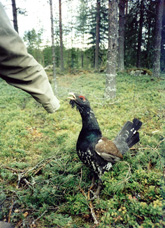
A displaying male Capercaille takes a liking to Killian's arm! Photographed in Finland by Peter ???.
| . | ||