Jamaica
With at least 27 endemic bird species - more than any other Caribbean island - as well as a host of Antillean and Neotropical specialities, Jamaica offers some of the most exciting birdwatching in the West Indies. It is also the only island where one has a very good chance of seeing every endemic in a single week. The setting is distinctly tropical and as well as the endemic birds there will be abundant butterflies and striking reptiles to distract us. And let us not forget the utterly scrumptious local foods (such as ackee, callaloo, bammy, and the famous jerk recipes) and the chances here and there to dip into Jamaica's fascinating history and culture. We'll journey to the desert-like southern peninsula, spend three full days exploring the more lush and mountainous eastern end of the island, where a few more endemic species await us, and conclude our visit to this island nation with a stay at a charming hotel whose surroundings and birdlife perfectly complement our itinerary.
Friday 4 April to Saturday 12 April
with Rich Hoyer as leader.
 Jamaica bird list
return
to the Central American and Caribbean introduction
return to Calendar
Day 1: The tour starts in London with a flight, via Kingston, to
Montego Bay where we'll spend the night.
Day 2: In the morning we'll visit a series of pools near the airport, where we may encounter Clapper Rail, Wilson's Plover, and a variety of other waders. Following a stop at Rocklands Bird Sanctuary, we drive to Mandeville, a town situated on a plateau more than 2,000 feet above sea level, and to our home for the next three nights, Marshall's Pen.
Days 3-4: Marshall's Pen is set in a 300-acre estate and private nature reserve. Birds are numerous and easily seen, both in the gardens around the Great House and from the extensive trail system. The Marshall's Pen experience starts in bed, with the glorious song of the endemic White-eyed Thrush, and by lunch we may have seen almost 20 of Jamaica's endemic birds and several Caribbean specialities including Jamaican Tody, Orangequit, Jamaican Elaenia, Chestnut-bellied and Jamaican Lizard-Cuckoos, Jamaican Spindalis, and Sad Flycatcher. In the afternoon we'll drive to the Upper Black River Morass to spend the evening in the marshes, surrounded by Least Bittern, Purple Gallinule, and Northern Jacana. If we're lucky we might see Masked Duck, Yellow-breasted Crake, West Indian Whistling-Duck, or perhaps a crocodile waiting expectantly under the heron roost. One of the best parts of the day at Marshall's Pen is the evening meal outside on the veranda, the table full of delicious Jamaican food, and the diners surrounded by the sounds of the Jamaican night - the voices of Jamaican Owl, Northern Potoo, and myriad amphibians.
One day we'll rise early and drive into the Cockpit Country, home to several birds not found elsewhere on the island. We'll arrive in time to see the mist lift from the 'egg-box' hills which give the area its name, and more importantly, to view the early morning flights of Yellow-billed and Black-billed Parrots. The rugged karst formations here have been an effective deterrent to forest clearing, making the Cockpit Country some of the most pristine habitat in Jamaica. We'll look especially for Ring-tailed Pigeon, Stolid Flycatcher, and Jamaican Crow. We'll return to Marshall's Pen in the mid-afternoon offering a chance to bird the grounds of the property, travel into Mandeville, or simply rest. Nights at Marshall's Pen.
Day 5: We'll depart Marshall's Pen mid-morning for the radically different habitats of Portland Ridge. Here the arid acacia scrub resembles more East Africa than it does other parts of the island and is home to Bahama Mockingbird, Vervain Hummingbird, and Rufous-tailed Flycatcher. Later a search for waterbirds in the mangrove lagoons and northern migrants in the surrounding scrub will add to the day's interest. Night in Kingston.
Days 6-7: We'll depart early on the morning of day 6, driving north from Kingston through Hardwar Gap to Port Antonio. We'll spend the morning high in the Port Royal Mountains where as much as 100 inches of rain a year support a luxurious and fascinating vegetation - strange gnarled trees and a heavy growth of mosses, lichens and bromeliads - which in turn harbour some of Jamaica's most elusive specialities such as the splendid but secretive Crested Quail-Dove, the striking Rufous-throated Solitaire, and the unusual Jamaican Blackbird, the only member of its genus. After a picnic lunch we'll continue on to Port Antonio where our hilltop hotel offers a vista of the town, the Caribbean Sea and the Blue Mountains, amidst a lush, tropical garden.
From our base in Port Antonio, we'll spend a full morning in the Drivers River Valley where, if we've missed the quail-dove or the blackbird, we'll look again for them, and in our search we should also see Jamaican Woodpecker, White-chinned Thrush, Blue Mountain Vireo, Arrowhead Warbler, and Jamaican Oriole. The one bird found only at this end of the island (including on our hotel grounds) is the distinctive black-billed subspecies of the endemic Streamertail. Nights in Port Antonio.
Day 8: Our final day should allow a relaxed morning
to enjoy the beautiful and bird-filled hotel grounds where Ring-tailed
Pigeon, Ruddy Quail-Dove or Jamaican Lizard-Cuckoo may round off the trip
list. We'll make a stop at the spectacular sea cliffs of nearby Hector's
River, the nesting habitat of the equally spectacular White-tailed Tropicbird.
On the way to Port Royal we'll stop at Kingston Harbour where we'll look
for waders, gulls, and terns. After dinner we'll transfer to the airport
and catch an overnight flight back to London where the tour concludes
on day 9.
Cost £2020
Single Room Supplement £130
Maximum group size: 14 participants and 2 leaders.
The ground arrangements for this tour are organised
by our American associates WINGS.
Jamaica bird list
return to top of page
return
to the Central American and Caribbean introduction
return to Calendar
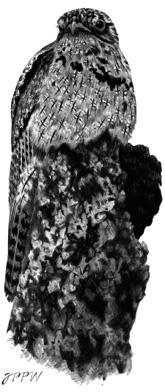
Our dinners at Marshall's Pen will be enlivened by the sounds of the Jamaican night including the song of the Northern Potoo.