Cuba is attracting a lot of attention these days from the general tourist market eager to sample its tropical beaches. However birdwatchers have largely overlooked this, the largest of the Caribbean islands, which is surprising considering the fabulous species that can be seen there. Of course most people know it for its cigars and its charismatic leader, Fidel Castro, and for its troubled relationship with the USA which reached its peak, more than 30 years ago, in the missile crisis and the Bay of Pigs fiasco.
Cuba remains a timeless, sleepy, tropical island with pleasing contrasts of golden beaches, dense forests, and rolling hills. It is also blessed with a unique avifauna, being home to more than twenty endemics, and it has achieved ornithological fame as the last possible refuge of the Ivory-billed Woodpecker. In addition to the island's endemic species there are also a number of distinctive races of mainland forms, and of course it is the only place to see the smallest bird in the world, the delightful Bee Hummingbird. Our tour is designed to offer the best chance of seeing the majority of the endemics and is also timed to coincide with the remaining wintering North American species and passage birds on spring migration.
Saturday 12 April to Thursday 24 April
with Séan McMinn and Arturo Kirkconnell as leaders.
 Cuba bird list
return
to the Central American and Caribbean introduction
return to Calendar
Day 1: The tour will start with a flight from London to Havana, via Madrid. On arrival we'll be met by our local guide and transferred to our hotel in Havana.
Day 2: We'll make an early start this morning and drive to La Guira National Park. This lush mix of tropical forest, interspersed with small stands of pine is home to many species including Scaly-naped Pigeon, Cuban Trogon, Cuban Solitaire, Cuban Tody, Olive-capped and Yellow-headed Warblers, and Western Spindalis. Here we also have a very good chance of seeing Gundlach's Hawk and, nearby, the endemic Cuban Grassquit. Night in Havanna.
Day 3: We'll leave Havana for the long drive to south-central Cuba and the town of Camaguey. We'll see a few birds on the drive and resident species should include the distinctive Cuban race of American Kestrel and the grotesque Smooth-billed Ani. At our lunch stop we might find some northern migrants such as American Redstart and other colourful warblers including Black-throated Blue, Magnolia, and Northern Parula. Night in Camaguey.
Day 4: We'll spend the morning near Najasa, where we'll look for one of the scarcer endemics - Giant Kingbird - and we'll also seek out other special birds of the area including Plain Pigeon, Palm and Cuban Crows, Cuban Parakeet, and Cuban Parrot. This is a rich area, and other endemic birds we expect to find are Cuban Green Woodpecker and Cuban Vireo. In the afternoon we'll visit Sierra de Cubitas, where we'll search the forest for Great Lizard Cuckoo and the brilliant Cuban Emerald, and have another chance of seeing the Cuban Trogon. Night in Camaguey.
Day 5: In the morning we'll make a second visit to Sierra de Cubitas where we'll concentrate on finding quail-doves. By walking the quiet back-trails in the early morning we'll hope to find Ruddy and Key West Quail-Doves, and also have a chance of seeing the scarce Blue-headed. In addition there will be a host of other interesting species to look for such as Cuban Martin, La Sagra's Flycatcher, Oriente Warbler, Cuban Bullfinch, and Cuban Blackbird. In the afternoon we'll drive to Cayo Coco, an island lying off the northern coast that was recently connected to the mainland by the construction of a remarkable 27 kilometre causeway. Night in Cayo Coco.
Day 6: We'll spend the day in this delightful coastal location searching for such specialities as Zapata Sparrow, Oriente Warbler, Thick-billed Vireo, Bahama Mockingbird, and Cuban Gnatcatcher, as well as a variety of waterbirds including Magnificent Frigatebird, Anhinga, Tricolored Heron, Roseate Spoonbill, and a variety of waders. We also have a good chance here of seeing West Indian Whistling-Duck. Night in Cayo Coco.
Day 7: Leaving Cayo Coco we'll drive south across the island to another coastal site, Playa Larga, situated on the Bay of Pigs. This is a fantastic area for birds and should be the ornithological highlight of the tour. Night in Playa Larga.
Days 8-11: Within reach of our hotel there is a wide range of habitats, mostly contained within the confines of the Cienaga de Zapata National Park. This peninsula consists of some 300,000 hectares of brush and plantations, almost 40,000 hectares of swamp and over 2,000 hectares of forest, and we'll visit several areas that require special entry permission. It is here that we'll look for species such as Fernandina's Flicker, Bare-legged Owl, and the world's smallest bird, the Bee Hummingbird, a real avian gem. Quail-Doves are also well represented here and include Grey-headed, and the sensational, endemic, Blue-headed, though they are shy forest creatures and never easy to see. We will also explore the Zapata area's vast network of waterways. As we explore the narrow canals and swamp we'll look for Limpkin and Green Heron, but our main quarry will be the rarely seen Zapata Wren, which occurs nowhere else in the world. After dark we'll venture out to look specifically for Stygian Owl, and Greater Antillean (Cuban) Nightjar. As it is often hot in this area during the middle of the day our birding activities will take place in the mornings and late afternoons, with pleasant mid-day breaks providing an opportunity to swim and relax at a typical beach resort. Nights in Playa Larga.
Day 12: After a final morning in Playa Larga we'll drive back to Havana in time to explore parts of Old Havana before catching our overnight flight to London, via Madrid.
Day 13: We'll arrive in London in the afternoon where the tour concludes.
Cost £2220
Single Room Supplement £140
Maximum group size: 16 participants and 2 leaders.
Cuba bird list
return to top of page
return
to the Central American and Caribbean introduction
return to Calendar
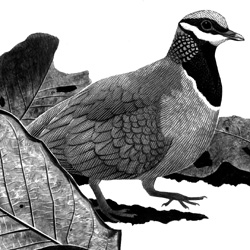
The sensational endemic Blue-headed Quail-Dove is a shy forest creature which is never easy to see.