India – birds and history
India - exotic, mysterious and intriguing - words that can as equally well be applied to the birds one finds there as to the country's fascinating history and culture. It is no surprise therefore that India is an ideal destination for a Birds and History tour. India has always been one of our most popular destinations, and for the last fifteen years we have offered up to three trips to Northern India each winter. This dual-interest tour has been designed to meet requests to provide something different and in particular to devote more time to exploring the history of this fascinating country. The common denominators of Agra, the Taj Mahal and Fatehpur Sikri remain (all 'musts' for the history buff), as does Bharatpur for its spectacular birdlife. But instead of heading north for Corbett and Nainital we'll explore the historical wonders of Jodphur, Jaipur, and Jaisalmer and the very different birdlife of the Thar desert. To add to the sense of adventure and the experience of 'the real India' we'll include one journey by rail.
Monday 18 November to Wednesday 4 Dec 2002
Monday 17 November to Wednesday 3 Dec 2003
with Bryan Bland as leader.
 India bird list
return to the 'Birds and…'
introduction
return to Calendar
Day 1: The tour begins with a flight from London to Delhi. We'll
arrive late in the evening and after clearing customs we'll transfer to
a Delhi hotel for one night.
Day 2: After an early breakfast we'll set out on our journey, calling in almost straight away at Okhla dam on the Yamuna River for our first birds. Despite its close proximity to the city, this area provides a good introduction to many typical northern India species such as Indian Pond Heron, Black-shouldered Kite, Common Peafowl, Ring-necked Parakeet, lndian Roller, Black Drongo, and Common and Bank Mynas. The area also holds huge numbers of wintering waterfowl. Stopping for lunch en route, we'll then drive to Agra. We may have time to visit Akbar's tomb as we enter the city, but certainly, after checking in to our hotel, we'll visit the Red Fort, the second-most famous site in Agra. Situated up-river from the Taj Mahal this truly impressive sandstone fort will be a fitting introduction to the might of the Moghul Emperors and will give us our first tantalizing glimpse of the Taj as the sun begins to set. Night in Agra.
Day 3: We'll start the day with an early morning visit to one of the world's great buildings, the Taj Mahal - 'no mere building but a love immortalised in marble'. The emperor Shah Jahan promised his wife, Mumtaz Mahal, that he would build her a tomb that would for ever remind the world of their great love. Arriving before most of the crowds, we'll take time to reflect on the sheer beauty of this stunning building and also to look for Large Green Barbet and Koel in the grounds, as well as Great Black-headed Gull and River Lapwing on the adjacent Yamuna River.
We'll then drive to the deserted sandstone city of Fatehpur Sikri. In the 16th century the Emperor Akbar moved his capital here to honour the mystic Salim Chishti, but the city was soon abandoned and the new capital became a ghost town. Today it is haunted by memories of a resplendent era and by Brown Rock Chats and Dusky Crag Martins. We'll then continue to Bharatpur for a late lunch and some birding before dinner. Night in Bharatpur.
Days 4-8: We'll stay at the comfortable Forest Lodge, inside the park, and for five full days we'll use it as a base from which to explore Bharatpur and the surrounding countryside.
Bharatpur was originally developed as freshwater marshes for duck shooting. Coaches are not allowed inside the reserve, so we'll explore the 29 square kilometres on foot, by bicycle-rickshaw, and in the park's electric bus. The pace will be relaxed and leisurely with plenty of opportunity to photograph the amazingly approachable birds. With the possibility of over 200 species ranging from Sarus Crane to Small Minivet, there will always be something to look at. On the water, Oriental Darter, Black-necked and Painted Storks, Intermediate Egret, and Cotton Teal will vie for our attention as we search for less-usual species such as Ferruginous Duck, Red-crested Pochard, and Greater Painted-snipe. In the trailside trees we'll look for Yellow-legged Green Pigeon, Coppersmith Barbet, Marshall's Iora, Common Wood Shrike, Asian Paradise Flycatcher, White-bellied Drongo, and Ashy Prinia. Beneath the bushes the slightest movement could herald a Bluethroat or, with luck, an Orange-headed Thrush or Siberian Rubythroat. In the sky above might be Spotted, Imperial or Crested Serpent Eagle. Dusk may bring us Collared Scops Owl, Dusky Eagle Owl or Indian Nightjar.
One morning will be spent visiting Jatoli Village on the outskirts of the park. This is an ordinary Indian village of the kind that most tours just pass by, which is a pity as our visit will provide us with a unique insight into the everyday life of the rural population. We'll also end one day by taking a boat ride out onto one of the larger jheels. This is a magical way to see Bharatpur and get close to many of the birds.
Other locations outside the park, which we sometimes visit, include Ajun Bund and Bund Barata where we have seen Ruddy Crake and Indian Courser.
For our history session, we'll take a private tour of Dig Palace, still used by the Maharajah of Bharatpur for official functions and with all its furniture and fittings intact down to working punkahs and combined Indian and Western style dining room. Nowhere else will we sense what life was really like in the day of the Raj. Nights in Bharatpur.
Day 9: An early start will ensure that we have time for a coffee break and a search for Yellow-wattled Lapwing on the way and still reach Jaipur in time for plenty of sightseeing. Jaipur, the capital of Rajasthan, is built of pink sandstone and was founded in 1727 by the astronomer-king, Sawai Jai Singh II. Our sightseeing will include the City Palace and Museum, which now contains rare manuscripts, paintings and an armory; the Observatory, built in the 17th century by Jai Singh, with a sundial nearly 30 metres high; and the Palace of the Winds, a landmark of Jaipur made of pink sandstone and of unique design. We'll also pause at the Water Palace, surrounded by Marsh Sandpipers and Black-winged Stilts. However the highlight will be an elephant-back ride to the top of the Amber Fort, built in the 17th century and a distinguished example of Rajput architecture. The Jai Mandir (Hall of Victory) is so delicately ornamented with fine inlay work that it glows. The fort of Jaigarh, crowning the summit of a peak, is of amazing beauty and grandeur. For those that wish, a ride to the top can again be arranged on elephant back. Night in a former palace in Jaipur.
Day 10: Today we transfer to Jodhpur and another palace, set in bird-rich grounds overlooking the oldest man-made lake in Rajasthan. We'll also explore the cenotaphs and avifauna of the nearby Manecore Gardens. Night in Jodhpur.
Day 11: After breakfast we'll depart for Jaisalmer calling in on the way at Kheechan to witness one of the most unusual avian sights in Asia. Several years ago this small village established a feeding station for wintering Demoiselle Cranes and now, every morning and afternoon, thousands of these graceful birds crowd in to a fenced-off area to take the grain put out for them. Continuing our journey westwards we'll keep an eye open for Tawny and Spotted Eagles, Long-legged Buzzard, and Pallid and Montagu's Harriers, which can be numerous in this part of India. As the day draws to a close, we'll get our first and never-to-be-forgotten glimpse of Jaisalmer rising from the golden sands of the Thar Desert. Legend traces the origin of this city to a prediction of Lord Krishna himself that a descendant of the Yadava shepherd clan would rule it. In 1156 Rawal Jaisal moved his capital here and built forts, palaces, and temples, establishing an important trading point for the caravans plying their trade with the West. Today it retains much of its original atmosphere with beautifully carved merchants' houses and the colourful bustle of street traders. Night in Jaisalmer.
Day 12: We'll begin the day by birdwatching around the outskirts of the town. The Thar Desert straddles the India-Pakistan border and many desert birds on the eastern edge of their range can be found here. At the man-made lake just outside the town we should see Chestnut-bellied and Black-bellied Sandgrouse coming to drink in the early morning. In the adjacent desert we'll search for Laggar Falcon, Cream-coloured Courser, Desert Warbler, Isabelline, Variable and Red-tailed Wheatears, Trumpeter Finch, and House Bunting. Although not particularly stunning to look at, the little-known Plain Leaf Warbler winters in this area and can sometimes be found flitting around the tall acacia trees. In the afternoon we'll explore the city, wandering its cool narrow streets, admiring its ancient buildings, and perhaps haggling with some local trader over the price of a rug or some local silverwork. Night in Jaisalmer.
Day 13: Providing we can obtain permission from the local authorities, we'll make a full day visit to the Desert National Park close to the border with Pakistan, leaving very early in order to arrive at the park for dawn. We'll also explore other desert habitats outside the park where we have our best chance for vultures since their catastrophic decline in numbers in the 90's. Established in 1980, the park covers 3,100 square kilometres. Some of the area is a classic desert of rolling sand dunes, with patchy scrub, trees and flowers, while other places are covered in sparse stony grassland. Animals to be seen include Chinkara, Wolf, Desert Fox, Indian Hare, and Desert Cat. The park is one of the strongholds of the Great Indian Bustard and a sighting of this magnificent bird would be the highlight of the day. We'll also look for the smaller Macqueen's Bustard, Spotted Sandgrouse, Bimaculated, Hoopoe and Short-toed Larks, Black-crowned Finch-Lark, Desert Wheatear, Isabelline Shrike, and Spanish Sparrow. Stoliczka's Bushchat, another little-known species, regularly winters in this area and we'll keep a sharp eye open for this desirable species. Night in Jaisalmer.
Day 14: This morning we'll drive back to Jodhpur, which stands on a range of sandstone hills surrounded by a wall nearly ten kilometres in length with a total of seven gates. Dominating the city is an eminence surmounted by a massive fortress (1459 AD). The walls of this rise up from a rocky base that made the fortress well nigh impregnable. Within the walls can be found royal palaces, priceless jewels, a striking collection of arms, and a breeding colony of Indian Long-billed Vultures. Our tour of Jodhpur includes visits to the fort, palaces, armory, and Jaswant Tara. Night in Jodhpur.
Day 15: The area around Jodphur is inhabited by the Bishnoi people. This community has developed a remarkable affinity with nature. They are strict vegetarians who go some way to protecting the wildlife on their land. This results in the birds and animals being even more approachable than they are in the rest of India and this is an excellent place to see the handsome and rare Blackbuck. Some of these protected areas are ideal for birds and we'll search here for White-eyed Buzzard, White-bellied Minivet, Tawny and Long-billed Pipits, and Booted Warbler, among many others. The area has also produced a few records of White-winged Black Tit, a rare local endemic which we'll be very lucky to see. We'll also have time to visit the fascinating bazaar before we take the overnight sleeper train to Delhi.
Day 16: Believed to be the Inderprastha described in the epic Mahabharat, Delhi has been the seat of power for a number of dynasties - the Rajputs, the Muslim invaders from the north, the Afghan dynasties which in turn were followed by the Tughiags, the Sayyaids, the Lodis, and the Mughals. This last powerful group continued the imperial line right up to the period of British rule.
The old city, built by Shah Jahan in the 17th century, stands today as the epitome of the whole history of Indo-Islamic architecture. New Delhi, designed and constructed by Sir Edwin Lutyens and Sir Herbert Baker is a mixture of East and West. The public buildings in red sandstone are in the Moghul style. It has a circular Parliament House and an imposing Central Secretariat in two blocks which stand at the approaches to Rashtrapati Bhawan, the residence of the President of India. Our city tour will visit the Red Fort, the Friday Mosque, Gandhi's memorial, Humayun's Tomb (1565 AD), aptly called the predecessor of the Taj Mahal, and the Qutb Minar, 72 metres high and one of the most perfect of Persian towers. Driving around Delhi we'll also take in the Birla (Laxmi Narayan) temple (1938 AD), the Government Buildings (1921-30 AD) and Connaught Place, New Delhi's main shopping area.
After dinner in an airport hotel we'll catch an overnight flight to London, arriving there on the morning of Day 17.
Cost £2950 (2002)
Single Room Supplement £290
Cost £3190 (2003)
Single Room Supplement £310
Maximum group size: 16 participants and 2 leaders.
India bird list
return to top of page
return to the 'Birds and…'
introduction
return to Calendar
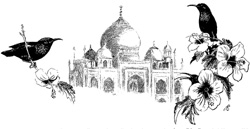
In India many historical sites are also great places to watch birds, such as these Purple Sunbirds at the Taj Mahal.