Thailand
Thailand is one of the most fascinating and ornithologically exciting countries in Asia. A wide variety of habitats and an extensive park and sanctuary system support a huge number of resident bird species and a rich array of Palearctic migrants. Our tour travels from the marshy plain and mangrove coastline around Bangkok, through the lovely forested national park at Khao Yai to the cool mountains around the northern capital of Chiang Mai.
The food and accommodation on this tour are superb. Participants wishing to explore the varied and spectacular temples and river life in Bangkok are encouraged to arrive a day or two before the tour begins. Please also note that this tour can be taken in conjunction with our Malaysia and Borneo tour (see pages 87-89).
Friday 7 February to Monday 24 February 2003
Friday 6 February to Monday 23 February 2004
with Jon Dunn and Phil Round as leaders.
 Thailand bird list
return to Asia introduction
return to Calendar
Day 1: The tour begins in London with a flight to Bangkok. Night
in Bangkok.
Day 2: Depending on the time our flight arrives in Bangkok, there will either be some local birdwatching or a sightseeing excursion around this fascinating city. Night in Bangkok.
Day 3: Today we'll explore the mudflats, mangroves and salt pans of the Gulf of Thailand, west of the mouth of the Chao Phraya River, near Samut Sakhon. Here we will search for a variety of waders including Red-necked and Long-toed Stints, Broad-billed and Marsh Sandpipers, Greater and Lesser Sandplovers, and Brown-headed Gull. There is a real possibility of seeing the very rare, and globally threatened, Spoon-billed Sandpiper - one to four birds winter in this area annually. We'll also find Brahminy Kite, Black-capped and Collared Kingfishers, and perhaps Golden-bellied Gerygone among many other species. If time permits we'll explore some freshwater marshland and orchards, before returning to our hotel in the late afternoon. Night in Bangkok.
Day 4: In the early morning we'll visit a freshwater marsh on the outskirts of the city to look for a variety of marsh birds and wintering passerines including Yellow Bittern, Ruddy-breasted Crake, Pallas's Grasshopper Warbler, Oriental and Black-browed Reed Warblers, and Bluethroat. As we journey onward to Ayutthaya we'll stop to examine concentrations of Asian Openbills in the marshy fields en route. We'll have lunch at a riverside restaurant in Ayutthaya, the former capital of Old Siam, where among the ruins we'll find a further variety of woodland and parkland birds including Coppersmith Barbet, Common Iora, and Scarlet-backed Flowerpecker. We'll arrive at Khao Yai in the late afternoon. Tonight, and the next three nights, will be spent in a luxury resort amid spectacular cliffs and wooded scenery by the northern gate of Khao Yai National Park. We'll search for Red-breasted Parakeets, and other birds, within the resort grounds. Night near Khao Yai National Park.
Days 5-7: We'll spend three full days exploring the densely forested hills, clear rivers and waterfalls at Khao Yai, one of the loveliest and best-preserved tracts of tropical evergreen forest in Indochina. Khao Yai is noted for larger forest birds, and we'll look for four species of hornbills, including the magnificent Great Hornbill, as well as Orange-breasted and Red-headed Trogons, Banded Kingfisher, and Silver-breasted and Long-tailed Broadbills. In addition we can expect a variety of raptors, pigeons, barbets, woodpeckers, leafbirds, bulbuls, laughingthrushes, babblers, warblers, sunbirds, and flowerpeckers. Red Junglefowl and Siberian Blue Robin haunt the undergrowth, and there is a chance of scarcer ground birds such as the elegant Siamese Fireback, and the elusive Coral-billed Ground-Cuckoo. At dusk we'll look for Great Eared-Nightjar and later, within our hotel grounds, for Brown Boobook and other nightbirds. Khao Yai is especially rich in mammals including Pig-tailed Macaque, gibbons, Black Giant Squirrel, civets, Sambar and Barking Deer, and Asian Elephant. Nights near Khao Yai National Park.
Day 8: After a final morning's birdwatching in Khao Yai we'll return to Bangkok in time for an afternoon flight to Chiang Mai. Night in Chiang Mai.
Day 9: The avifauna of northern Thailand differs markedly from that of the central region, and includes many Himalayan birds. Over the following week we'll visit a succession of habitats, from open plains to forested mountain slopes, where we'll find a wealth of new species, including numerous new barbets, bulbuls and babblers. This is also one of the most exciting parts of the country for such wintering Palearctic birds as thrushes, Olive-backed Pipit, and Common Rosefinch.
By special arrangement, we'll visit the summit of Doi Pui, an area of open oak and pine forest and cypress plantations at over 5,000 feet. It is ideal for wintering and resident birds and always seems to produce a surprise or two. We'll focus on flycatchers, chats, thrushes, Phylloscopus warblers, including both resident White-tailed and wintering Hume's Leaf Warblers, perhaps Chestnut Bunting, and such resident species as Blue-throated Barbet, Grey-chinned and Long-tailed Minivets, and Yellow-cheeked Tit. After a picnic lunch on the mountain, we'll visit open scrub and grassland on the western outskirts of the city to search for Burmese Shrike, Ashy Woodswallow, Indochinese Bushlark, Yellow-streaked Warbler, and other birds. Night in Chiang Mai.
Day 10: We'll spend the morning visiting the Huai Hong Khrai Royal Development Project, a lovely area of low rolling hills covered with deciduous forest and containing scattered lakes. Here we'll be looking for one of the most threatened large birds in Asia, Green Peafowl, which has recently re-colonized this area owing to much-improved protection. We'll also stop to examine a lowland paddy basin, on the way back to Chiang Mai, for Oriental Skylark, Grey-headed Lapwing and, if we are lucky, Small and Yellow-legged Buttonquails. After lunch we'll travel to Doi Inthanon, where we'll spend the next three nights in a delightful resort at the foot of the mountain. Night at Inthanon Highland Resort.
Day 11: We'll spend three days exploring the huge range of habitats on Doi Inthanon, which, at 8,400 feet, is Thailand's highest mountain. Habitats range from open deciduous Dipterocarp woodland on the lower slopes, upward through a succession of pine, open woodland and deforested open country, and finally moist, broad-leaved evergreen forest. We'll spend our first morning around the summit of the mountain, which supports an upper montane forest with an abundance of gorgeous flowering rhododendrons and orchids. Here we're certain to see a multitude of brightly-coloured small birds including Chestnut-tailed Minla, Rufous-winged Fulvetta, Yellow-bellied Fantail, and the stunning Gould's and Green-tailed Sunbirds. As we follow a boardwalk around a sphagnum-moss bog, we'll look for shy ground-skulkers such as Rufous-throated Partridge, White-browed Shortwing, Dark-sided, Chestnut and Grey-sided Thrushes, Red-flanked Bluetail, Snowy-browed Flycatcher, and Chestnut-crowned Laughingthrush. After a picnic lunch we'll begin our descent, birding as we go. Night at Inthanon Highland Resort.
Day 12: We'll begin the day working the dry Dipterocarp forest of the lower slopes, at roughly 1,200 feet, looking for Collared Falconet, Crested Treeswift, Chestnut-bellied Nuthatch, Black-hooded Oriole, and woodpeckers, perhaps including White-bellied and Black-headed, an Indochinese endemic. If we're very fortunate we'll also find another Indochinese endemic, White-rumped Falconet. We'll also stop at a waterfall to look for White-capped and Plumbeous Redstarts. After a picnic lunch we'll spend the remainder of the day in a quiet valley, birding cultivated land and regenerating forest for the birds typical of these habitats. Night at Inthanon Highland Resort.
Day 13: Our final morning on Doi Inthanon will be spent exploring the loftiest and most species-rich forest on the mountain, at 5,000-6,000 feet elevation. Among the species we'll be looking for are Maroon Oriole, Short-billed Minivet, Brown-throated Treecreeper, Silver-eared Mesia, Spectacled Barwing, Rufous-backed Sibia, Chestnut-crowned Warbler, and Large Niltava. We'll return to Chiang Mai in the late afternoon. Night in Chiang Mai.
Day 14: We'll leave early for the Mae Taeng Irrigation Project, part way to Chiang Dao District. The open country, where a shingle river descends from the steep mountains to the west, always produces a fine variety of birds including Wire-tailed Swallow, Chestnut-capped Babbler, Chestnut-tailed Starling, Crested Bunting, and Red Avadavat. Siberian Rubythroat is common here and we'll hope for excellent views of this living jewel. We'll also look for Baikal (Spotted) Bush Warbler among other species.
We'll take lunch en route and drive on to our accommodation at the Ang Khang Nature Resort, which lies close to prime birding areas on Doi Ang Khang, at about 6,000 feet. There will be some time for afternoon birding in scrub and open woodland. Night at Ang Khang Nature Resort.
Days 15-16: We'll spend two full days exploring Doi Ang Khang, a rugged and beautiful mountain perched on the Thai-Burmese border. The mountain is home to Chinese (remnants of Chiang Kai-shek's armies who settled here following the Chinese revolution) as well as Shan, Lahu and Palong tribespeople. The Thai government has established watershed protection and upland agriculture projects to help conserve the environment. Though forest cover is much reduced, a great diversity of forest birds remains. Open oak-pine forests support Long-tailed Minivet, Slender-billed Oriole, and even a few Giant Nuthatches, though this species has become very hard to find. Among the specialties we can expect are Mountain Bamboo Partridge, Brown-breasted Bulbul, Rusty-cheeked Scimitar-Babbler, White-browed Laughingthrush, and Spot-breasted Parrotbill. We'll also hope to see Crimson-breasted Woodpecker, Buff-throated and Chinese Leaf Warblers, Crested Finchbill, Red-faced Liocichla, and Black-browed Parrotbill, and there is a very real possibility of Hume's Pheasant. The airspace above teems with Pacific Swifts that roost in a cave on the mountain, and there is always the chance of spotting something unexpected - perhaps a rare bunting or finch. The proximity of our accommodation to the prime birding areas means that we'll be able to return to the hotel for a relaxing midday break. Nights at Ang Khang Nature Resort.
Day 17: Depending on our birding up to this point, we'll either spend our last morning on Doi Ang Khang, or leave the mountain early and descend to Mae Fang National Park, where a rushing clear-water stream emerges from the foothills amid mixed deciduous woodland. This is the only known location in Thailand where Brown Dipper is still regular and we'll search for it. We also have a chance of adding a few more forest birds, perhaps including Pin-tailed Pigeon, Yellow-bellied Warbler, or Spot-winged Grosbeak. After lunch we'll return to Chiang Mai, where we'll catch a late afternoon flight back to Bangkok. We'll then take an overnight flight to London where the tour concludes on Day 18.
Cost £3220 (2003)
Single Room Supplement £240
Maximum group size: 16 participants and 2 leaders.
The ground arrangements for this tour are organised
by our American associates WINGS.
Thailand bird list
return to top of page
return to Asia introduction
return to Calendar
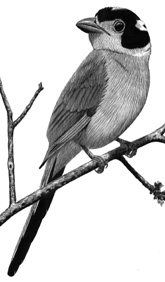
The tropical evergreen forest
preserved in Khao Yai
National Park is home to the colourful Long-tailed
Broadbill.