Sri Lanka - the teardrop of India
Early travellers romantically named Sri Lanka 'the teardrop of India'. Just 270 miles long and 140 miles wide, this small island does indeed look like a tear which has fallen from the face of the sub-continent to become petrified in the Indian Ocean. Having, in reality, risen from the sea millions of years ago and since been subjected to much geological upheaval, Sri Lanka has developed into a magical land of mountains, gently undulating hills, open plains, and lush valleys. Running through these are countless rivers dotted with beautiful waterfalls, many hidden beneath a dense cloak of rainforest.
For the birdwatcher, islands have the added attraction of endemic species that have evolved through centuries of isolation. With upwards of 24 unique birds, Sri Lanka is no exception and we'll endeavour to encounter them all during our visit. A large number of northern migrants winter on the island, joining many other resident species which are difficult or impossible to see on our usual birdwatching circuits of northern India. Add to this a rich cultural history and the world-famous hospitality of the Sri Lankan people and you have the recipe for a perfect birdwatching holiday.
These tours will be the ninth and tenth Sunbird trips to Sri Lanka.
Saturday 1 March to Friday 14 March 2003
Saturday 28 February to Friday 12 March 2004
with Paul Holt and Deepal Warakagoda as leaders.
 Sri Lanka bird list
return to Asia introduction
return to Calendar
Day 1: The tour begins with an overnight flight from London to Colombo, the island's capital. We arrive in the early hours of the morning on Day 2 and drive straight to an airport hotel for the rest of the night.
Day 2: The calls of the ubiquitous Asian Koel are sure to waken us and after an early lunch we'll drive to Kitulgala, on the banks of the River Kelani, arriving in time for some birdwatching in the grounds of our hotel where our first birds might include Green Imperial and Pompadour Green Pigeons, Layard's Parakeet, and White-throated Flowerpecker. Night in Kitulgala.
Day 3: It was here that Bridge on the River Kwai was filmed and in the early morning we'll cross the river by dug-out canoe to spend some time birding in the tropical forest in search of such birds as Sri Lanka Junglefowl, Sri Lanka Grey Hornbill, a variety of woodpeckers including Lesser Yellownape, Rufous, Brown-capped and the crimson-backed form of Greater Flameback, Malabar Trogon, Yellow-fronted Barbet, 'Black-headed Yellow' Bulbul, Spot-winged Thrush, Tickell's Blue and Brown-breasted Flycatchers, and Black-naped Monarch. After lunch we'll continue our journey and drive to the town of Ratnapura in the heart of the island's gem-mining region. Night in Ratnapura.
Days 4-5: These two days are set aside for exploring Sinharaja and other rain forest sites in the heart of the wet zone. Because our hotel, which is the nearest suitable accommodation, is some distance away from Sinharaja, we'll need to make early starts to reach the forest for first light. The park's extensive bird-list includes all but one of the country's endemics and we have a good chance of seeing the majority of them, although some are easier to find than others. The ground-dwelling Sri Lanka Spurfowl require stealth and sharp eyes, whereas roving flocks of Ashy-headed Laughingthrushes and Orange-billed Babblers are much more obliging. Sri Lanka Mynas call loudly and clearly from exposed positions while Sri Lanka Hanging Parrots shriek past.
The exquisite Sri Lanka Magpie is a real gem, and with luck several will be seen here, and we'll also be keeping a sharp eye open for Red-faced Malkoha cavorting around the tangled vines and creepers. White-faced Starling may appear high up in the trees and the very elusive Chestnut-backed Owlet haunts the dense canopy. Multicoloured butterflies the size of saucers float in and out of the warm, humid forest which at times echoes to the excited calls of mixed-species bird flocks. Sinharaja will undoubtedly be a rewarding experience and possibly the highlight of the tour. Nights at Ratnapura.
Day 6: Before we leave the forested wet zone we'll still have one other special bird to look for. To see the extremely shy Green-billed Coucal we'll have to leave very early once again, to arrive at the small forest reserve at Ingiriya just as dawn is breaking. The undisturbed forest surrounds a Buddhist retreat and as we follow the path up to the sanctuary we'll listen carefully for the distinctive call that will betray the presence of this remarkable bird.
After a break for tea and coffee, and hopefully Collared Scops Owl, we'll continue to the Uda Walawe National Park. Established to protect the forest catchment of a large reservoir, this park is home to good numbers of waterbirds and mammals. We'll switch to open-topped jeeps and drive around the park searching for the distinctive Sri Lankan forms of Changeable Hawk-Eagle, and Barred Button Quail, as well as for Malabar Pied Hornbill, Plum-headed Parakeet, Orange-breasted Green Pigeon, Stork-billed Kingfisher, Brown Fish Owl, Forest Wagtail, and Blyth's Pipit. We can also expect close encounters with some of the many wild Indian Elephants that inhabit the park. Night at Embilipitiya.
Day 7: After breakfast we'll visit an extensive area of marsh and coastal lagoons to look for Black and Yellow Bitterns, Watercock, Ruddy (Ruddy-breasted) Crake, a variety of waders including Pacific Golden Plover and Pintail Snipe, and hordes of stunning Blue-tailed Bee-eaters. We'll then travel east to the village of Tissa, famous for its large tank (or lake) and ancient domed dagoba (Buddhist shrine). After lunch we'll visit Yala National Park where, having left the wet zone behind, we'll encounter drier forest and open grasslands. These habitats are still very rich in birds and we'll look for Lesser Adjutant, Asian Openbill, Spot-billed Pelican, Great Thick-knee, and Ashy-crowned Sparrow Lark among others. Yala is also home to many mammals including Indian Elephant, Wild Boar, Grey Langur, Sambar, and Spotted Deer. When dusk comes we'll linger to search for the recently split Jerdon's Nightjar and also the commoner Indian Nightjar. Night at Tissa.
Day 8: This morning we'll explore the wader-rich pools of Bundala Sanctuary where Indian Pratincoles breed. Here mixed flocks of roosting terns will hold Caspian, Great Crested, Lesser Crested and, with luck, Saunders's Terns. There will also be hordes of waders to search through, and we'll see good numbers of Lesser Sand Plovers here as well as a few wintering Red-necked Phalaropes. We'll end the day by searching a coconut plantation for the elusive White-naped Woodpecker. Night at Tissa.
Days 9-10: We'll depart early for Nuwara Eliya in the heart of Sri Lanka's hill country and tea-growing region. We'll pause on our way up to sample some of the tea and also to look for the scarce Sri Lanka Wood Pigeon. Over the next few days we'll visit many sites, including the beautiful and elegant Hakgala Botanical Gardens, to look for Kashmir and Dull-blue Flycatchers. Among the formal shrubbery of Victoria Park we should see Indian Pitta and Pied Thrush, while on the Horton Plains we'll be searching for Jerdon's Baza, Yellow-eared Bulbul, Indian Scimitar-Babbler, Sri Lanka Bush Warbler, Sri Lanka White-eye, and Black-throated Munia among others. However the real prize of our visit to this region will be the Arrenga or Sri Lanka Whistling Thrush, one of the rarest and most magical birds on the island. Nights in Nuwara Eliya.
Day 11: After leaving Nuwara Eliya we'll call in at a tea factory to see just how the delicious tea we have been enjoying is made. We'll then continue to Kandy, home of traditional Sri Lankan culture and famous for the temple that houses a sacred tooth rescued from the Buddha's funeral pyre in 543 BC. We'll visit the temple as well as the splendid Royal Botanical Gardens that contain a surprising number of birds and a large colony of flying foxes. Night in Kandy.
Day 12: After breakfast we'll visit Uda Watakele Nature Reserve on the very edge of Kandy town where we may get our best views of the colourful Oriental Dwarf Kingfisher. We'll then continue north to have lunch in the shadow of perhaps the most striking sight on Sri Lanka, the 600-foot rock rising out of the jungle at Sigiriya. After lunch we'll spend some time birdwatching around the base of the rock looking for more Indian Pittas, which can be numerous here, Plaintive and Banded Bay Cuckoos, Indian Blue Robin, White-rumped Shama, and Large-billed Leaf Warbler, before continuing on to Polonnaruwa for the night.
Day 13: Polonnaruwa was the island's capital from the 11th to the 13th centuries. Today, with its abandoned, intricately carved buildings, and brooding Buddha image, it exists as a place of rare beauty and one that we'll take time to visit. The adjacent huge, man-made lake and the surrounding forest are rich in birds and we'll search for Grey-headed Fishing Eagle, Greater Painted-snipe, Blue-faced Malkoha, Black-headed Cuckoo-shrike, Streaked and Baya Weavers, and Purple-rumped Sunbird. After some early morning birding around the lake edge we'll visit the remains of the ancient city. After lunch we'll drive back to Colombo where we will spend the night.
Day 14: We'll transfer early to the airport to catch our flight back to London where the tour concludes.
Cost £1890 (2003)
Single Room Supplement £140
Maximum group size: 14 participants and 2 leaders.
Sri Lanka bird list
return to top of page
return to Asia introduction
return to Calendar
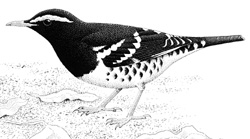
As well as the many endemics, Sri Lanka also offers other much sought-after species including Pied Ground Thrush.