South Korea
Lying between China and Japan, little-known South Korea is set to become one of the Far East's best winter birding destinations. Snowy mountain forests, extensive rice-fields, tidal-flats, and rocky shores are all packed into a country the size of England and are the winter home to many northern Palearctic species. These include birds that most European birdwatchers dream of seeing such as Steller's Sea Eagle, Scaly-sided Merganser, Relict and Saunders's Gulls, Siberian Accentor and, perhaps best of all, the almost mythical Baikal Teal. South Korea is the only place in the world where this species is easy to find and no one will forget the thrill of watching a cloud of 150,000 Baikal Teals filling the sky.
Our tour will travel throughout much of the country visiting forests in the northwest near the capital Seoul, wide tidal-flats and coastal plains in the west, the southern scenic volcanic island of Cheju, the Nakdong river estuary in the east, and the rocky eastern coastline of the Pacific. Thus we will take in all the best winter birding sites, and by staying at a wide range of accommodation we will have plenty of chances to meet local people (and birders) and gain an insight into this fascinating country.
Wednesday 4 to Tuesday 17 December 2002
Saturday 6 to Friday 19 December 2003
with Paul Holt as leader.
 South
Korea bird list
South
Korea bird list
return to Asia introduction
return to Calendar
Day 1: The tour starts in London with an overnight flight to Incheon
International Airport.
Day 2: After arrival we'll begin our exploration of this fascinating country with some birding close to the airport looking for Chinese Penduline Tit, Vinous-throated Parrotbill, and Pallas's Reed and Rustic Buntings. After this introduction to the birds of Korea we'll travel to Kanghwa Island where we'll spend the night.
Day 3: Kanghwa Island is a mixture of habitats with tidal mudflats, scrub and woodland. Here we hope to find Red-crowned Cranes feeding in the salt marsh, and flocks of Ruddy Shelduck, Tundra Bean Geese, and Mongolian, Vega and Black-tailed Gulls, out on the tidal mudflats. We have a good chance of finding Japanese Reed Bunting in the reed-filled ditches, while the scrubby woodland edge should provide good views of Daurian Redstart, Yellow-throated Bunting, and perhaps a Pallas's Rosefinch or Siberian Accentor. Moving in to more mature woodland we'll expect to see Japanese Pygmy Woodpecker and Varied Tit. In the evening we'll travel the short distance to Gimpo where we'll spend the night.
Day 4: In the morning, we'll drive along the Han-Imjin River towards Imjingak, overlooking the Demilitarised Zone and North Korea. We'll scan the river for geese, especially Greater White-fronted and Tundra Bean Geese as well as raptors, hopefully including Black Vulture and Upland Buzzard. Although we cannot stop along the highway, we'll have permission to enter an area of rice-fields next to the river, where we should find White-tailed Eagle and small numbers of White-naped Cranes. Another brief stop should give us views of Swan Goose and after lunch we'll visit the Song Do tidal-flat in Incheon, where the high tide should provide excellent views of both Saunders's and Relict Gulls. Numbers of the latter species were higher here in 2001 than almost anywhere else in the world in winter. We can expect more very close views of Mongolian, Vega and Siberian Gulls (of the subspecies taimyrensis) and a broad range of waterfowl might well include our first Baikal Teal and Mandarin Duck. As the evening approaches we'll drive to Sosan for the night.
Day 5: From Sosan we'll make the short drive down to Cheonsu Bay. Providing the area is not frozen, we should be confronted by several hundred thousand waterbirds, with 50,000 or more Baikal Teal perhaps the main attraction, although large rafts of Falcated Ducks and Smew will add to the scene. We'll have special permission to enter the area favoured by several hundred Ruddy Shelduck and thousands of geese including some Snow, (truly wild) Canada, Swan and Lesser White-fronted among the 40,000 or more 'grey' geese. We should be able to find Oriental White Stork and possibly one of the stars of the show, the magnificent Steller's Sea Eagle along with perhaps Eastern Imperial and Golden Eagles. Night in Sosan.
Day 6: We'll revisit Cheonsu Bay in the morning, concentrating on species we did not find the previous day. In the afternoon, we'll drive down to the Keum River, where we should see more Baikal Teal and Swan Geese, as well as the distinctive eastern form of Oystercatcher in the estuary. Night in Kunsan.
Day 7: We'll catch a morning flight to the volcanic island of Cheju and from the airport travel along the coast, visiting several excellent birding sites. We might locate a few divers, mostly Pacific with the occasional Black-throated, Pacific Reef Egret, a large flock of Mandarin Duck, which can peak at around 2,000, and small numbers of Ancient Murrelet. We should also find both Temminck's and, for comparison, Great Cormorants. By late afternoon we'll arrive in the southeast corner of the island, where we'll be able to see Black-faced Spoonbill, one of the world's rarest birds, roosting on black lava islands. Overnight in Cheju.
Day 8: We'll spend the morning on Mount Halla, South Korea's highest mountain, looking for Red-flanked Bluetail, Olive-backed Pipit, and Pale and Dusky Thrushes, before catching the lunchtime flight to Mokpo. In the afternoon, we'll visit Haenam, where we'll look for any birds that might have eluded us in Sosan. Highlights here might include up to 200,000 Baikal Teal, a variety of raptors, Japanese Quail, and Azure-winged Magpie, to name but a few. Night in Haenam.
Day 9: Birdwatching around Haenam in the morning should add Crested Lark and a rich mix of wetland and scrub-edge species. Moving eastward in the afternoon, we should find Long-billed Plover on a shingle river, before we arrive in Suncheon in the mid-afternoon. Here highlights will include South Korea's only wintering flock of Hooded Crane, up to 1,000 Saunders's Gulls (at the world's best wintering site for this species), and large numbers of passerines and other waterbirds, including more Relict Gulls. Night in Suncheon.
Day 10: Making an early start we'll drive to the Joonam reservoirs in the morning, where we'll search for the elusive Baer's Pochard and a variety of raptors. In the afternoon, we'll travel to the Nakdong estuary, where we'll watch rafts of White-winged Scoters, and look for a range of species from Black Kite to Grey Bunting. Night in Kyongju.
Day 11: We'll check the gravel river between Kyongju and Pohang briefly for more Long-billed Plovers, as well as Japanese Wagtail, before heading to the Kuryongp'o headland. Here we'll stop at several points, checking for both Ancient and Marbled Murrelets, and Rhinoceros Auklets. We should also see a variety of grebes and divers, as well as perhaps finding some late migrant passerines. Night in Pohang.
Day 12: Moving across the country we'll visit a prime site for another scarce and little-known species - Scaly-sided Merganser. Small numbers of this extremely rare and little-known duck winter in Korea every year. The birds do move around so before the tour takes place our local guides will be out scouting all the possible sites to locate them and with luck we should be rewarded with good views. There should be a variety of passerines on offer as well including Siberian Accentor and Long-tailed Rosefinch. In the afternoon, we'll begin the long drive up back towards Seoul, passing some magnificent scenery en route. Night in Icheon.
Day 13: Making an early start will take us to the forest at Kwangnung, northeast of Seoul. Here we should encounter White-backed and Black Woodpeckers, and hopefully Hazel Grouse and Solitary Snipe. After a full day in the forest we'll head in to central Seoul for the evening, where we'll check into a luxurious hotel. There will be the option of enjoying some evening sightseeing in Seoul, with a visit to the nearby culturally rich Insa Dong area. Night in Seoul.
Day 14: We'll transfer to the airport at Incheon in time to catch our return flight to London where the tour concludes.
Cost £2390 (2002)
Single Room Supplement £180
Cost £2720 (2003)
Single Room Supplement £250
Maximum group size: 16 participants and 2 leaders.
South Korea bird list
return to top of page
return to Asia introduction
return to Calendar
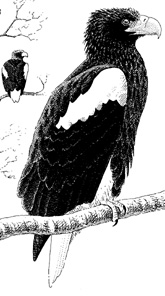
Hopefully Steller's Sea Eagle will be one of the stars during our visit to Cheonsu Bay.