Northern India - the complete tour
To many people India is a mystical and exotic country that epitomises foreign travel. It is a land of striking contrasts, rich heritage and fabulous culture, and long after you've returned home, images will remain to enrich and liven your daily round. The cool marble splendour of the Taj Mahal, the snows of the Himalayas flamingo-pink at dawn, the lush green jungles, and above all the birds. The thrill of your first Siberian Rubythroat, a Spotted Forktail or Altai Accentor beside a mountain stream, Sarus Cranes striding majestically through the bright yellow mustard fields, an Orange-headed Thrush lighting up the undergrowth, Scarlet Minivets streaming through the emerald canopy. With so many species on the potential list the examples can only be arbitrary and the total for the tour should be between 380 and 400 species.
We have been running up to three tours a year to Northern India for many years now and our unrivalled wealth of experience has made this one of our most successful and popular destinations. This year we are adding a visit to Ranthambhore, thereby offering the very real possibility of an encounter with a Tiger and making this one of the most comprehensive Northern India itineraries on offer.
Saturday 1 February to Wednesday 19 February 2003
Monday 9 February to Friday 27 February 2004
with Paul Holt as leader.
 Northern India bird list
return to Asia introduction
return to Calendar
Day 1: The tour begins with a flight from London to Delhi, arriving late in the evening. At the airport we'll be met by our driver and coach and transfer to a hotel for the night.
Day 2: After an early breakfast we'll transfer to one of Delhi's bustling railway stations where we begin our grand tour with a train ride south to the Ranthambhore Tiger Reserve. Gliding through the open countryside of the Gangetic Plain will be a wonderful introduction to rural India and we can expect to see Indian Pond Heron, Black-shouldered Kite, Common Peafowl, Rose-ringed Parakeet, Indian Roller, Black Drongo, and Common and Bank Mynas along the way. Arriving around midday we'll transfer straight to our hotel and in the afternoon we'll have our first safari drives in the reserve in search of the majestic Bengal Tiger. Night at Ranthambhore.
Day 3: Ranthambhore is the subcontinent's most famous and most accessible tiger reserve and we anticipate taking a number of drives in the morning and the early evening. We will ride in open-topped vehicles, allowing wonderful views of the wildlife and we will undoubtedly encounter good numbers of Spotted Deer, a main prey item for the elusive Tigers. Elusive they may be, but the habitat here is fairly open and a healthy population ensures that we have a good chance of at least one encounter with this magnificent cat. Ornithological distractions could include Painted Spurfowl, Changeable Hawk-Eagle, and White-naped Woodpecker. Night at Ranthambhore.
Day 4: This will be our second full day in and around Ranthambhore. If we still haven't seen a Tiger, we'll concentrate our efforts to find one. However there are numerous other attractions, including a spectacular ancient fort and a series of bird-thronged lakes, while outside the reserve we have a good chance of finding regional specialities such as the gorgeous Indian Courser and elusive Painted Sandgrouse. Night at Ranthambhore.
Day 5: After our final morning's jeep drive, we'll leave Ranthambhore and take the train to Bharatpur, one of the ornithological wonders of the world. Keoladeo National Park, known simply as Bharatpur, was originally a vast wetland developed for duck shooting. Coaches are not allowed inside the park, so we'll explore the 29 square kilometres on foot, by bicycle-rickshaw and in the park's electric bus. Those whose over-riding memories of birdwatching abroad are dusty and bumpy roads and whistle-stop stake-outs will find this a marvellously relaxing time. Nevertheless it will be very rewarding, with the possibility of over 200 species ranging from Sarus Crane to Small Minivet and Ruddy-breasted Crake to White-tailed Eagle. Among the vast numbers of waterbirds, Black-necked and Painted-Storks, Intermediate Egret, Cotton Pygmy-goose and Darter will vie for our attention as we search for less-usual species such as Ferruginous and Red-crested Pochards and Greater Painted-snipe. In the trailside trees we'll look for Marshall's Iora, Yellow-footed Green Pigeon, Common Wood-shrike, Asian Paradise-flycatcher, White-bellied Drongo, Coppersmith Barbet, and Ashy Prinia. Beneath the bushes the slightest movement could herald a Bluethroat or, with luck, an Orange-headed Thrush or Siberian Rubythroat. In the sky above might be Greater Spotted Eagle, Red-headed Vulture or Crested Serpent Eagle. Dusk may bring us Collared Scops-Owl, Dusky Horned-Owl or a nightjar or two. Night at Bharatpur.
Days 6-8: We'll have ample time to explore the reserve and on one day we'll travel outside the park to Bund Bharata, a reservoir 'discovered' by Sunbird a few years ago and now a standard part of the itinerary, where Indian Skimmers are regularly seen. Nights at Bharatpur.
Day 9: After breakfast we'll drive to Agra to visit the Taj Mahal - 'no mere building but a love immortalised in marble'. Obsessional birders in the party, who are not moved by Shah Jahan's promise to Mumtaz Mahal that he would build a tomb that would for ever remind the world of their great love, should at least enjoy seeing raptors in profusion over the Taj, and a chance of Pallas's Gull or River Lapwing on the Yamuna River, or Asian Koel and Brown-headed Barbet in the leafy gardens. In the afternoon we'll begin our journey towards the foothills of the Himalayas by driving to Gajroula, a small town close to the River Ganges. Night in Gajroula.
Day 10: After a pre-breakfast visit to the mighty River Ganges to look for Pallas's Gulls, Sand Larks and possibly Gangetic Dolphin, we'll continue north to Ramnagar where we'll search the boulder-strewn river for the rare and elusive Ibisbill, a species we almost always see, as well as wintering Wallcreepers. From there we move on to The Quality Inn, a delightful lodge just outside Corbett National Park which has superb views across the Kosi River and surrounding dense woodland where we are free to wander on foot. Night at Quality Inn.
Day 11: During our full day here we'll explore the river edge for Brown Fish Owl, Himalayan Kingfisher, Brown Dipper, and Plumbeous and White-capped Water Redstarts. The surrounding area is full of surprises and in recent years we have regularly seen Long-billed Thrush, Little and Slaty-backed Forktails and Mountain Hawk and Rufous-bellied Eagles here. Many new species are possible in the forest and could include Collared Falconet, Crested Tree Swift, Spangled Drongo, and Orange-bellied Leafbird. Night at the Quality Inn.
Day 12: After breakfast we'll enter the highly scenic Corbett National Park where Red Junglefowl and Kalij Pheasant are immediate possibilities. Please be warned that the accommodation here is spartan by Western standards; expect leaky plumbing and unpredictable supplies of heating, electricity and hot water. But the food is excellent and the location and its birds magnificent. Night in Corbett National Park.
Day 13: This internationally famous reserve, set up for Project Tiger, was established in 1935 and covers 520 square kilometres. The Tigers here are extremely hard to find and with vast areas of forest in which to roam, encounters are now very rare. However exploration on foot is not allowed - indeed it is only possible in areas adjacent to our lodge or if accompanied by an armed guard. Happily, safaris on elephant-back provide a thrilling alternative. Located in the Himalayan foothills between 400m and 1100m above sea level, the reserve is divided by the River Ram Ganga (which contains two species of inland crocodile) and offers a variety of habitats, from dense jungle and mature forests to open grassland, broad river valleys and rolling hills. The wealth and variety of species seems almost inexhaustible: Great Hornbill, Jungle Owlet, Slaty-headed Parakeet, Himalayan Swiftlet, Lesser Fish-Eagle, or even Great Thick-knee, Stork-billed Kingfisher or White-tailed Rubythroat. As well as Tiger, mammals include Indian Elephant, Indian Muntjac, Hog Deer and Common Langur. Night in Corbett National Park.
Day 14: After a final morning in the park we'll drive to the old hill-station of Nainital, a journey which takes us along one of the world's more spectacular mountain roads as we climb up into the Kumaon Hills on our way to this delightful 'lake city'. We'll stop along the way to look for birds. New species could include Long-tailed Broadbill, Black-throated Jay, Black-throated Tit, Blue-headed Redstart, and the spectacular Spotted Forktail. Night in Nainital.
Days 15-17: Driving up to the mountain ridge above Nainital we'll look across to the snow-capped Western Himalayas and the borders of China and Nepal. If the weather is clear we'll be able to see Nanda Devi, at 7816m India's second highest peak, from a view-point alive with Oriental Turtle Doves, Chestnut-crowned and White-throated Laughingthrushes, Grey-winged Blackbirds, and Orange-flanked Bush Robins. The gentle downhill stroll back to town will add many sub-Himalayan species to our list. On varied walks through the surrounding valleys and forested hills we'll hope for Hill Partridge, Altai Accentor, White-tailed Nuthatch, Rusty-cheeked Scimitar Babbler, Golden Bush Robin, Yellow-breasted Greenfinch, and Common, Dark-breasted and Pink-browed Rosefinches. From a nearby mountain look-out close-passing raptors could include Himalayan Griffon, Lammergeier, and Steppe Eagle and daily surprises could range from Koklass Pheasant and Great Barbet to White-browed Shrike-Babbler or Rufous Sibia. Streaked Laughingthrush is virtually a garden bird here and the numerous wooded gullies and gardens around the town can hold many other exciting birds. Recent tours have produced Chestnut Thrush, Fire-fronted Serin and Russet Sparrow all within walking distance of our hotel.
On one day we'll visit the lake at Sat Tal, passing through coniferous forests, a patchwork of farm fields, and the deciduous woodland surrounding the lake. Each of these habitats holds different birds and highlights on previous visits have included Brown Wood Owl, White-crested and Rufous-chinned Laughingthrushes, Red-billed Leiothrix, Scaly Thrush, Black-throated Accentor, and White-capped Bunting. Nights in Nainital.
Day 18: As there will still be new species to distract us on our journey back to Delhi, we'll ensure that we leave more than enough travelling time. Even after nearly three weeks in this fascinating country, unscheduled stops for a Verditer Flycatcher, Ashy Bulbul or another photograph of a bullock cart, spice stall or roadside temple will still be tempting. After dinner in an airport hotel we'll catch an overnight flight back to London where the tour concludes on the morning of Day 19.
Cost £3160 (2003)
Single Room Supplement £300
Maximum group size: 16 participants and 2 leaders.
Northern India bird list
return to top of page
return to Asia introduction
return to Calendar
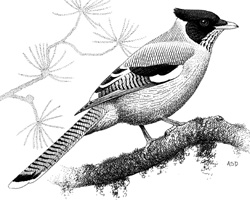
We should find raucous Black-headed Jays when we enter the Himalayan forests of the north.