Northern China - Manchuria and
the Qinghai-Tibetan Plateau
China is a vast country, the third largest on earth, with a dazzling array of landscapes and environments that rivals anywhere else on the planet. China also boasts numerous truly impressive ornithological jewels including elegant cranes, amazing pheasants, and demure redstarts. Many of the nation's 1200 or so species are endemic or nearly so, and the majority are poorly known.
We'll visit Wulingshan, a forested hill not far from Beijing. With specialities such as Koklass Pheasant, White-backed Woodpecker, and healthy populations of Chinese Leaf Warbler, Grey-sided Thrush and 'Chinese' Narcissus Flycatcher, we'll be kept busy. Xianghai will be our next port of call, a huge wetland reserve in Jilin Province near the border with Inner Mongolia. Here we'll search in particular for the enigmatic Jankowski's Bunting. Other attractions include Swan Goose, Baer's Pochard, Falcated Duck, Oriental Stork, three species of crane, and Asian Dowitcher. Later we'll fly out to the Qinghai-Tibetan plateau, the so-called 'Roof of the World'. Here the surreal lunar landscape and Qinghai Hu (Lake Koko Nor to many), in particular, hold an impressive array of alluring species. These could include majestic Black-necked Cranes, Pallas's Sandgrouse, the elusive Kessler's Thrush, stunningly patterned White-winged and Ala Shan Redstarts, six species of snowfinch, numerous larks, engaging White-browed Tits, and the enigmatic Henderson's Ground Jay. Moving off the Plateau we'll head to Huzu Bei Shan, a recently opened area harbouring an impressive remnant ancient forest thronged with Phylloscopus warblers, redstarts and buntings, as well as many regional specialities.
We'll also have the opportunity to see some of the Middle Kingdom's amazing cultural heritage, as we'll visit the Great Wall, the Summer Palace, Tiananmen Square, and the Forbidden City.
Monday 9 June to Saturday 28 June
with Paul Holt as leader.
 Northern China bird list
return to Asia introduction
return to Calendar
Day 1: The tour begins in London with an overnight flight to Beijing.
Day 2: Arriving early in Beijing, we'll transfer to our hotel before heading out sightseeing around the city. We'll visit Tiananmen Square in the heart of the city and one of Beijing's most famous landmarks, before entering the Forbidden City. Home to the emperors of both the Ming and Qing dynasties, the Forbidden City now harbours the largest and best preserved cluster of ancient buildings in the nation. Night in Beijing.
Days 3-4: After a morning watching Yellow Bittern, Ruddy-breasted Crake, Black-browed, Oriental Reed, and possibly Blunt-winged and Pallas's Grasshopper Warblers in the royal gardens of the Summer Palace, we'll leave Beijing and drive up to Wulingshan in neighbouring Hebei province. The fabulous forested mountain here rises to about 6,500 feet and we'll have ample time to explore a variety of habitats. Our primary targets will be Grey-sided Thrush and the endemic Chinese race of Narcissus Flycatcher - fortunately, both are reasonably common. The forests resound with the songs of Chinese Leaf and Hume's Warblers, while the vociferous cries of Koklass Pheasants and Spotted Nutcrackers ring from the hillsides. Chinese Bush Warblers and Siberian Blue Robins creep about far more furtively, but may well be tricked into the open. We'll spend two nights here.
Day 5: We'll be able to spend another morning on Wulingshan before returning to Beijing in the early afternoon. We'll have time to freshen up back at the hotel before catching a comfortable overnight sleeper train north into Manchuria.
Day 6: Arriving at Kaitong around midday, we'll transfer directly to Xianghai nature reserve, a little over an hour away. This will be our base for the following two nights, and we'll stay in the nature reserve's guesthouse. Xianghai is a huge reserve dominated by extensive reedbeds, large expanses of open water and grasslands typical of the Mongolian steppe, but also containing tracts of woodland, scrub and agriculture. Jankowski's Bunting, an almost mythical species, was discovered here recently. Thankfully, it is not usually a difficult species to find. We'll also search for Baer's Pochard, Falcated Duck, Japanese, White-naped and Demoiselle Cranes, Asian Dowitcher, and a variety of other water and grassland birds, such as Daurian Partridge, Amur Falcon, gorgeous White-winged Black Terns, Oriental Pratincole, and Chinese Grey Shrike.
Day 7: We'll spend all day at Xianghai nature reserve.
Day 8: Leaving Xianghai in the early hours, we'll catch our second sleeper train, and return to Beijing. We'll spend most of the day on the train arriving in Beijing that evening.
Day 9: We'll spend all day in Beijing. In the morning we'll visit the Great Wall at Badaling for a combination of sightseeing and birding. Stretching for nearly 5000 kilometres, the Wall has some sections which are over 2000 years old and although most of the parts we'll see have been recently restored, it's still an amazing structure and reputedly the only man-made object visible from space! Ornithological treats could include Chinese Hill Warbler, Vinous-throated Parrotbill, Pére David's Laughingthrush, Yellow-bellied Tit, Yellow-rumped and Asian Paradise Flycatchers, Chinese and Eastern Crowned Leaf Warblers, and Godlewski's Bunting. After lunch we'll head back to the city and visit Xiangshan Park. We're sure to hear Large Hawk and Indian Cuckoos and should also see Azure-winged Magpie and Chinese Nuthatch, as well as several species of migrants still heading north to their Siberian breeding grounds. Night in Beijing.
Day 10: In the morning we'll catch a flight to Xining, Qinghai province, in north-central China. We'll then drive to Laoye Shan, an hour northwest of Xining. Siberian Rubythroats, Yellow-streaked Warblers and Rufous-breasted Accentors are among the commonest and most conspicuous species here, though the splendid forests on this little-known mountain host a variety of other interesting species such as Elliot's Laughingthrush, White-bellied Redstart, Kessler's Thrush, the recently described Gansu Leaf Warbler, Chinese Bush Warbler, and Pine Bunting. We'll return to spend the night in a very comfortable hotel in Xining.
Days 11-12: Leaving Xining we'll drive west, climb up onto the Qinghai-Tibetan plateau and head for spectacular Qinghai Hu (Lake Koko Nor) some 3,200 metres above sea level. We'll spend three days on the plateau visiting as many different habitats as possible. The rolling alpine grasslands and dramatic snow-capped peaks of this high plateau are a world away from the China we'll have seen earlier, and it's hard to believe that we're still in the world's most populous nation.
On the shores of the lake, Bar-headed Geese, Lesser Sandplovers, and Great Black-headed and Brown-headed Gulls breed and will vie for our attention. We'll also search for, and expect to see, the rare Black-necked Crane and the endangered Pallas's Fish Eagle. In the neighbouring grasslands, among the domesticated yaks and horses and scattered Tibetan tents, we should find species such as Long-billed Calandra and Mongolian Larks, six of the world's seven species of snowfinch - White-winged, Tibetan, White-rumped, Small, Rufous-necked, and Plain-backed - plus comical Hume's Ground Jays. Pikas are common throughout the grasslands and constitute an important food source for the often numerous Upland Buzzards and Saker Falcons. We'll spend both nights in a hotel near Bird Island.
Day 13: We'll continue west from Qinghai Hu stopping to spend the morning in a ravine. It's a moderately steep walk to the top, but we'll move slowly, our steps perhaps enlivened by Tibetan Partridge, Wallcreeper, Kessler's Thrush, brash White-tailed Rubythroats, Blue-fronted Redstart, glistening gem-like White-browed Tit Warblers and perhaps Eagle Owl and Lammergeier. In the afternoon we'll drive over a road pass to Caka, a bizarre area rich in mineral salt deposits and yet with tracts of intensive and surprisingly lush agriculture. We'll be looking particularly for Henderson's Ground Jay as we approach town. Night in Caka.
Day 14: We'll leave early for a dry wash about 15 miles east of Caka. Here in the early morning light we'll look for Przevalski's Partridge, Pallas's Sandgrouse, Desert Wheatear, Mongolian Finch and perhaps Great Rosefinch. Later we'll visit a shallow canyon that is home to another excellent selection of exciting birds including Pink-tailed Rosefinch, White-browed Tit and, with luck, both White-winged and Ala Shan Redstarts. We'll return from Caka to near Qinghai lake late in the day, looking again for ground jays.
Day 15: Leaving our hotel early we'll have the opportunity of again visiting a mountain valley, and by mid-day we'll head back east past Qinghai Hu to Xining, stopping for birds en route. Night in Xining.
Day 16: Today we'll drive to Huzu Bei Shan, an impressive forested reserve on the border of Qinghai and Gansu provinces. We'll arrive before lunch and spend the afternoon birding. We'll spend two nights camping here, in tents erected by our ground agents.
Day 17: Huzu Bei Shan has only recently become accessible to foreigners, and we'll be one of only a handful of groups to have visited this amazing site. Conspicuous species here include Daurian and White-throated Redstarts, and White-winged Grosbeak, but it is the more difficult species that are Huzu's primary attraction. Pheasants rank highly on anyone's list of difficult birds to see and there are several species here; Common Pheasant should not be too difficult, but Blood and Blue Eared Pheasant, as well as Chinese Grouse, will require a lot more effort. Other target species include Black Woodpecker, Large-billed, Hume's, Chinese and Gansu Leaf Warblers, Hodgson's Redstart, Crested Tit Warbler, Rufous-vented Tit, and Grey-headed Bullfinch. We should also see several species that have distinctive local races that may actually be full species - Spotted Bush Warbler and White-cheeked Nuthatch being two prime examples. Night camping.
Day 18: We'll leave Huzu Bei Shan mid-day and drive slowly back to Xining. We'll leave plenty of time for stopping en route, maybe to search again for Blue Eared- or Blood Pheasant, Chestnut Thrush or White-winged Grosbeak. We'll spend the night in Xining.
Day 19: We'll catch a late morning flight to Beijing where we should arrive in time for some last minute shopping or sightseeing. We'll spend the night in the capital.
Day 20: We'll catch an early morning flight back to London where the tour concludes.
Cost £3140
Single Room Supplement £210
Please note that much of the accommodation on this tour is of a lower standard than normal expectations, and in many places bathroom facilities are shared.
Maximum group size: 10 participants and 1 leader.
Northern China bird list and brief itinerary
return to top of page
return to Asia introduction
return to Calendar
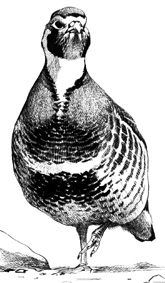
Przevalski's Partridge is just one of China's many specialities that we hope to see on this tour.