Central Asia – birding the Silk Road
The Silk Road, Samarkand and Bukhara - names that conjure up images of fierce Mongol hordes storming out of the east and of dusty camel trains and crowded bazaars where exotic jewels and oriental spices were traded by travellers from far-off lands. Stretching from the Caspian Sea to the Tien Shan mountains, the Central Asian countries of Kazakstan and Uzbekistan are indeed richly endowed with history and culture, a flavour of which we'll sample on this exciting tour.
The varied traditions and customs of this fascinating region are matched by a wide variety of habitats. We'll follow the route of the ancient Silk Road from the dramatic splendour of the snow-capped Tien Shan mountains, home to Himalayan Snowcock and Güldenstadt's Redstart, to the drifting sand dunes of the Kyzyl-Kum desert, where we'll look for Pander's Ground Jay, one of the region's really special birds. Surrounded by the enormous skies and wormwood-scented breezes of the northern Kazak steppes we shall see White-winged and Black Larks in abundance and we shall seek out ancient woodlands where Yellow-eyed Stock Doves and Saxual Sparrows still breed.
Although this region has developed substantially since the break-up of the old Soviet Union, it is still almost completely overlooked by Western birdwatchers. This is a great pity as, full of species guaranteed to fire the imagination and possessing a unique cultural heritage, it is sure to present a truly memorable birdwatching experience which Steve, on his ninth tour to the region, is keen to share with you. Please note that although some of the accommodation in Kazakstan is basic, we keep our nights here to a minimum and always stay before and after in a comfortable hotel in Almaty.
Sunday 11 May to Tuesday 27 May
with Steve Rooke, Victoria Kovshar and local ornithologists as leaders.
 Central Asia bird list
return to Asia introduction
return to Calendar
Day 1: The tour begins with a flight to Almaty via Frankfurt, arriving
in the late evening. Night in Almaty.
Day 2: Today we'll drive east from Almaty to the endless desert plains and low hills that eventually lead to China. Here we'll explore secluded valleys for Chukar, Pied Wheatear, Hume's Lesser Whitethroat, and Rock and White-capped Buntings while all the time keeping an eye open for Sakers, Golden, Imperial and Steppe Eagles and Griffon Vultures. The plains at first sight can appear barren and devoid of life, but careful searching should reveal Lesser Kestrel, Shore and Lesser Short-toed Larks, Desert Warbler, Rock Sparrow and hopefully Mongolian Trumpeter Finch. We'll be staying at an old hunting lodge surrounded by trees that can be a real magnet for migrants as well as being home to a pair of Scops Owls. A short drive to an artesian well should give us our best views of Pallas's Sandgrouse as they come to drink. Night at Ash Tree Grove Lodge.
Day 3: We return to Almaty stopping along the way to look at a colony of Pale Martins and also to search for White-capped Penduline Tit at a regular breeding site. Elsewhere we will encounter numerous Grey-necked Buntings and, hopefully, catch sight of some massive Himalayan Griffons. Night in Almaty.
Days 4-5: Today we drive north into the wild heart of Kazakstan to spend two nights camping in the Taukum Desert, a vast area of undulating hills and wormwood covered grasslands. European Rollers and Lesser Grey Shrikes will line the roadside wires and we are sure to see vast numbers of Rose-coloured Starlings. We'll stop at the Tamgaly-Tas petroglyphs, an ancient collection of bizarre rock carvings, where we will search the surrounding hills for Eastern Rock Nuthatch, and Desert Finch. The plains will be alive with Calandra and Bimaculated Larks and numerous Long-legged Buzzards will be using roadside telegraph poles as lookouts. Our camp will be by an artesian well that, at dawn, will be visited by flocks of Black-bellied Sandgrouse and perhaps some of the scarce resident Greater Sandplovers or handsome Caspian Plovers in full breeding plumage. This open desert is also home to McQueen's (Houbara) Bustard and we stand a good chance of finding a pair close to our camp. Further north lies the delta of the Ili River, a strange area of sand dunes interspersed with marshy pools and stands of turanga trees, and it is here that three of the region's very special birds; Yellow-eyed Stock Dove, White-winged Woodpecker, and the beautiful Saxaul Sparrow, are all easy to see.
Day 6: We'll drive back to Almaty today, stopping along the way at a small lake where we can marvel at a colony of around 5000 pairs of Rose-coloured Starlings and catch an evening flight to Astana, Kazakstan's new capital city. Night in Astana.
Day 7: From this new city we will venture out into the ancient steppe with its vast grasslands and lakes of fresh and salt water where bird song will fill the air and the sense of space will be exhilarating. We'll search the grasslands for Dalmatian Pelican, White-headed Duck, Pallid Harrier, Red-footed Falcon, Demoiselle Crane, Great Black-headed, Caspian, Little and Slender-billed Gulls, and a range of waders including breeding Black-winged Pratincoles, Sociable Plovers, hordes of migrant Red-necked Phalaropes, and handsome Ruffs in full breeding plumage. Passerines should include Citrine Wagtail, Pine Bunting and two splendid larks - White-winged and Black - steppe birds par excellence. The marshes will be alive with clouds of White-winged Black Terns and displaying Marsh Sandpipers, while Paddyfield Warblers and Little Crakes creep around the reedbeds and monotone Booted Warblers and showy Bluethroats sing from the bush tops. Night in Astana.
Day 8: After some final birding we'll take a return flight to Almaty with its dramatic snow-capped backdrop of the Zailiysky Alatau mountains. It is to these mountains that we next travel, climbing steadily through pristine spruce forests. We'll pause at a lake beautifully located in a deep valley and scan the stony shoreline for Ibisbills, which regularly nest here, although our attention will undoubtedly be drawn to the tinkling song and striking plumage of numerous Red-fronted Serins.
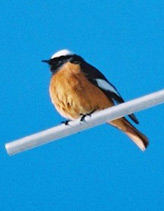
Once we clear the tree line we'll find ourselves in a crystal clear landscape of dense juniper bushes, flower-strewn alpine meadows, and snow-capped peaks. We'll be staying in the Almaty Astronomical Observatory and after lunch we'll drive even higher to a breathtaking pass where handsome Güldenstadt's Redstarts nest and both Red-billed and Alpine Choughs wheel overhead. We'll also be looking for some of the mighty Lammergeiers and dainty Altai Accentors that inhabit this mountain wilderness. Night in the Observatory.
Day 9: At these altitudes the weather can be somewhat fickle so we are allowing plenty of time to fully explore this wonderful habitat. Our morning will be spent walking through alpine meadows scattered with juniper bushes. As the first rays of sun hit the mountain tops the eerie calls of Himalayan Snowcock will be heard echoing around the valley and careful searching should reveal these impressive birds. The juniper will be alive with the song of Himalayan Rubythroats, Hume's Leaf Warblers, Brown and Black-throated Accentors, Red-mantled and Common Rosefinches, Plain Mountain Finches, and Spot-winged Grosbeaks. The beautifully marked Severtzov's Tit-Warbler can also be found in this habitat, along with the skulking Sulphur-bellied Warbler. Night in the Observatory.
Day 10: Today we return to Almaty, taking all day to wander down through the dense spruce forest where we should find Nutcracker, Three-toed Woodpecker, Songar Tit, and Eversmann's and Blue-capped Redstarts while the numerous mountain streams are home to Blue Whistling Thrush and both Brown and White-bellied Dippers. Night in Almaty.
Day 11: After time to explore the bustling local bazaar we'll take a flight from Almaty to Tashkent, capital of Uzbekistan and set out straight away on the ancient silk route for the fabled city of Samarkand, arriving in time to explore a little of this fascinating city. Night in Samarkand.
Day 12: To the south of the town lie the Zeravshan Hills where we'll stroll along a delightful valley alive with Red-headed Buntings. White-throated Robins and Upcher's Warblers breed among the bushes and the little-known Hume's Short-toed Lark feeds among the rocky outcrops, as do Orphean Warblers and Isabelline Shrikes, and at all times we'll keep a watchful eye on the skies above for Black Vultures. Striking Asian Paradise Flycatchers live here, as well as a few pairs of Yellow-breasted Tits, and those interested in plants or butterflies will find much to occupy them. In the afternoon we'll return to the city to explore its treasures further. Night in Samarkand.
Day 13: Continuing along the Silk Road we come to Bukhara, a city even more richly endowed with historic sites than Samarkand. The true splendour of this magical place has to be seen to be believed. The turquoise blue domes, towering minarets and covered bazaars, bustling with numerous shops selling spices, jewellery and famous Bukhara rugs, are guaranteed to transport you back to the days when this was one of the most important cities on the Silk Road. Night in Bukhara.
Day 14: Within easy reach of Bukhara can be found some extensive wetland habitats surrounded by rich desert. Blue-cheeked Bee-eaters are abundant and we are sure to get some wonderful views of this colourful bird as they share the roadside wires with Pied Bushchats and Long-tailed Shrikes. The bushes below are home to the rama race of Booted Warbler, sometimes considered a separate species, Sykes's Warbler, as well as Rufous Bush Robins and a few pairs of the shy Ménétries Warbler.
At the wetlands we'll explore reedbeds that are home to Clamorous and Savi's Warblers as well as the Caspian race of Reed Warbler and Bearded Tit. White-tailed Plovers, all in smart breeding plumage, are common here and Marbled Duck and Caspian Gulls can usually be found with ease. Flights of Pygmy Cormorants skim the water and Collared Pratincoles nest on the lake shore. Night in Bukhara.
Day 15: In contrast to these rich wetlands we'll venture deep into the dry Kyzyl-Kum Desert to search for the handsome Pander's Ground Jay, one of the really special birds of Central Asia, before returning to Bukhara to take an evening flight back to Tashkent. From here, for our grand finale, we travel to a luxurious hotel superbly located in wooded hills.
Day 16: We will spend our last day in this splendid setting. Eurasian Griffons sail overhead and the surrounding woodland is alive with birds from colourful Golden Orioles and Hawfinches to Yellow-breasted and Rufous-naped Tits. Towards the end of the day we will travel back to Tashkent to connect with a return flight to London where the tour ends on Day 17.
Cost £2990
Single Room Supplement £190
Maximum group size: 14 participants and 2 leaders.
Central Asia bird list
return to top of page
return to Asia introduction
return to Calendar
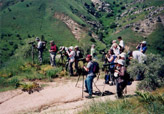
| Birding near Samarkhand. | ||
 |
||
| The mountains of Kazakhstan are one of the easiest places in the world to see Güldenstädt's Redstart. Photographed on the Sunbird 2001 tour by Steve Chalmers. | ||
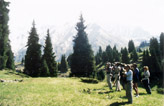
| Birding in the Tien Shan Mountains. | ||
 |
||
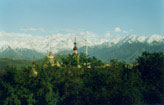
| View from our hotel in Almaty - Panilov Park, Zenkov Cathedral and the Tien Shan Mountains. | ||
 |
||
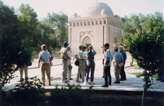
| Taking time out to explore the old city of Bukhara. | ||
 |
||
| A steppe sunset in Kazakhstan. | ||
 |
||
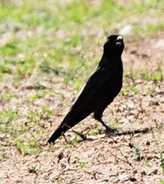
| No trip to Kazakstan is complete without a visit to the northern steppe to see Black Larks. Photographed on the Sunbird 2001 tour by Steve Chalmers. | ||
 |
||
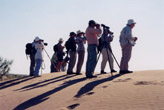
| Scanning for Pander's Ground Jay in Central Asia. | ||
 |
||
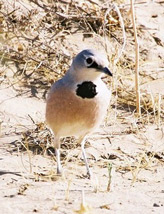
| Pander's Ground Jay by Steve Chalmers. | ||