South Africa -
the Kalahari to the Cape
In recent years South Africa has become a very popular destination for birdwatchers and a glance at one of the many excellent field guides soon reveals why. Over 700 different bird species occur there, of which over 100 are endemic or near-endemic. Thousands of kilometres of shoreline harbour a myriad of migrant and resident birds, and offshore congregate some of the largest concentrations of seabirds in the world.
Early September is the absolute best time to visit western South Africa. Spring will be under way and many of the birds will be full breeding plumage as they busy themselves with the onset of nesting. The early rains will have coaxed life from the desert and we should be treated to one of the best wildflower displays anywhere in the world. Our journey will take us from the rolling red sand dunes of the Kalahari Desert, through the hauntingly beautiful plains of Bushmanland to the Atlantic coast. From there we travel to the vast expanse of the Great Karoo before ending our tour where two oceans meet, at the windswept Cape of Good Hope. Steve has been running tours to South Africa for eight years and this new itinerary, designed by him and Rod Cassidy, will be complemented by a two-week tour to the Eastern Cape in the early part of 2004.
Saturday 30 August to Saturday 13 September 2003
with Steve Rooke and Rod Cassidy as leaders.
 South Africa bird list
return to Africa introduction
return to Calendar
Day 1: The tour begins with a flight from London to Johannesburg,
arriving early the following day where we connect with an onward flight
to Bloemfontein.
Day 2: After arriving in Bloemfontein at around midday we'll make our way northwest towards Kimberley stopping en route for our first taste of African birds such as Pale Chanting Goshawks, Black Korhaan, Swainson's Francolin, and White-backed Mousebird. With luck we may also encounter Orange River Francolin and Blue Korhaan.
To most people Kimberley means diamond mines and the famous 'Big Hole' but birdwatchers also know it as the only place in the world to see two new pipit species. The local birdwatcher who discovered these is Richard Liversidge and he will join us for the afternoon as we search for Long-tailed and the very recently discovered Kimberley Pipits. At dusk we'll visit the aforementioned 'Big Hole' (once the largest man-made hole in the world) to watch flocks of Bradfield's Swifts coming into roost. Night in Kimberley.
Day 3: An early start finds us heading north towards the Kalahari desert and the terrain becomes notably more arid as we progress. There will be stops, our first to search for a very localised endemic the Short-clawed Lark, but other birds that might halt our journey include Pygmy Falcon, Crimson-breasted Shrike, Sociable Weaver, Red-headed Finch, and possibly Short-toed Rock Thrush, while further west there is the chance of a Double-banded Courser. Night in Kalahari Gemsbok Park.
Day 4: Sandwiched between Namibia and Botswana, the Kalahari Gemsbok Park is one of Africa's wildest and least known National Parks and we'll spend two nights in this magnificent desert habitat. Among the bright red dunes interspersed with grassy plains and wooded river beds we will search for a variety of special birds including Ludwig's Bustard, Northern Black and Red-crested Korhaans, Burchell's and Namaqua Sandgrouse, Rosy-faced Lovebird, Burchell's Courser, and Swallow-tailed Bee-eater. Among the smaller birds we should easily find Southern Pied Babbler, Pink-billed Lark, Red-eyed Bulbul, Chat and Marico Flycatchers, Kalahari Robin, Ashy Tit, and Violet-eared Waxbill. Gemsbok or Namib Oryx are common here, as are Springbok, Red Hartebeeste, Zebra, Blue Wildebeeste and Greater Kudu. We might also see a pride of the large black-maned Kalahari Lions or a skulking Cheetah. Night in Kalahari Gemsbok Park.
Day 5: Today we retrace our steps to Uppington and then on to Pofadder, calling in at Augrabies National Park along the way. Here the Orange River tumbles into a deep and spectacular gorge before flowing on to form the border with Namibia. We'll have time to admire the falls and look at some of the plentiful birdlife to be found nearby, including Golden-tailed Woodpecker, Acacia Pied Barbet, Pale-winged Starling, and Namaqua Prinia. Night in Pofadder.
Day 6: South of the Orange River lies the arid and semi-arid regions of Bushmanland where, in the not too distant past, the tiny San people followed and hunted the migrant herds of ungulates. Today this area is still sparsely populated and it is possible to travel through this stark and beautiful wilderness all day without seeing another person. Driving along the endless dirt roads that service the remote farms we hope to see Great Kestrel, Cape Francolin, Karoo Korhaan, Spotted Eagle Owl, Tractrac, Sickle-winged and Karoo Chats, Layard's Tit-babbler, Southern Grey Tit, Cinnamon-breasted Warbler, Red-headed Finch, and Lark-like Bunting, among many other species.
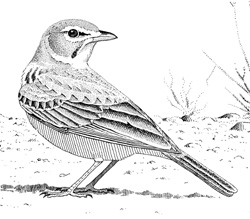
This habitat is ideal for larks and we should compile an impressive list of species before we leave. A trip out before dawn one day will take us to the breeding grounds of the fabulous Red Lark, a bird not yet seen by many birdwatchers and one that is only active for a short time after first light. Others we hope to see in this region include Sclater's, Stark's, Spike-heeled, Thick-billed, and Red-capped Larks, and Black-eared Finchlark. Night in Pofadder.
Day 7: Leaving Pofadder we'll travel west to the town of Springbok, gateway to Namaqualand and the world famous wildflower region. We will stop at an information point in Springbok to find out where the best flower areas are at that time and then head off in search of the spectacular displays. The sheets of colour stretching to the horizon are breathtaking and there will also be plenty of birds to distract us, including Mountain Chat, Malachite Sunbird, and Black-headed Canary.
Dragging ourselves away from this botanical extravagance will not be easy but an ornithological one awaits us further south at the thriving fishing port of Lambert's Bay. Here we visit the famous Cape Gannet colony which will be teeming with tens of thousands of birds well into their breeding season. The sight, sound and, it must be said, smell of all these birds packed together is unforgettable. In the throng of Cape Gannets we should also find Cape and Crowned Cormorants jostling for space, and we'll watch Cape Fur Seals basking on the rocks. Night at Lambert's Bay.
Day 8: From Lambert's Bay we'll drive through extensive coastal scrub looking for Karoo Robin, Grey-backed Cisticola, Cape Penduline Tit, and Bar-throated Apalis, before calling in at Veldriff at the mouth of the Berg River. Swift Terns will be much in evidence on the salt pans, along with Caspian Terns, Kelp and Hartlaub's Gulls, and a variety of waders including Chestnut-banded and White-fronted Plovers. Night in Langebaan.
Day 9: Langebaan lies at the head of an enormous inlet that forms the spectacular West Coast Nature Reserve. We'll visit the Reserve to search for striking Black Harriers quartering the flower-strewn coastal fynbos and spend time searching through the vast flocks of waders that make this huge natural lagoon their winter home. As the day draws to a close we'll travel inland to the Cedarberg Mountains and the town of Ceres, where we'll spend the night.
Day 10: Ceres is surrounded by spectacular mountain scenery and endless fruit orchards. The higher altitude habitats here are in marked contrast to those we'll have seen so far, and around the outskirts of the town we should see Grey-winged Francolin, Victorin's Warbler, Spotted Prinia, Orange-throated Longclaw, Cape Sugarbird, Orange-breasted Sunbird, and Protea Canary. Venturing out in to the Great Karoo, an endless stony plain covered in the most beautiful array of small Euphorbias and succulent scrub, we'll look for many of the small birds that live here such as the tiny Rufous-eared Warbler and Karoo Eremomela. Night in Ceres.
Days 11: As our tour draws to a close we'll head south to our final destination, Cape Town, and arguably the best birding of the trip. On the way we will call in at a reserve established to protect that beautifully marked antelope the Bontebok, and where we could also see Stanley's Bustard and Clapper Lark. Night in Cape Town.
Days 12-14: We'll have three days in which to sample the delights that birding around the tip of Africa has to offer. The weather here is notoriously fickle, but if conditions permit we'll venture out one day into the South Atlantic in search of seabirds. Our objective is to find a deep-sea trawler which, when sighted, appears to have a thick dark cloud of smoke trailing for several kilometres behind it. Astonishingly, this is a throng of thousands of seabirds, mostly albatrosses, petrels and shearwaters, following the ship in search of offal being dumped overboard. We'll cruise among this throng for hours and binoculars will hardly be necessary, as many of the birds will be almost too close to focus on. We should see Shy, Black-browed and Yellow-nosed Albatrosses, Southern Giant, Pintado and White-chinned Petrels, Sooty and Great Shearwaters, Sub-antarctic Skua, and Wilson's Storm-petrel. Less common possibilities include Wandering and Grey-headed Albatrosses, Soft-plumaged Petrel, and Black-bellied Storm-petrel. Back on dry land, we'll explore the Cape's verdant mountains, passes and valleys looking for Ground Woodpecker, Cape Rockjumper, Cape Rockthrush, Orange-breasted Sunbirds, Knysna Warbler, and Cape Siskin. We will take time to visit the world famous Kirstenbosch Botanical Gardens, lying in the shadow of Table Mountain. These gardens are not just a wonderful place for plants - there are plenty of birds to be seen as well. A resident Spotted Eagle Owl roosts in an avenue of camphor trees, Forest Canaries feed among the undergrowth and Lesser Double-collared Sunbirds buzz around the masses of flowers. We'll visit the Simonstown Jackass Penguin colony and a roost site for Antarctic Tern, and, of course, we'll fit in a visit to the Cape of Good Hope. Nights in Cape Town.
During the evening of Day 14 we'll catch an overnight flight back to London where the tour ends on Day 15.
Cost £3240
Single room supplement £150
Maximum group size: 14 participants and 2 leaders.
South Africa bird list
return to top of page
return to Africa introduction
return to Calendar
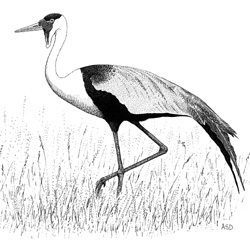
A few stately Wattled Cranes can usually be found striding through isolated marshes of the Drakensberg.
|
The little-known Red Lark inhabits the arid farmland around Pofadder. |
||