The Okavango Delta and Namibia
The Skeleton Coast, Etosha, Okavango - all names that conjure up images of the real Africa, and all places we'll visit during this tour. Namibia is a country full of natural wonders and many very special birds, including some which can be seen nowhere else. The vast Namib Desert is a place of stark beauty that possesses a fascinating ecology all its own. Here rich-red towering sand dunes throw out sharp shadows in the intense heat creating stunning landscapes that eventually fall into the sea along the infamous Skeleton Coast.
At Walvis Bay, steeped in the history of the Atlantic whaling industry, vast numbers of wintering waterbirds mingle with resident species such as Damara Terns and White-fronted Plovers. In the renowned Etosha pan, Lions and Cheetahs stalk the numerous animals that scratch a living from the dry earth, and any patch of water is a mecca for numerous birds, not least the large flocks of sandgrouse that inhabit the region.
Water is, however, in abundance farther east in the Okavango Delta of Botswana, perhaps one of the best known wildlife sites in the whole of Africa, familiar to all through numerous natural history documentaries. We shall spend a few days exploring this special place by boat, from the comfort of our lodge, seeking out some of the birds and mammals for which the area is famous.
Namibia boasts a wonderful infrastructure with superb roads and comfortable welcoming lodges, allowing you to relax and enjoy the marvellous countryside and its rich birdlife.
Saturday 1 March to Sunday 16 March
with Rod Cassidy and Séan McMinn as leaders.
 Namibia bird list
return to Africa introduction
return to Calendar
Day 1: The tour begins with an overnight flight from London to Windhoek.
Day 2: After arriving in Windhoek we'll start birding straight away. Close to the town is some prime habitat where the endemic Rockrunner is a distinct possibility and other species could include Tawny Eagle, Orange River Francolin, Lilac-breasted and Purple Rollers, Pale-winged Starling, Bradfield's Swift, Great Sparrow, Black and Marico Sunbirds, and perhaps Chestnut Weaver. Later we'll set out on our exploration of this fascinating country by driving westward to coastal Namibia via the great Namib Desert. This will be a leisurely journey and we'll stop en route to look at roadside birds such as Southern Pale Chanting Goshawk, Southern Yellow-billed Hornbill, and Short-toed Rock Thrush. The dry riverbeds may hold Red-billed Francolin, Titbabbler, Violet-eared Waxbill, and Scaly-feathered Finch. Further and deeper into the desert where vegetation is almost totally absent, we might encounter our first larks, with Stark's and Fawn-coloured being the most likely, and we should see Tractrac and Mountain Chats on roadside boulders. As we approach the coast the sudden drop in temperature and possible fog are indicative of the icy cold Benguela Current in the south Atlantic that created the Namib, the oldest desert in the world. Night in Walvis Bay.
Day 3: Our time in coastal Namibia will be spent looking for such specialities as Gray's and Dune Larks, Dusky Sunbird, and Bokmakierie. The bay itself, together with the nearby salt pans and freshwater lagoons is home to literally millions of birds, as huge numbers of Palearctic terns and waders mingle with resident Cape Cormorants, Kelp Gulls, Damara Terns, and endless flocks of Lesser Flamingos. Night in Walvis Bay.
Day 4: An early start will take us into the desert to search for Rüppell's Korhaan and Burchell's Courser and we'll linger for a while at the towering inselberg of Spitzkop. Here we should find Rosy-faced Lovebird, Sabota and Long-billed Larks, Pale-winged Starling, and Layard's Tit-babbler. However the real prize here is the little-known Herero Chat and we should hopefully get good views of this enigmatic bird. Our final destination is Omaruru in the foothills of the Erongo Mountains where we'll search for Hartlaub's Francolin, Freckled Nightjar, and White-tailed Shrike. Night in Omaruru.
Days 5-7: The Etosha National Park is a vast region packed full of mammals and birds and we'll be based here for three nights. The lodges are situated inside the reserve, some alongside floodlit waterholes where mammals and birds come to drink 24 hours a day. The grassy plains that stretch to the horizon are dotted with mammals and their attendant predators. Black and Red-crested Korhaans are common, as are Double-banded and Burchell's Sandgrouse, while Blue Cranes and Kori Bustards can usually be found with ease. Raptors are abundant and spiralling flocks of vultures might, with luck, include the southern African Cape Vulture. Larks are numerous in the drier regions and we'll look for Rufous-naped, Spike-heeled, Grey-backed Finch-, Chestnut-backed Finch-, Red-capped, Pink-billed, and Clapper Larks. Nights in Etosha National Park.
Days 8-9: After leaving Etosha we'll wend our way northwest into the heart of Ovamboland. Our drive takes us through much more lush scenery and an area with much higher rainfall, before we enter the Namib Desert again at its northern end on the Angolan border. Here, a vast river, which drains the highlands of Angola, bisects the desert and is paralleled with lush riverine vegetation and towering palms. In this area we'll search for the elusive Cinderella Waxbill and Rufous-tailed Palm Thrush, at what is virtually the only area in the world where they can be seen. Other species found here are Bennett's Woodpecker, Grey Kestrel, and possible migrant flocks of the massive Dusky Lark. Nights in Oshakati.
Day 10: Our drive today will take us from Oshakati, south past Etosha and then north again towards the Angola border. We'll travel through fascinating habitats that change from dry acacia woodland through to moist palm savanna and into mature teak forests in a truly tropical African setting. In the surrounding woodland we'll search for bird parties which can contain Rufous-bellied Tit, Racquet-tailed Roller, and Sharp-tailed Starling, and, in the evening, we'll look for Pennant-winged, Fiery-necked and Mozambique Nightjars, as well as African Grass and African Marsh Owls. Night in Rundu.
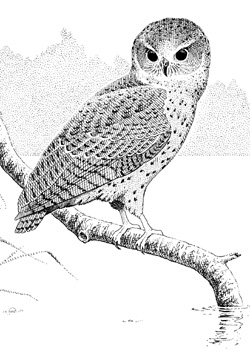
Days 11-12: After a short drive that follows the course of the mighty Kavango River we enter Botswana for a two-night stay in a luxury lodge. Here in the depths of the Okavango Delta's panhandle we'll explore the vast region's swamps and riverine forests. On small powered boats or poled 'dug-outs' we'll wend our way through beds of papyrus in search of Slaty Egret, Rufous-bellied Heron, Lesser Jacana, Black Crake, Pygmy and Spur-winged Geese, African Skimmer, Rock Pratincole, Long-toed Plover, Greater Swamp Warbler, and many more. The adjacent forests and grasslands hold Western Banded Snake-eagle, Bradfield's Hornbill, and Swamp Boubou, with a supporting cast of bee-eaters, warblers, shrikes, rollers, and weavers. At night our small craft will silently traverse the choked papyrus channels in search of the enormous Pel's Fishing Owl and White-backed Night Heron and there is a real chance of seeing both Red Lechwe and Sitatunga. Nights in the Okavango Delta.
Day 13-14: Reluctantly we'll leave the Delta and drive through northern Namibia to the Waterberg National Park. This vast area of mountains and plateaux is famous for raptors, and we should see Verreaux's and Booted Eagles soaring along the cliffs. We might also bump into large migratory flocks of Amur and Red-footed Falcons, swarming over locust hatches. In the surrounding woodland we should find Rüppell's Parrot, Bradfield's Hornbill, Carp's Tit, and many more dry-country species. Nights in Waterberg National Park
Day 15: From here it is a short journey back to Windhoek where we'll catch a flight back to London where the tour ends on Day 16.
Cost £3250
Single Room Supplement £150
Maximum group size: 14 participants and 2 leaders.
Namibia bird list
return to top of page
return to Africa introduction
return to Calendar
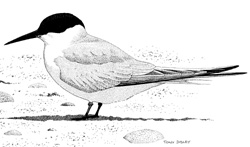
The little-known Damara Tern is one of the regular highlights in Walvis Bay.
|
The Okavango is one of the best sites for Pel's Fishing Owl in Africa. |
||