Kenya - from Tsavo to the Masai Mara
The vast expanses of East Africa have long been part of every traveller's dreams, a land of rolling grasslands dotted with acacia trees, mountains such as Kilimanjaro rising above the limitless horizons, and riverine forests harbouring exotic birds and troops of monkeys. Of course the large mammals of the East African plains are readily summoned to mind, and it is a wonderful fact that, by visiting Kenya, it is still possible to see huge concentrations of animals along with 500 or more species of bird. During this tour we'll visit Nairobi, Tsavo and Amboseli National Parks, Lakes Baringo and Nakuru, and we'll end up in the spectacular Masai Mara National Reserve - the Africa of everyone's imagination.
There is no doubt that Kenya is one place that everyone interested in birds and natural history should visit at least once. The combination of abundant birds and animals, together with an excellent tourist infrastructure and fantastic lodges in superb settings, will make this a truly memorable trip. Sunbird has been running Kenyan bird safaris since 1982, and our years of experience here allows us to offer what we believe to be the best value-for-money Kenya tours available.
Tuesday 19 November to Thursday 5 December 2002
Tuesday 24 June to Thursday 10 July 2003
Tuesday 18 November to Thursday 4 December 2003
with Brian Finch
and Mel Ogola
as leaders.
 Kenya bird list (January tour)
Kenya bird list (June tour)
Kenya bird list (November tour)
return to Africa introduction
return to Calendar
Day 1: The tour begins in London with an overnight flight to Kenya.
Day 2: Morning arrival in Nairobi. We'll go straight to our hotel for a short break and a rest after our flight. People who are too excited to rest can birdwatch in the grounds where we'll see our first African birds, perhaps including local specialities such as Giant Kingfisher and Holub's Golden Weaver. Later, we'll visit Nairobi National Park - rolling grassland and acacias with gazelles, Giraffes and possibly Lions, as well as a heady array of birds; Ostrich, Secretary-bird, Bateleur, Rattling Cisticola, Long-tailed Fiscal and Red-billed Oxpecker among many others. Night in Nairobi.
Days 3-4: After breakfast we'll drive to Tsavo National Park where we'll spend two nights at Ngulia Lodge. On the autumn tours we'll have the chance to witness the marvel of bird migration as large numbers of European and Asiatic migrants pass through on their way south. The lodge is situated on a dramatic escarpment overlooking the vast expanse of Tsavo stretching out below. At night the lights of the lodge can be seen for miles and attract migrant birds, sometimes, depending upon the weather and the moon, in their thousands. The morning following such a fall can find the bushes alive with Thrush Nightingales, Marsh Warblers and Isabelline Shrikes, while careful searching usually reveals splendid male White-throated Robins, Barred, River, Olive-tree, Upcher's and Olivaceous Warblers, and the enigmatic Basra Reed Warbler.
Ngulia is the perfect place from which to explore Tsavo. The acres of acacia thorn scrub and mighty baobab trees are home to a surprisingly large number of species including Vulturine Guineafowl, Wahlberg's and Martial Eagles, Pygmy Falcon, Orange-bellied Parrot, White-bellied Go-away Bird, Rosy-patched Shrike, the stunning Golden-breasted Starling, Hunter's Sunbird, Green-winged Pytilia, and Somali Golden-breasted Bunting, to name but a few. There is also a good population of Leopards here and we have an excellent chance of seeing one during out stay. Nights at Ngulia Safari Lodge.
Day 5: Today we'll drive to Amboseli National Park. We'll pass through open bush country with many passerine species. In particular we'll be looking out for White-headed Mousebird, Bare-eyed Thrush, Black-cheeked Waxbill, and Southern Grosbeak Canary. We may also see the graceful Gerenuk here. We'll stay at Tortilis Camp, a new, luxurious camp on the southern side of Amboseli National Park. It takes its name from the species of tall acacia trees that shade the extremely well-appointed tents, each of which has an uninterrupted view of Mount Kilimanjaro. Colourful Lilac-breasted Rollers nest in the trees and as dusk falls the car-alarm calls of Slender-tailed Nightjars fill the air. It is usually possible to find these birds roosting during the day and we'll take time to stroll around the camp looking for these and many of the other species the camp attracts. Night in Tortilis Tented Camp.
Day 6: We'll spend the day in Amboseli exploring the park's open plains, lakes and swamps. There will be an abundance of large mammals - Giraffe, Zebra, gazelles, Impala, Wildebeest, Buffalo and Elephant. Birds will also be plentiful and could include Goliath Heron, White-backed Duck, Grey Crowned-Crane, Two-banded Courser, Pangani Longclaw, and the local speciality - Taveta Golden Weaver. Night at Tortilis Tented Camp.
Day 7: This morning we'll drive back towards Nairobi and on to Blue Post Hotel, a famous watering hole during colonial times. On the way we pass through some good dry-country habitat, where we'll look for Fawn-coloured Lark, Paradise Wydah, Grey-headed Silverbill, and Blue-capped Cordon-bleu, among others. Night at Blue Post Hotel.
Day 8: Before setting out for Mountain Lodge, there will be time for some early morning birding in the extensive grounds of the hotel. Located at the confluence of two rivers, the Blue Post is popular with visitors for the spectacular Chania Falls and was the place where Winston Churchill camped while on safari. Most of the surrounding land is now given over to farming, but the tall trees and lush gardens of the hotel attract a variety of birds including Trumpeter Hornbill, Brown-hooded Kingfisher, Yellow-rumped Tinkerbird, Eastern and Wahlberg's Honeybirds, Violet-backed Starling, Black-backed Puffback, Bronze Sunbird, and the rufous-backed form of Black-and-white Mannakin. There is also a chance of African Finfoot here.
We'll arrive at Mountain Lodge in time for lunch and spend the afternoon birdwatching from the roof-top balcony. Located in the heart of the Mount Kenya Forest Reserve, the lodge is a great place for birds. Groups of Silvery-cheeked Hornbills and Bronze-naped Pigeons are common and Crowned Eagles can regularly be found soaring over the trees. Walking around the fenced-off grounds of the lodge we'll look for a variety of birds including Moustached Green Tinkerbird, Waller's Starling, Rüppell's Robin-Chat, White-starred Robin, Doherty's Bush-shrike, Grey-headed Negrofinch, and White-browed Crombec, all displaying colours that have to seen to be believed. Night at Mountain Lodge.
Day 9: After another morning at Mountain Lodge we'll drive to Naro Moru River Lodge for lunch. The Lodge is located on the lower slopes of Mt. Kenya and, although the forest here is only a remnant patch, birds are numerous. We should see Hartlaub's Turaco, Crowned Hornbill, Paradise Flycatcher and up to eight species of sunbird during our stay. Night at Naro Moru River Lodge.
Day 10: Today we'll drive around the edge of the Aberdare Mountains stopping at the spectacular Thompson Falls, which sometimes have the added bonus of Slender-billed Chestnut-winged Starlings. We'll then drop down into the Rift Valley and drive north to Lake Baringo looking for Dark Chanting Goshawk and Silverbird along the way. We'll arrive in time to spend the late afternoon birdwatching along the lake edge. Night at Baringo.
Day 11: Before breakfast we'll visit nearby cliffs where Cliffchats nest, and in the scrub along the escarpment edge we'll look for Hemprich's, Jackson's and Yellow-billed Hornbills, Brown-tailed Rock-Chat, and Bristle-crowned Starling. The rest of the morning will be spent exploring the bird-rich habitats around Lake Baringo. After lunch we'll drive south to Lake Nakuru National Park where we'll spend the next two nights. As we enter the park we will catch sight of the lake through the elegant yellow-barked acacias that fringe the lake and will get our first glimpses of the thousands of pink flamingos.
Day 12: We will spend all day birding around the lake, world-famous for its vast flocks of flamingos and its wealth of waterbirds. The acacia woodland here is a fine example of this habitat and we'll look for such species as Narina Trogon, Red-throated Wryneck, Arrow-marked Babbler, and Red-headed Weaver. Hartlaub's Francolins wander the shaded tracks and shy Tambourine Doves hurtle through the trees. There is a good population of Leopards at Nakuru and the chances of finding one of these magnificent beasts lazing in a tree are good. Water levels at the lake vary a lot, but normally the scene along the lakeshore consists of dense flocks of thousands of Lesser Flamingos feeding in the shallows, while doughnut-shaped rings of White Pelicans scattered across the lake's surface feed collectively in the deeper water. This sight surely forms one the ten natural wonders of the world. Night at Lion Hill Lodge.
Day 13: We'll leave early for our drive to Masai Mara National Reserve. The first part of the journey will take us up out of the Rift Valley and through the rich tea-growing region around Kericho. Here, in patches of remnant forest, we'll look for Many-coloured and Lüdher's Bush-shrikes, Black-collared Apalis, Banded Prinia, and Abyssinian Crimsonwing, among others. Night at the Mara River Camp.
Days 14-15: In many respects the Mara is the most spectacular part of the trip, with long views over flat-topped acacias and grassy plains with an abundance of animals. We'll spend three nights at the Mara River Camp, a tented camp among trees on the edge of the Mara River. Silver Galagos come to a feeding station at night. The rich rumbling grunts of Hippos roll up from the river and at night the countryside resounds with animal noise. We'll spend the days driving in the reserve and should see most of the plains species for which East Africa is famous: Lion, Cheetah, Wildebeest, Hartebeest, Topi, Thompson's and Grant's Gazelles and many others. Birdwatching here will be delightful, and highlights should include Temminck's Courser, Yellow-throated Sandgrouse and, hopefully, Saddle-billed Stork. Nights at the Mara River Camp.
Day 16: We'll drive back to Nairobi, stopping in the Rift Valley to look for White-eyed Kestrel and Swallow-tailed Kite. Night in Nairobi.
Day 17: After breakfast we'll catch a flight back to London where the tour concludes in the afternoon.
Cost £3540 (November 2002)
Single Room Supplement £350
£3590 (June & November 2003)
Single Room Supplement £360
Maximum group size: 13 participants and 2 leaders.
return to top of page
Kenya bird list (January tour)
Kenya bird list (June tour)
Kenya bird list (November tour)
return to Africa introduction
return to Calendar
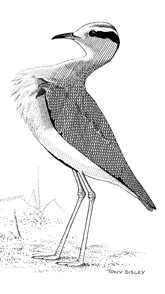
Temminck's Courser is just one of several species in this group that we'll hope to see in Kenya.