Ethiopia – the roof of Africa
Millions of years ago eastern Africa was subjected to immense and violent volcanic activity. As unimaginable forces pushed the earth's crust upwards in a gigantic dome, great fissures opened up in the centre causing large areas to sink back while the outer edges continued to rise. The resulting slash in the surface of the planet became the Rift Valley, the geographical feature that dominates this corner of Africa and runs right across Ethiopia.
The highland plateaux that formed on either side of the Rift represent the continent's largest area of Afro-alpine habitat and also contain some of the most spectacular scenery in Africa. Isolated for thousands of years, these regions have also seen the evolution of many distinct forms of life. Mammals such as the Giant Mole Rat and the secretive Simien Wolf haunt a stark and beautiful landscape full of strange and unusual plants. Over 800 birds have been seen in the region, of which 29 can be found nowhere else in the world. We hope to encounter many of these endemics as we travel along the Rift Valley floor and across highland areas rightly christened 'the roof of Africa'.
Ethiopia, the point where Africa meets Arabia, sits on a cultural and historical crossroads. The country's strong connections with the early days of Christianity can be seen from the ancient churches at Lake Tana and Debre Libanos. This combination of history, stunning scenery and above all a fascinating and easily accessible wildlife, makes Ethiopia a perfect destination for a birdwatching holiday. Steve returns there this year for his seventh Ethiopian tour.
Friday 1 November to Sunday 17 November 2002
Friday 31 October to Sunday 16 November 2003
with Steve Rooke
and Mered Gabrimicael
as leaders.
 Ethiopia bird list
Ethiopia Endemics bird list
return to Africa introduction
return to Calendar
Day 1: The tour begins with an overnight flight from London to Addis Ababa.
Day 2: After arriving in Addis we will spend the rest of the day at a lake on the outskirts of town where our first endemics should include Rouget's Rail, Blue-winged Goose, Wattled Ibis and White-collared Pigeon, as well as the tiny Brown-rumped Seedeater and a host of other local species. Night in Addis.
Day 3: We'll take a full day to drive north through the Solulta Plain to Debre Libanos. On the Solulta Plain we'll search for more endemics, including Abyssinian Longclaw, Erlanger's Lark and Black-headed Siskin, as well as looking for the flocks of Common Crane that winter here, and seeking out the few pairs of Red-chested Swallows that breed. Debre Libanos is an important monastic centre for the Orthodox Church, where the 13th century monk and mystic, Telehaimanot, is reputed to have stood on one leg for seven years. There will be no such hardships for us as we search this spectacular location on the edge of a massive gorge for Lammergeier, Rüppell's Griffon Vulture, Verreaux's Eagle, Erckel's Francolin, the endemic Black-winged Lovebird, Rüppell's Chat, White-billed Starling, and White-backed Tit. Night in Addis.
Day 4: We'll continue our exploration of this exciting country by taking an early morning flight northwest to Bahar Dar on the shores of Lake Tana. This, the highest lake in Africa, is famous not only as the source of the Blue Nile but also for its large number of waterbirds. Birding along the banks of the Blue Nile should give us multi-coloured flocks of Yellow-mantled Widowbirds, Black-winged Red and Yellow-crowned Bishops, and Zebra Waxbills, as well as African Darter, African Pygmy-goose and Black Crowned-Crane. In the afternoon we will take a boat out on to the lake to visit one of the wooded islands that are sure to be alive with massive Silvery-cheeked Hornbills and, of course, we will also visit the actual point where the Blue Nile begins its epic journey through Africa. Night in Bahar Dar.
Day 5: Not far from the lake the Blue Nile plummets over the Tississat Falls and in this stunning setting we should find White-cheeked Turaco, Black-billed Barbet, Slender-billed Chestnut-winged Starling, and the recently split, endemic White-throated Seedeater. There will be time for some local birding around the hotel looking for Black-billed and Double-toothed Barbets, Yellow-fronted Tinkerbird, and Copper Sunbird before we take a late afternoon flight back to Addis. Night in Addis.
Day 6: Today we'll head down the Rift Valley to Lake Langano and as we travel south we'll begin to notice vividly-coloured Northern Carmine Bee-eaters on the roadside wires. After arriving at our hotel we'll search the grounds for Freckled Nightjars, Red-fronted Barbets, wintering Masked Shrikes, Boran Cisticolas and Rüppell's Weavers. Night at Lake Langano.
Day 7: Leaving Lake Langano we'll immediately call in at another Rift Valley lake - Abiata. Here the lakeshore can be thronged with tens of thousands of flamingos and wintering waders. Continuing south down the Rift Valley we should reach Lake Awassa in time for lunch. In the afternoon we'll search the lake edge for more waterbirds, as well as the adjacent forest for White-rumped Babbler, Common Wattle-eye, Spotted Creeper, Grey-headed Batis, and Red-fronted Tinkerbird. Night in Awassa.
Day 8: For those who wish, today we'll travel even further south to the remote town of Yabello. Here can be found perhaps one of the most remarkable birds in the whole of Africa, Stresemann's Bush Crow, a species restricted to a tiny part of southern Ethiopia. We should also see the endemic White-tailed Swallow as well as White-crowned Starling and a host of other species not seen elsewhere on the tour. However, the accommodation here is very basic and those wishing to opt out of this journey can remain in the comfort of the lakeside hotel at Awassa. Night in Yabello.
Day 9: After some more birding around the outskirts of Yabello we'll return to Awassa, birding along the way. Night in Awassa.
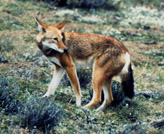
Days 10-11: Today's climb into the Bale Mountains and across the southeast highlands to Goba will take us through some spectacular scenery where we'll stop to look for Abyssinian Long-eared Owl. We'll spend two days birdwatching in the superb setting of the Bale Mountains National Park in search of typical birds of the region, which include Wattled Crane, Spot-breasted Plover, Abyssinian Woodpecker, Abyssinian Longclaw, Abyssinian Catbird, and Abyssinian Thrush. The Park is also the haunt of two rare mammals - the Simien Wolf and the Mountain Nyala, both of which we'll hope to see. Nights in Goba.
Day 12: We'll leave the highlands and retrace our steps back down towards the Rift Valley to spend one night at Wondoguenet.
Day 13: Our hotel is located in an extensive area of forest that is home to many birds including Bruce's Green Pigeon, Yellow-fronted Parrot, Half-collared Kingfisher, Abyssinian Black-headed Oriole, and Red-shouldered Cuckoo-Shrike. Here we can also expect to see the striking Eastern Black-and-white Colobus Monkey. After a morning spent wandering the woods, we drop back down into the Rift Valley and drive to Lake Langano. Night at Lake Langano.
Day 14: Our hotel here is different to the one we previously stayed at and there are different birds to look for including Hemprich's Hornbills and Slender-tailed Nightjars. After some early morning birding, we'll continue north along the Rift Valley to Awash National Park, where we'll spend two nights. Our lodge at Kereyou is perched on the edge of the dramatic Awash Gorge affording superb views and eye-level encounters with Fan-tailed Ravens.
Day 15: We'll spend the day birding in Awash National Park. Here a few Lions still roam the plains but we are more likely to see Beisa Oryx, Soemmering's Gazelle, and Swayne's Hartebeest, as well as White-bellied, Crested, Kori and possibly Arabian Bustards. Raptors could include Red-necked and Sooty Falcons, and Swallow-tailed Kites. Ethiopian Swallows can also be found here along with Red-winged and Singing Bush Larks, Fawn-coloured and Gillet's Lark, and Chestnut-backed Sparrow-Lark. One night we'll stay out after dark to look for Plain and the very similar Star-spotted Nightjars, and Heuglin's Courser. Nights in Awash.
Day 16: We'll spend the morning in the park before returning to Addis in the afternoon in time for a special end-of-tour meal at the best Italian restaurant in Africa. Night in Addis.
Day 17: We'll catch a morning flight back to London where the tour concludes in the early evening.
Note: For those wishing to stay out in Ethiopia and visit some of the cultural and historical sites in the north of the country such as the rock-hewn churches at Lalibella, we can arrange a post-tour extension either with or without a local guide. Please contact the Sunbird office for details.
Cost £2450 (2003)
Single Room Supplement £140 (2003)
Maximum group size: 14 participants and 2 leaders.
Ethiopia bird list
Ethiopia Endemics bird list
return to top of page
return to Africa introduction
return to Calendar
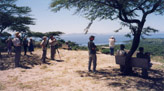
| Birding in the shade above Lake Abiata. |
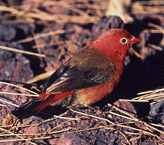
| Red-billed Firefinch at Lake Awassa, photographed by Sam Alexander. | ||
 |
||
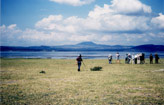
| Lake Abiata in the Abiata-Shala National Park. Photograph Sam Alexander. | ||
 |
||
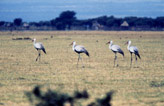
| Wattled Cranes in the Abiata-Shala National Park, photographed by Sam Alexander. | ||
 |
||
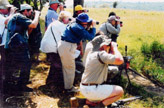
| Watching Zebra Waxbill on the banks of the Blue Nile. | ||
 |
||
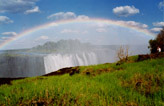
| Blue Nile Falls. | ||
 |
||
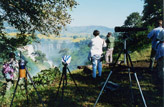
| Birding at the Blue Nile Falls. | ||
 |
||
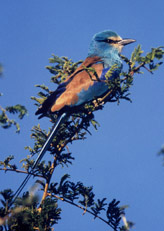
| Abyssinian Roller, Awash National Park. | ||
 |
||
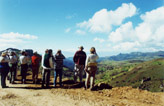
| Roadside birding in the Bale Mountains | ||
 |
||
| Simien Wolf, Bale Mountains, photographed by Sam Alexander. | ||
 |
||
| Gelada Baboons near Debre Libanos. Photographed by Sam Alexander. | ||